The post-BSN DNP FNP track at Troy: four preceptorships, then synthesis
On Troy University's post-BSN FNP track, the DNP manual makes you the recruiter: students "contact prospective preceptors" and ask them to serve, while faculty "can assist students by suggesting preceptors." In practice you recruit a preceptor for each of four FNP courses worth 780 clinical hours, then document the rest of your 1,000 hours in the synthesis courses. We line up each preceptor ahead of the form deadline so every clinical semester starts on schedule.
Match my FNP track preceptors
Your city and your next FNP course are enough to start.
The track in order
The FNP track puts the heavy preceptor work first. You complete the same four FNP clinical courses MSN students take, then move into the 8000-level synthesis sequence, where each course asks for clinical-hours documentation on the way to 1,000.
| Course | Focus | Credits | Hours |
|---|---|---|---|
NSG 6619 | Advanced health assessment and diagnostic reasoning, head-to-toe exams | 3 | 120 |
NSG 6666 | Primary Care I: pediatrics and women's health, two preceptors | 3 | 180 |
NSG 6668 | Primary Care II: adults and older adults | 3 | 180 |
NSG 6680 | Family Nurse Practitioner Internship, first course where hospital hours count | 5 | 300 |
NSG 8810-NSG 8840 | DNP Synthesis Project courses, hours documented in each | See your planner | Toward 1,000 |
Elsewhere, in its Progression section, the same manual sets the first three FNP courses at 135 clock hours apiece. Until your faculty advisor tells you which figure applies to your cohort, keep both in view when you estimate preceptor days.
When the first preceptor is due
NSG 6619 is a fall course, and the DNP manual paints two pictures of FNP clinical timing. One passage keeps clinical courses out of the opening fall semester only, which would put your first preceptorship after it. Another says they run in every semester except summer. Your semester planner in the DNP Student Organization course shows which pattern your plan follows.
Either way, the paperwork window is tight. Under the DNP manual, each preceptor form is due on the final no-penalty drop date, earlier than the one-month grace the MSN manual gives for courses after NSG 6619. Advanced Pharmacology NSG 6649 and Advanced Pathophysiology NSG 6671 must already be done or taken alongside NSG 6619, with no exceptions, so check your planner before you recruit. The course has its own guide: NSG 6619 health assessment preceptorship.
Who can precept each FNP course
Four kinds of clinician appear on the DNP manual's FNP list: NPs holding an NP license in their practice state and a year or more in the role, physicians (MD or DO), nurse midwives, and physician assistants. Graduate preparation is the expectation, and other preceptors are considered individually.
NSG 6619: a preceptor who will let you run complete head-to-toe exams in an outpatient setting, since hospital hours wait for the internship.NSG 6666: two preceptors who together cover pediatrics and women's health; the course guide is Primary Care I.NSG 6668: a primary care preceptor with a steady adult and older-adult panel.NSG 6680: 300 internship hours, and the first course where a hospital setting counts toward your total.
Family members are a gray area: the MSN manual forbids a related preceptor and the DNP list says nothing, so the safe choice is someone unrelated. Full credential detail sits on the FNP preceptor requirements page.
From 780 hours to 1,000
Once NSG 6680 is behind you, the four FNP courses have given you 780 hours under the manual's course list. The rest comes through the synthesis courses, NSG 8810 Project Identification through NSG 8840 Project Evaluation. Each asks you to document clinical hours, and those logs feed the reflection pages in your DNP portfolio.
If the synthesis hours still leave a gap, NSG 8880 Directed Professional Practicum can fill it at 60 hours a credit, to a maximum of 180. Along the way, NSG 8820 requires a green light from the outside agency where your DNP Synthesis Project will run, so the project site deserves as much planning as any preceptor. The project courses are covered on DNP synthesis courses. Keep a running total from your first FNP course onward, so you know by NSG 8830 whether NSG 8880 belongs on your plan.
Entering with a master's in another field or a non-clinical MSN
Troy routes a master's outside nursing to the post-BSN entry, so those students follow this track from NSG 6619 onward. A nurse whose MSN is non-clinical adds the FNP track, and the DNP manual allows up to 12 hours to be credited. Troy's DNP page lists a separate FNP degree map for students with a non-clinical MSN and for students with no MSN.
Credit decisions belong to the DNP Coordinator. Ask which courses the credited hours replace before you plan preceptors, because every FNP preceptorship still on your planner needs its own approved preceptor, outside your work setting and within Troy's two-use cap. If your master's is in another field, ask the coordinator whether any of its courses transfer rather than assuming a waiver.
Courseware, licenses and certification
Troy's FNP courses use Shadow Health and APEA, both billed outside tuition, and APEA is the nurse practitioner certification preparation Troy requires. The placement costs page sorts out which costs sit with students.
For every clinical course, your RN license must be unencumbered in the state where you log hours and stay that way from the semester's opening day through its close. Troy holds any out-of-state preceptor request until that state's license is on file; our RN license for clinicals guide explains the rule.
The track prepares graduates for national FNP certification, and the School of Nursing page reports a 2024 certification pass rate for its DNP FNP graduates. Troy's pages do not name a certifying body, so choose your exam with your faculty advisor. Clinical requirements stay current throughout, with ViewPoint Screening tracking the drug test and background check you complete before your first clinical course and renew yearly.
How we run your FNP track search
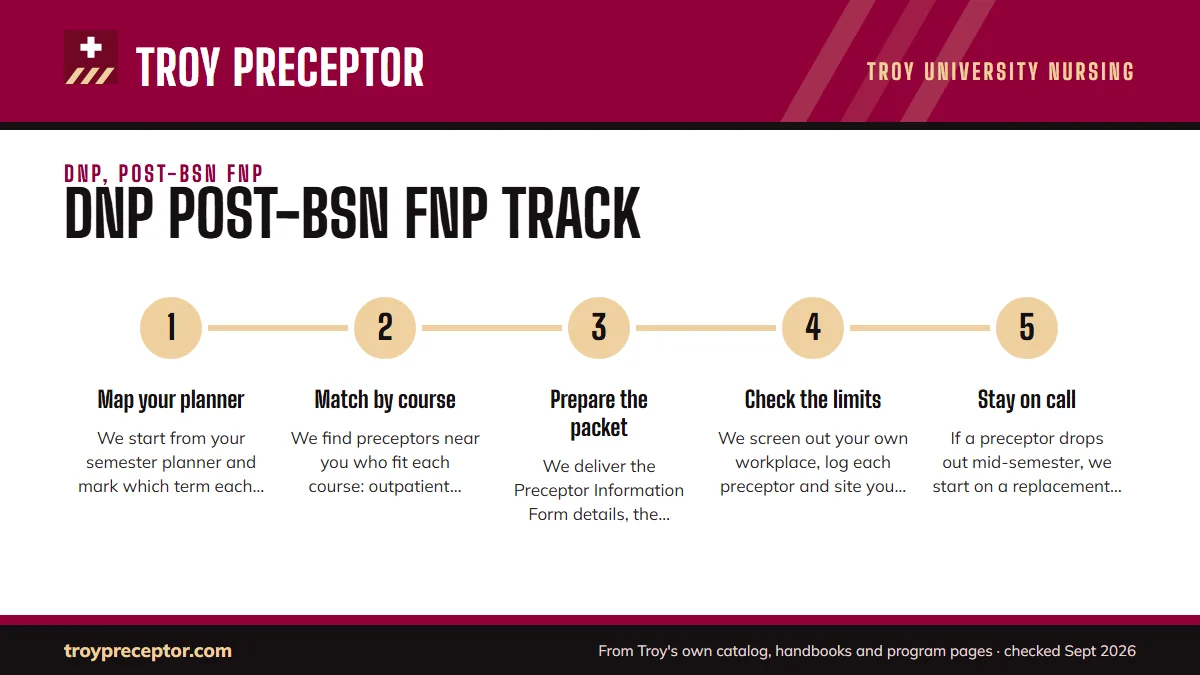
- Map your plannerWe start from your semester planner and mark which term each FNP course falls in, so the search for
NSG 6619begins well before the fall it runs. - Match by courseWe find preceptors near you who fit each course: outpatient exams for
NSG 6619, pediatric and women's health coverage forNSG 6666, adult primary care forNSG 6668and an internship setting forNSG 6680. - Prepare the packetWe deliver the Preceptor Information Form details, the biosketch and a license copy, packaged for your faculty advisor well before the drop deadline.
- Check the limitsWe screen out your own workplace, log each preceptor and site you use to keep all of them within Troy's two-use limit, and point out agencies that will probably need a fresh formal contract.
- Stay on callIf a preceptor drops out mid-semester, we start on a replacement straight away and help you tell faculty about the schedule change.
Faculty at Troy approve each preceptor and setting; we see that every packet reaching them is complete and matches Troy's rules. Tell us your semester with the form below.
Questions Troy students ask
How many clinical hours are in Troy's DNP FNP track?
The total is 1,000. Under the DNP manual's course list, the four FNP preceptorships account for 780: 120 in NSG 6619, 180 apiece in NSG 6666 and NSG 6668, and 300 in NSG 6680. A second section sets 135 hours apiece for the first three courses. Synthesis course hours and, if needed, NSG 8880 make up the difference.
Can a physician assistant precept me on Troy's DNP FNP track?
Yes. Physician assistants appear on the DNP manual's FNP preceptor list next to nurse practitioners with a year or more of NP experience, physicians (MD or DO) and nurse midwives. Graduate preparation is expected, and faculty approve each person. In NSG 6666, where two preceptors are required, a PA can be one of the pair with faculty approval.
Can I log hospital hours before the FNP Internship?
No. Hospital settings open up only in NSG 6680, the 300-hour internship. NSG 6619, NSG 6666 and NSG 6668 belong in outpatient settings, and none may sit inside your own employer's unit or setting. Hours logged against the rule, or before faculty clear you, do not count.
What happens if my preceptor form is late on the DNP FNP track?
One cutoff covers every DNP clinical course: the final day you can drop without an academic penalty. The MSN manual spells out what a missed deadline costs MSN students, losing the clinical course plus its paired co-requisite. Treat a late DNP form as equally serious, and tell your faculty advisor at once if a preceptor falls through.
Related pages
Last checked 2026-09-27
We check these pages against Troy's own 2026-27 MSN, DNP, AMSN and RN to BSN orientation manuals, program pages, degree maps and state authorization pages. Your faculty advisor, your course faculty and the School of Nursing have the final word.
Troy asks you to recruit your preceptor. We make that the easy part.
Tell us your Troy program, where you live and which semester your next clinical course starts. We find preceptors who meet Troy's rules for the course, check the setting against Troy's limits, and prepare everything the Preceptor Information Form and biosketch ask for, well ahead of the form deadline.
- Preceptors matched to the course: a graduate-prepared NP or physician for
NSG 6619, pediatrics and women's health forNSG 6666, adults and older adults forNSG 6668 - Preceptor Information Form details, a biosketch and a copy of the preceptor's license, ready for your faculty advisor
- In your own area, in Alabama or a state where Troy can offer clinicals, never in your own work setting
Start your placement plan
Program, city and semester is all we need to begin.