How we find and prepare your Troy preceptor, course by course
Troy University's orientation manuals for graduate and RN to BSN students ask you to recruit your own preceptors, and Troy faculty approve each one. We take on the recruiting: a preceptor close to home who fits Troy's rules for the course, every detail your preceptor packet needs, and a timeline set against your form deadline. Here is exactly what happens after you reach out.
Start your placement plan
Your program, the course that needs a preceptor, your city and the start semester are all we need to begin.
Your part, our part, Troy's part
You bring three facts: your Troy program, the course that needs a preceptor, and where you live. We turn those into a preceptor who fits Troy's rules for that course and a packet your faculty advisor can act on the day it arrives. The calls, the follow-ups and the credential checks sit with us, and you hear from us at each stage.
Troy keeps the decisions that belong to Troy. Your course faculty sign off on the person and the place, the School of Nursing starts the paperwork with the agency, and no hour counts until faculty clear you to begin. Troy's side runs in a fixed order, laid out on our preceptorship process guide, and our work is timed to fit it.
The search, step by step
Every request moves through the same seven stages, whether you need one course covered or a whole program planned.
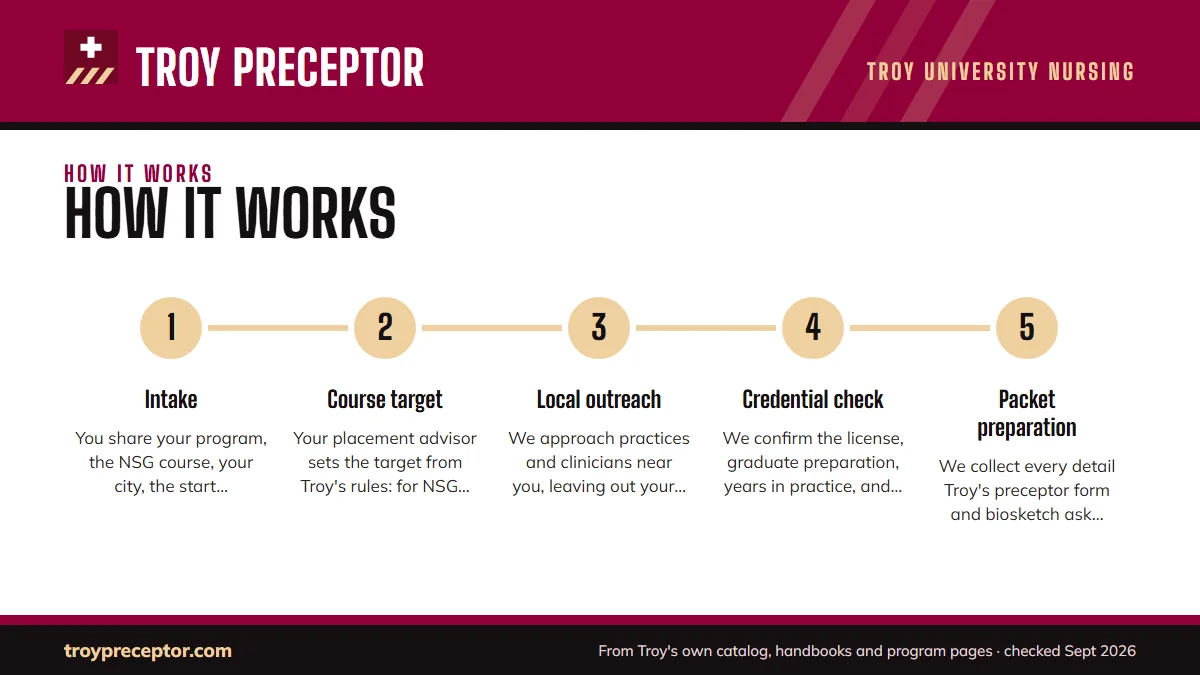
- IntakeYou share your program, the NSG course, your city, the start semester, your workplace and any preceptors or sites already used at Troy.
- Course targetYour placement advisor sets the target from Troy's rules: for
NSG 6619, an NP with a year of NP experience, a physician, a nurse midwife or a PA; forNSG 6666, two preceptors; for the HINL practicums, an informatics or leadership lead. - Local outreachWe approach practices and clinicians near you, leaving out your own work area and anyone you have already used twice.
- Credential checkWe confirm the license, graduate preparation, years in practice, and that the preceptor is not a relative.
- Packet preparationWe collect every detail Troy's preceptor form and biosketch ask about, plus a copy of the preceptor's license.
- SubmissionYou send the finished packet to your faculty advisor with time to spare before the form deadline for your course.
- StandbyAfter clearance we stay on call all semester, ready to open a replacement search if your preceptor steps away.
What we verify before you see a name
Troy leaves incomplete forms unprocessed, and a preceptor who misses a single rule costs you the weeks it took to find them. So every candidate clears these checks first.
- Credential fit for the exact course, including the one year of NP practice Troy asks of nurse practitioner preceptors
- Graduate preparation: Troy expects an MSN or DNP, and the DNP manual weighs other preceptors case by case
- A current license where the preceptor practices, with a copy ready for your packet
- Distance from your own work area and your employer's settings
- Your Troy history, so no preceptor or site is used a third time
- Setting type, because hospital hours are closed to FNP students until
NSG 6680 - Your own RN license, which must be valid in the state where the hours happen
When a strong candidate practices at a site likely to need a new formal contract with Troy, we tell you at once. Troy's manuals say that route takes longer and ask students to apply early, so an early warning buys you time.
Timing that works back from Troy's deadline
We plan from the date your forms are due, not the date your course starts. Under Troy's MSN manual, NSG 6619 paperwork is due on the final drop date without academic penalty, and other MSN clinical courses allow one month from the first class day. The DNP manual ties every form to the last drop day, and your faculty advisor settles which date applies to you.
Earlier contact means more choice. A request made a semester ahead leaves room to compare preceptors, let agreements close and fix any gap in ViewPoint Screening before the packet goes in. A request made close to the deadline gets the same checks on a compressed schedule, and need a preceptor fast explains how that works.
Every Troy program that uses preceptors
Troy's rules shift from program to program, so the search shifts with them.
| Program | Who we look for | Troy detail we plan around |
|---|---|---|
| MSN FNP and post-master's FNP | NPs with a year of NP experience, physicians, nurse midwives or PAs | Four preceptorships, 780 hours; hospital hours only in NSG 6680 |
| MSN HINL and post-master's HINL | Informatics or leadership preceptors who meet one of the manual's options | Three practicums; any setting outside your work area |
| Nursing Education certificate | An academic nurse educator with an MSN or doctorate and five or more years in nursing education | NSG 6676, 180 hours |
| DNP, post-BSN tracks | The FNP or Nurse Leader preceptors the DNP manual lists | Faculty can suggest names; forms due by the last drop day |
| DNP, post-master's | An external agency or setting for your DNP Synthesis Project | Agency approval in NSG 8820 |
| Accelerated MSN (Dothan) | An experienced RN for NSG 5549; a leadership preceptor for NSG 6698 | Rules set in the AMSN manual |
| RN to BSN | Qualified preceptors in approved clinical settings | Troy's own form in Canvas, approved by lead faculty |
Each program's courses and hours are laid out on the programs hub.
On call until your last clinical hour
Plans shift. A preceptor changes jobs, a clinic trims a service line, or a practice cuts back its student hours. When that happens we open a replacement search the same day and hold it to the same Troy rules, reuse count included. A new preceptor means a new packet and a fresh faculty approval, and faculty need to hear about any change to your approved schedule immediately; the preceptor dropped out guide covers that path.
This is why Troy students choose us. We are built around Troy's own manuals, course numbers and forms, so preceptors fit on the first submission and every remaining clinical course can be planned together. Troy faculty have the final say on each preceptor and setting, and the packet they receive already fits the course. Use the form below to begin.
Questions Troy students ask
Do I still send the Preceptor Information Form myself?
Yes. Troy's manuals have you email the typed form, the biosketch and the license copy to your faculty advisor yourself, and RN to BSN students use their own form in Canvas. We prepare every detail those documents ask for, so what you send is complete. The DNP manual also says not to ask the preceptor to sign the form.
How far ahead should I contact you?
As soon as you know which clinical course comes next. Troy publishes no fixed lead time, but its manuals warn that a site needing a new formal contract takes longer. Reaching out a full semester early leaves the most room to choose a preceptor, and time for the agreements to close before your forms are due.
Can you find a preceptor outside Alabama?
Yes, in states where Troy can offer clinicals. Two checks come first. You need an unencumbered RN license in that state, because Troy processes no out-of-state preceptor request until you provide proof of it, and Troy's 2020 table of clinicals by state should be confirmed with the Clinical Placements Specialist.
Can you plan every clinical course in my program at once?
Yes. FNP students can ask us to plan all four preceptorships together, so we can spread the work across different preceptors and sites within Troy's two-use limit and secure the NSG 6666 pair and the NSG 6680 hospital setting early. Each course still gets its own packet and its own faculty approval.
What if my faculty advisor declines a preceptor?
The decision belongs to Troy faculty, and it stands. We go back to the search with the reason in hand and bring you another preceptor who fits the same course, then prepare a fresh packet so you can resubmit as quickly as possible.
Related pages
Last checked 2026-09-27
We check these pages against Troy's own 2026-27 MSN, DNP, AMSN and RN to BSN orientation manuals, program pages, degree maps and state authorization pages. Your faculty advisor, your course faculty and the School of Nursing have the final word.
Troy asks you to recruit your preceptor. We make that the easy part.
Tell us your Troy program, where you live and which semester your next clinical course starts. We find preceptors who meet Troy's rules for the course, check the setting against Troy's limits, and prepare everything the Preceptor Information Form and biosketch ask for, well ahead of the form deadline.
- Preceptors matched to the course: a graduate-prepared NP or physician for
NSG 6619, pediatrics and women's health forNSG 6666, adults and older adults forNSG 6668 - Preceptor Information Form details, a biosketch and a copy of the preceptor's license, ready for your faculty advisor
- In your own area, in Alabama or a state where Troy can offer clinicals, never in your own work setting
Start your placement plan
Program, city and semester is all we need to begin.