Preceptors for Troy's MSN in Healthcare Informatics and Nursing Leadership
One sentence in the 2026-27 MSN Student Orientation Manual governs every graduate clinical course at Troy University, HINL included: "Students must contact preceptors to ask them to serve in that capacity; faculty must approve all preceptors." For the Healthcare Informatics and Nursing Leadership track, that means three practicums and 480 hours with informatics or leadership preceptors. We find those preceptors for you, matched to Troy's HINL qualification routes and ready for faculty review.
Get your placement plan
Tell us your Troy program and where you live. A placement advisor replies with the preceptor and site options that fit your Troy course.
The HINL track in brief
Healthcare Informatics and Nursing Leadership, which Troy shortens to HINL, is one of the two online MSN tracks run through TROY Online. The MSN manual's Progression section sets it at 37 semester hours and 480 clinical clock hours, with a minimum of five semesters from a Fall start. The 2025-26 Graduate Catalog calls the track fully online with no on-campus requirements, so your main School of Nursing contact is the faculty advisor Troy matches to you by track and nearest campus.
MSN admission opens every semester, on the same application dates as the FNP track. Among its sample MSN courses, Troy's MSN page lists Healthcare Economics, Foundations of Advanced Nursing Practice, Theories in Nursing and Advanced Nursing Practice Internship I.
At the end, the MSN manual says graduates can apply for certification exams in their specialty area. Troy does not name a particular exam or certifying body for HINL, so treat that as a conversation for your faculty advisor rather than a fixed outcome.
Three practicums and their hours
| Course | Title | Credits | Clinical hours |
|---|---|---|---|
NSG 6630 | Introduction to Nursing Leadership and Technology Practicum | 2 | 120 |
NSG 6636 | Advanced Nursing Practice Internship I | 3 | 180 |
NSG 6637 | Advanced Nursing Practice Internship II | 3 | 180 |
The MSN manual gives the 480-hour total, and the per-course split comes from the DNP manual, because the post-BSN DNP Nurse Leader track takes the same three courses before adding NSG 8880. The figures agree: 120, 180 and 180 make 480. Each of the three courses needs its own approved preceptor paperwork, even when one preceptor covers two of them.
What each practicum asks of you and your preceptor, from the introductory leadership and technology course to the two internships, is covered on the HINL practicums guide. This page stays with the track as a whole and the preceptor search behind it.
Who qualifies as a HINL preceptor
HINL preceptors come from informatics and leadership, not primary care, and the MSN manual gives four routes. A preceptor needs to meet any one of them.
- A master's in nursing (MSN) plus hands-on work in nursing informatics, or in leadership and administration.
- A master of science in computer technology or in administration, plus direct involvement in active clinical practice.
- A bachelor's in nursing (BSN) and three or more years in the field, ideally with certification.
- A bachelor of science (BS) and five years in the field, ideally with certification.
The manual's general line for graduate courses still applies: Troy expects preceptors prepared at the graduate level, and faculty approve each one. That makes the two master's routes the strongest first choices, with the bachelor's routes available when experience runs deep. Post-BSN DNP students in this track need leadership and administration preceptors specifically, which the DNP Nurse Leader track guide explains.
For side-by-side detail on informatics, leadership and Nurse Leader preceptors, see HINL and leader preceptors.
Any setting, with two limits
HINL has more room than the FNP track. The Preceptor Information Form notes that HINL students may use any setting, and the FNP bar on hospital hours before NSG 6680 does not reach these courses. A hospital informatics team, a health system's nursing administration office, a public health agency or a long-term care organization can all be workable, as long as the preceptor fits one of the four routes.
The first limit is your own job. Troy's MSN manual keeps clinical hours out of the unit or setting where you are employed, and if you already work in informatics or leadership, the department that would suit a practicum may be your own. Ask your faculty advisor early whether a different unit or facility of your employer counts as a separate setting, before you approach anyone there.
The second limit is repetition. A preceptor or site can be used twice at most over the program, so three practicums need at least two different preceptors. Both rules are unpacked on work setting and reuse rules.
Timing and forms for HINL courses
The MSN manual does not publish a semester-by-semester map for the HINL practicums. For comparison only, the DNP manual starts Nurse Leader clinical courses in the spring of the first year. Your own planner sits in Canvas, so confirm the semester for NSG 6630 with your faculty advisor as soon as you are admitted.
Because none of the HINL courses is NSG 6619, the MSN manual's one-month rule applies: your three documents (the Preceptor Information Form, the Biosketch and the license copy) must reach your advisor no later than a month after classes begin. Missing that window means dropping the practicum and its co-requisite. DNP students in these courses work under the DNP manual, which ties all forms to the no-penalty drop date; the forms guide walks through each field.
Practicum hours have to sit inside the semester you are enrolled, never in a break, and Student Self-Service takes each paired didactic and practicum course as a single registration.
From a preceptor's yes to your first practicum hour
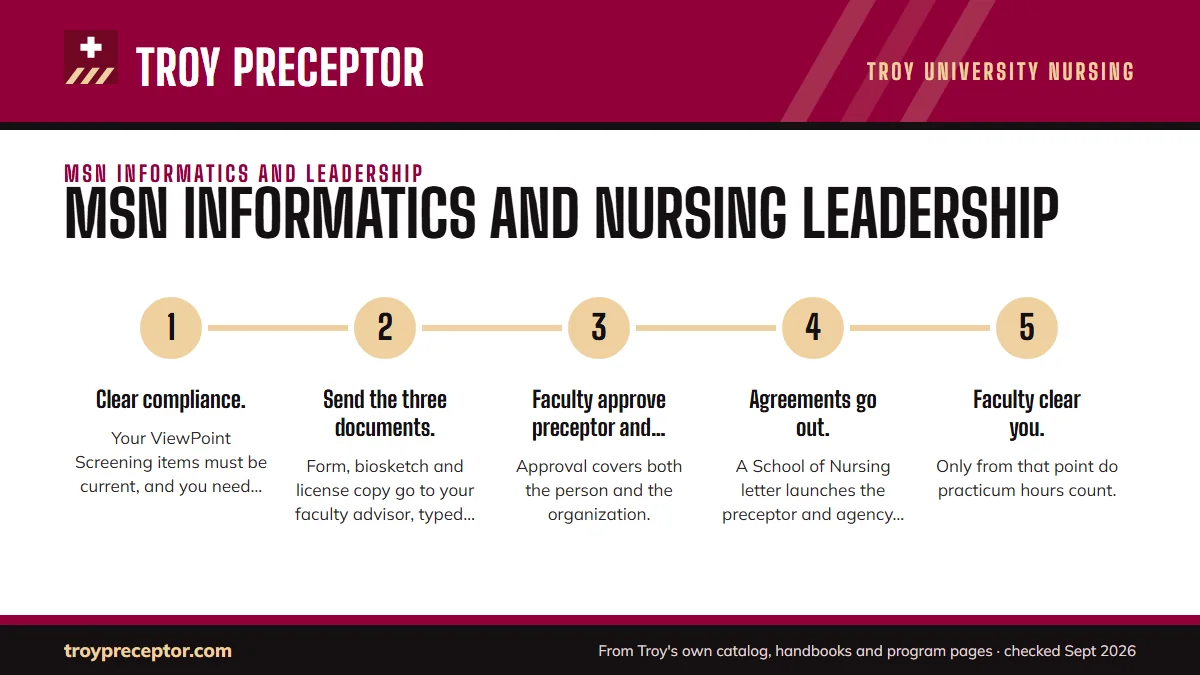
- Clear compliance. Your ViewPoint Screening items must be current, and you need an RN license good in the practicum's state.
- Send the three documents. Form, biosketch and license copy go to your faculty advisor, typed and complete.
- Faculty approve preceptor and setting. Approval covers both the person and the organization.
- Agreements go out. A School of Nursing letter launches the preceptor and agency agreements, and both must come back signed before you start.
- Faculty clear you. Only from that point do practicum hours count.
- Share objectives and schedule. Hand over the course objectives; when your preceptor signs off on a schedule, file the clinical schedule form.
Large health systems and informatics departments may not have a formal contract with Troy yet, and Troy says that case takes longer, so it pays to apply early. Agency agreements covers that stage in depth.
Why HINL students choose us
The right informatics or leadership preceptor often works in an office students rarely see, such as a clinical informatics team or a nursing administration suite. We know where to look, and we match each candidate to one of Troy's four HINL routes before you hear the name: degree, years in the field, certification where it strengthens the case, and a setting apart from your own workplace.
We plan all three practicums together, so no preceptor or site goes past Troy's two-use limit and each internship builds on the one before. Your form, biosketch and license details are assembled and double-checked on our side, well ahead of the one-month deadline, and any organization that will need a new formal contract is flagged to you early. If a preceptor leaves partway through, a replacement search starts at once.
Troy faculty make the call on every HINL preceptor and setting. What we add is a request that arrives complete and already inside Troy's rules, so approval is not held up by missing pieces. Send your state and admission term from our contact page, or fill in the form at the foot of this page.
Questions Troy students ask
Do Troy HINL students need a nurse practitioner as preceptor?
No. The NP, physician, midwife and PA list belongs to the FNP courses. A HINL preceptor qualifies through informatics or leadership credentials and experience, from the two master's routes to bachelor's routes that call for three or five years in the field. Faculty approve each one against the MSN manual's HINL list.
Can I use my own employer for Troy HINL practicum hours?
Not the unit or setting where you work, which Troy's MSN manual rules out for every graduate clinical course. Whether a separate department or facility within the same organization counts as a different setting is something to put to your faculty advisor first. Settle it early, especially if your current role already sits in informatics or nursing leadership.
Can a preceptor with only a BSN supervise a Troy HINL practicum?
Troy's MSN manual lists a BSN with three or more years in the area, preferably certified, as one qualifying route, and a BS with five years as another. The same manual expects graduate-level preparation for preceptors in general, so faculty weigh each case. A BSN preceptor with strong experience and certification stands the best chance of approval.
Is Troy's HINL program completely online?
The 2025-26 Graduate Catalog describes the HINL track as fully online with no on-campus requirements, and courses run through TROY Online. The practicums still happen with an approved preceptor in an approved setting near you, so the 480 hours are completed with that organization under the arrangements your faculty approve.
Related pages
Last checked 2026-09-27
We check these pages against Troy's own 2026-27 MSN, DNP, AMSN and RN to BSN orientation manuals, program pages, degree maps and state authorization pages. Your faculty advisor, your course faculty and the School of Nursing have the final word.
Troy asks you to recruit your preceptor. We make that the easy part.
Tell us your Troy program, where you live and which semester your next clinical course starts. We find preceptors who meet Troy's rules for the course, check the setting against Troy's limits, and prepare everything the Preceptor Information Form and biosketch ask for, well ahead of the form deadline.
- Preceptors matched to the course: a graduate-prepared NP or physician for
NSG 6619, pediatrics and women's health forNSG 6666, adults and older adults forNSG 6668 - Preceptor Information Form details, a biosketch and a copy of the preceptor's license, ready for your faculty advisor
- In your own area, in Alabama or a state where Troy can offer clinicals, never in your own work setting
Start your placement plan
Program, city and semester is all we need to begin.