NSG 6680 FNP Internship: the final 300 hours
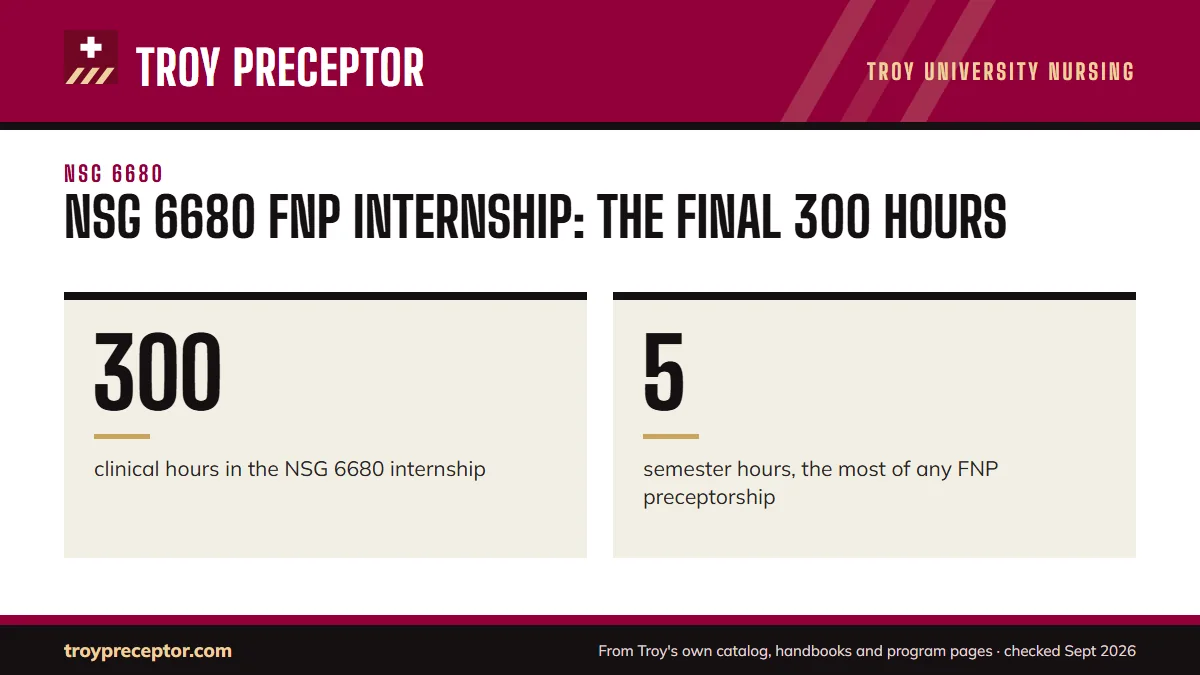
NSG 6680, the FNP Internship, is the last and largest of Troy University's four FNP preceptorships: 5 semester hours and 300 clinical hours, more than a third of the 780 total. It is also the first course in which Troy's MSN manual lets FNP students log hours in a hospital setting.
Plan your NSG 6680 internship
Tell us where you live and which semester your internship starts.
What sets the internship apart
Every earlier FNP preceptorship carries 3 semester hours and 120 or 180 clinical hours. NSG 6680 carries 5 and 300, and it closes the FNP sequence for MSN, post-master's certificate and post-BSN DNP FNP students alike. For a full-time Fall entrant it most likely lands in the Spring of year two, the fifth and last semester of the minimum.
It is also the one FNP course figure that Troy's two current manuals never contradict. The DNP manual's 135-hour line touches only the first three courses, and both 2026-27 manuals list 300 hours for the internship. The 780-hour FNP page covers the rest.
Troy's 2024-25 catalog page for the course pairs it with NSG 6670 as a co-requisite, the APEA fee list ties the fourth clinical semester to that same course, and the 2021-22 catalog titled it Role Synthesis Seminar. Check the pairing in your semester planner and register both together in Student Self-Service.
Hospital hours: what opens up and what stays the same
Troy's MSN manual keeps FNP students out of hospital settings for clinical hours right up to the internship. From here on, a hospital-based preceptor or unit is a legitimate option. The manual permits hospital hours here rather than requiring them, so an internship spent entirely in outpatient practice remains open to you.
Much stays exactly as before. The preceptor must still qualify under Troy's FNP list (an NP licensed and a year into NP practice, an MD or DO, a nurse midwife or a PA), faculty still sign off on preceptor and setting, and signed agreements still have to be back at the School of Nursing before your first shift.
If you work as an RN in a hospital, the employer rule matters more in this course than in any other. Troy rules out hours in any area or setting that employs you, so run any unit in your own hospital or health system past your faculty advisor before approaching a preceptor there. The full rule sits on work setting and reuse rules.
A hospital new to Troy may need a formal contract before you can start, and Troy says those take longer. Ask about the contract before you ask about the schedule.
Fitting 300 hours into one semester
Three hundred hours is the heaviest single load in the program, and it has to fit between clearance and the course's last day. Troy's manual allows no clinical hours during semester breaks, so nothing can be moved into the weeks after the semester ends. The clinical hours page works through the weekly numbers for a late clearance.
You may want more than one preceptor or setting to make the numbers work. Troy expects a variety of preceptors and settings and limits any one of them to two uses in the program, but the manual sets no count of preceptors for the internship, so agree the plan with your course faculty. Each extra preceptor needs their own approval, biosketch and license copy.
A heavy schedule also has to be an accurate one. You file the clinical schedule form after your preceptor approves the dates, report every change to faculty at once, and expect unannounced faculty visits by phone, video or in person. Being absent on a scheduled date when faculty visit brings a zero on the clinical evaluation; see schedule and site visits.
The deadline and what a late form costs
Internship forms are due a month after MSN classes begin, and DNP students work to the last date to drop without penalty. Under the MSN manual, a late form forces you to withdraw from the clinical course and the course paired with it, and faculty will withdraw you if you leave it.
In the final semester that consequence is sharper than anywhere else. FNP-specific courses run once a year, so a dropped internship may wait a full year for its next offering, and graduation moves with it. Confirm your own options with your faculty advisor, and read delayed graduation if that is already your situation.
If the hours fall short near the end, an In-Progress grade exists in Troy's 2025-26 Graduate Catalog for a short list of course types, internships and practicums among them; it has to be cleared within one calendar year or it turns into an FI. Ask your course faculty whether it applies to your case; the detail is on incompletes and time limits.
After the internship
For MSN FNP students, NSG 6680 completes the 780 clinical hours. Graduates can then apply to sit the national FNP certification exam, according to Troy's MSN page, and APEA runs through the program as Troy's required certification preparation. The graduation application is filed through Self-Service by the deadline on Troy's academic calendar.
Post-master's FNP certificate students receive a certificate, not another degree, and the MSN manual notes that certificate completers are not part of the graduation ceremonies.
Post-BSN DNP FNP students keep going, with the internship closing out their 6000-level FNP clinical courses. The internship brings them to 780 of the 1,000 hours the DNP requires, and the rest is documented through the synthesis courses; the path is on the DNP FNP track guide.
An internship lined up before the final semester
Your final semester is the worst time to be searching. We start the NSG 6680 search early, in your own area, for preceptors with the clinic days to carry 300 hours, and where hospital time fits your goals we look for hospital-based preceptors outside your own unit and employer.
Every candidate is checked against Troy's FNP standard and your record of earlier preceptors and sites, and we raise it early when a hospital or practice looks set to require a new formal contract, so the agreement is not what holds you up. The biosketch details and license copy reach you with time to spare before the one-month mark. The decision on every internship preceptor and setting rests with Troy faculty, and we make sure the paperwork they see is finished and fits Troy's rules from the start. Begin with the form below.
Questions Troy students ask
Is NSG 6680 the only Troy FNP course that allows hospital hours?
Yes. The MSN manual holds FNP students out of hospital settings until the internship, so the three earlier preceptorships all happen elsewhere. Even in NSG 6680, faculty approve the specific setting, and the unit that employs you stays off limits. Hospital time is allowed there, not required.
What is the co-requisite for Troy's NSG 6680?
The 2024-25 catalog course page lists NSG 6670, which the 2021-22 catalog called Role Synthesis Seminar, and Troy's APEA fee list ties the fourth clinical semester to it. Troy registers each didactic and preceptorship pair in a single Self-Service submission, so confirm the pairing in your semester planner first.
What if I have not finished 300 hours when the semester ends?
Clinical hours cannot continue into a semester break, so raise the shortfall with your course faculty as early as you see it coming. Troy's 2025-26 Graduate Catalog permits an In-Progress grade for internship and practicum courses, which must be cleared within one calendar year; ask whether it applies to you. The behind on clinical hours guide covers practical options.
Do post-master's FNP certificate students take NSG 6680?
Yes. The certificate carries the full 780 clinical hours in the MSN manual, earned in the same clinical courses MSN students take, so the internship's 5 credits and 300 hours apply to certificate students in full. The same form deadline, hospital rule and employer bar apply as well.
Related pages
Last checked 2026-09-27
We check these pages against Troy's own 2026-27 MSN, DNP, AMSN and RN to BSN orientation manuals, program pages, degree maps and state authorization pages. Your faculty advisor, your course faculty and the School of Nursing have the final word.
Troy asks you to recruit your preceptor. We make that the easy part.
Tell us your Troy program, where you live and which semester your next clinical course starts. We find preceptors who meet Troy's rules for the course, check the setting against Troy's limits, and prepare everything the Preceptor Information Form and biosketch ask for, well ahead of the form deadline.
- Preceptors matched to the course: a graduate-prepared NP or physician for
NSG 6619, pediatrics and women's health forNSG 6666, adults and older adults forNSG 6668 - Preceptor Information Form details, a biosketch and a copy of the preceptor's license, ready for your faculty advisor
- In your own area, in Alabama or a state where Troy can offer clinicals, never in your own work setting
Start your placement plan
Program, city and semester is all we need to begin.