What shapes the cost of your Troy preceptor placement
Every quote we give a Troy University nursing student is built for that student: the program, the course, where you live and how soon your forms are due. This page walks through each factor, what a placement includes, and the Troy costs that sit apart from ours, so you know what you are weighing before you ask.
Ask for your quote
Share your program, course, city and start semester, and your placement advisor replies with a quote built for your search.
One quote per student, built from your search
We quote each placement individually because two Troy students rarely need the same search. An online FNP student in Montgomery who needs the two NSG 6666 preceptors faces a different task from an HINL student in Georgia who needs one leadership preceptor for a single practicum. Troy's online programs put clinicals where you live, so every search starts from your address rather than from a campus.
Your quote names what it covers, and you see it before any work begins. It reflects the real shape of your search: the preceptor type Troy requires, the number of courses, the local market and the time left before your faculty advisor needs the packet. The factors below are the ones that move it most.
The factors that move a quote
- The course. An
NSG 6666search is really two, since Troy asks for two preceptors in Primary Care I. A Nursing Education certificate search looks for an academic educator with at least five years in nursing education, a narrower pool than general practice. - How many courses. One preceptorship is one search. A full FNP plan covers four courses and 780 hours, spread widely enough that every preceptor and site stays within Troy's cap of two uses.
- Where you live. Practices are spread thinner in rural counties, and clinicals outside Alabama also depend on holding an RN license valid in that state.
- How close the deadline is. A search that starts a semester out runs at a steady pace. One that starts days before the form deadline packs the outreach into a short window.
- The setting. FNP hospital hours wait until
NSG 6680, and some sites will need a new formal contract with Troy, which adds coordination. - Your history. Your employer's settings and any preceptor or site you have already used twice come off the list, which can shrink a small market fast.
What a placement includes
The size of the search changes; the thoroughness does not. Each placement is worked the same careful way, and your quote spells out which pieces apply to you.
- Outreach in your area, aimed at clinicians who meet Troy's rules for your course
- License, credential and experience checks before a name reaches you
- A comparison with your employer's settings and your Troy preceptor history
- The details the Preceptor Information Form, Preceptor Biosketch and license copy ask for, gathered for your packet
- A schedule dated back from your form deadline
- An early warning if the site is likely to need a new formal contract
- A replacement search if a preceptor steps away mid-semester
The step-by-step version of this work is on how it works.
Costs that belong to Troy or to you
Our fee stands apart from anything Troy charges. Tuition and Troy's own fees are between you and Troy, and Troy lists no placement fee of its own. Troy's manuals put several clinical costs on the student: the ViewPoint Screening package with its background check and drug test, the yearly repeat, APEA and Shadow Health for FNP students, a lab fee on clinical courses from Fall 2026, and travel, meals and any overnight stays for clinicals.
RN to BSN students also see a clinical course fee on NSG 3310, NSG 4411 and NSG 4431. An agency's affiliation agreement can call for extra drug testing at your expense, and agencies may add requirements of their own. The Troy placement costs guide walks through each item without figures.
How timing changes the work
Starting early is the biggest lever you control. Troy's FNP courses run once a year in sequence, with NSG 6619 in Fall and clinical courses in every semester except summer, so the date you need your next preceptor is predictable months in advance. A plan made then leaves time to compare candidates and let agreements close.
A late start still gets the full set of checks, with the outreach packed into fewer weeks. Troy counts hours only inside the course you are enrolled in and allows none during semester breaks, so a late search cannot borrow time from the calendar. If your deadline is close, put the date in your first message so the quote reflects it. The need a preceptor fast page describes a short-notice search.
Getting your quote
A quote takes one short message. The more of your Troy history you share at the start, the closer the quote matches the search you actually need.
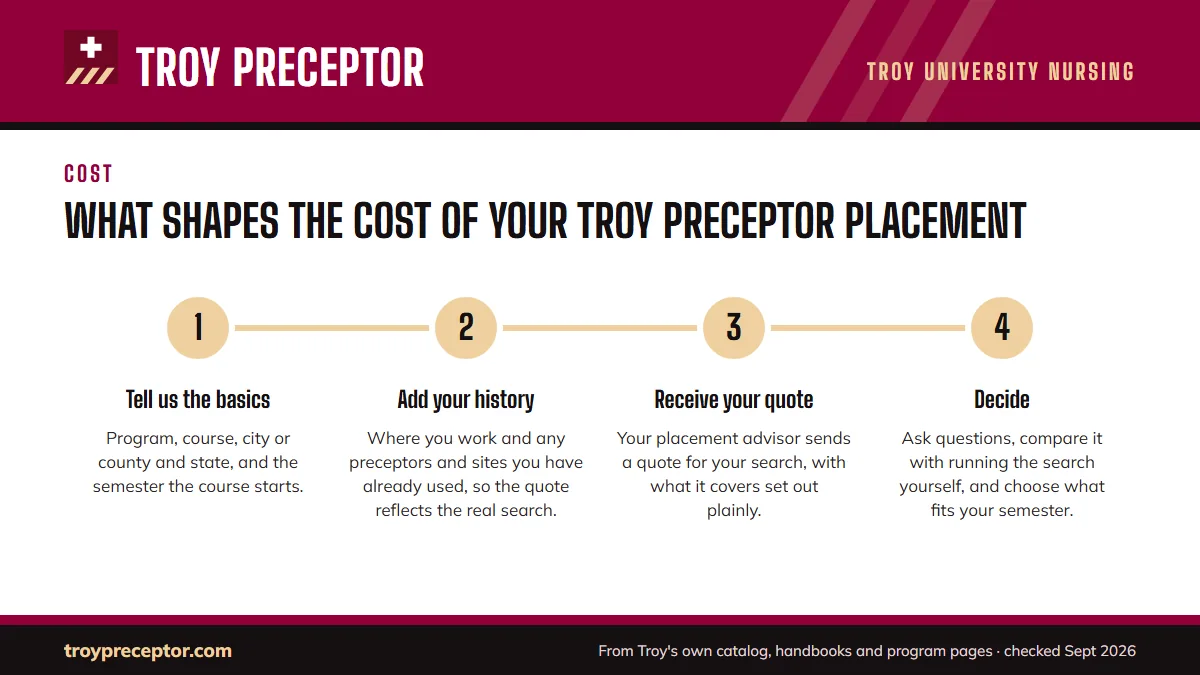
- Tell us the basicsProgram, course, city or county and state, and the semester the course starts.
- Add your historyWhere you work and any preceptors and sites you have already used, so the quote reflects the real search.
- Receive your quoteYour placement advisor sends a quote for your search, with what it covers set out plainly.
- DecideAsk questions, compare it with running the search yourself, and choose what fits your semester.
If you are still weighing your own search against a service, our decision guide sets the options side by side. Use the form below to start.
Questions Troy students ask
Is your fee part of Troy tuition?
No. Our fee is separate from Troy's tuition and fees, and Troy lists no placement fee of its own. You arrange your placement with us directly, and your quote shows what it covers. Troy's clinical costs, such as ViewPoint Screening and the clinical-course lab fee, stay between you and Troy.
Why is each quote individual?
Because the work varies more than a single price could show. One NSG 6630 practicum near home is a very different search from a four-course FNP plan in a rural county with a short deadline. A quote built for you reflects the actual course, location and timing you bring.
Does starting late change my quote?
It can. Timing is one of the factors we weigh, because a search squeezed into a few weeks takes more concentrated outreach than one spread across a semester. Starting early gives you more preceptor choice and a calmer schedule, and your quote reflects whichever situation you are in.
Will I owe anything to the clinical site?
Any charge a clinical agency or other third party makes is separate from our quote. Troy's manuals note that an agency affiliation agreement can require further drug testing at the student's expense and that agencies may add their own requirements, so leave some room in your budget for those.
Does my quote cover a replacement if my preceptor leaves?
Replacement support is part of how we work, and your quote sets out how it applies to your placement. If a preceptor steps away, we start a new search against the same Troy rules and prepare a new packet for faculty approval, keeping your reuse count in view.
Related pages
Last checked 2026-09-27
We check these pages against Troy's own 2026-27 MSN, DNP, AMSN and RN to BSN orientation manuals, program pages, degree maps and state authorization pages. Your faculty advisor, your course faculty and the School of Nursing have the final word.
Troy asks you to recruit your preceptor. We make that the easy part.
Tell us your Troy program, where you live and which semester your next clinical course starts. We find preceptors who meet Troy's rules for the course, check the setting against Troy's limits, and prepare everything the Preceptor Information Form and biosketch ask for, well ahead of the form deadline.
- Preceptors matched to the course: a graduate-prepared NP or physician for
NSG 6619, pediatrics and women's health forNSG 6666, adults and older adults forNSG 6668 - Preceptor Information Form details, a biosketch and a copy of the preceptor's license, ready for your faculty advisor
- In your own area, in Alabama or a state where Troy can offer clinicals, never in your own work setting
Start your placement plan
Program, city and semester is all we need to begin.