Finding your own preceptor as a Troy nursing student
Troy University expects you to find and ask your own preceptors, and each 2026-27 orientation manual that covers preceptor courses says so. Faculty approve the people you bring. The search goes best when you know the course rules before the first call and plan every clinical course at once, not only the next one.
Get your placement plan
Tell us your Troy program and where you live. A placement advisor replies with the preceptor and site options that fit your Troy course.
What Troy's manuals say about the search
Every Troy manual that covers preceptor courses puts the first contact on the student. The wording shifts a little between programs, and those shifts tell you how much help to expect.
| Troy document | What it says | Where it applies |
|---|---|---|
| MSN Student Orientation Manual | "Students must contact preceptors to ask them to serve in that capacity; faculty must approve all preceptors." | MSN FNP and HINL clinical courses, post-master's certificates |
| AMSN Student Orientation Manual | Repeats the MSN sentence word for word | NSG 5549 and NSG 6698 |
| DNP Student Orientation Manual | "Students contact prospective preceptors to ask them to serve in that capacity. Faculty can assist students by suggesting preceptors" | 6000-level clinical courses in the FNP and Nurse Leader tracks |
DNP manual, NSG 8820 progression policy | Students "must obtain approval from the external agency or setting" | The DNP Synthesis Project site |
| RN to BSN Student Orientation Manual | "Students must identify and contact qualified preceptors in approved clinical settings according to the preceptorship course enrolled." | NSG 3310, NSG 4411, NSG 4431 |
Two gaps are worth knowing. Only the DNP manual mentions faculty offering names, and only the DNP manual leaves room for a preceptor below MSN or DNP level, judged one at a time. For 8000-level DNP hours, the manual covers the agency's approval of your project but is silent on preceptors or mentors, so ask your faculty advisor how those hours are supervised.
What Troy offers alongside your search
Troy's help is real but specific. Nursing at Troy lists a single Clinical Placements Specialist, working from the Troy Campus. In Troy's documents, that person receives returned RN to BSN agreements and handles approval steps for several states; nothing Troy publishes has the role locating or assigning preceptors. Our page on the Clinical Placements Specialist sorts out that role against your faculty advisor's.
The MSN manual also describes good working ties between the graduate program and clinical agencies across Alabama, Georgia, Florida and a long list of other states. None of those agencies is named publicly, and Troy keeps no published preceptor database, so the ties show up later, when the office-use block on your form notes whether a formal contract is already in place. The RN to BSN program page puts the student's role plainly: you choose your preceptorship location.
Start with who can precept the course
Before you contact anyone, know who qualifies for the course in front of you. Troy's baseline for a graduate preceptor is graduate preparation, meaning an MSN or DNP, and each course layers its own rules on top.
- FNP courses (
NSG 6619,NSG 6666,NSG 6668,NSG 6680): an NP holding NP licensure in their practice state and one or more years in the NP role; physicians (MD or DO), nurse midwives and PAs qualify too. See FNP preceptor requirements. NSG 6666Primary Care I covers pediatrics and women's health and needs two preceptors.- HINL practicums (
NSG 6630,NSG 6636,NSG 6637) and the DNP Nurse Leader track call for informatics or leadership backgrounds, set out in HINL and leader preceptors. NSG 6676in the Nursing Education certificate: an academic nurse educator, MSN- or doctorally prepared, with five-plus years teaching nursing and an RN license that is active and unencumbered.- AMSN
NSG 5549: a BSN-prepared RN with a year of RN practice, or an ASN-prepared RN with two.
Checking fit first saves a round trip with your faculty advisor over a willing clinician whose credentials do not match the course.
Settings that come off the list
Three setting rules narrow the search further. No hours count in the unit or setting that employs you. No preceptor and no clinical site may appear in more than two of your courses, and Troy asks for a variety of both. FNP students keep out of hospitals until NSG 6680, the FNP Internship, while HINL students may work in any setting apart from their own employer's area.
The reuse cap is the rule students forget by the second year. A clinic that hosted you in two courses cannot host a third, even if a different clinician there offers to take you. Log each preceptor and site as you go, and read our guide to work-setting and reuse rules before you commit to a familiar office.
What to tell a clinician when you ask
A clinician says yes more easily when the whole commitment is clear up front. Cover these points in the first conversation.
- The course number, its focus and the hours it requires, all inside the semester dates, since Troy counts no clinical hours during breaks.
- Their side of the paperwork: biosketch details, a copy of their license, and the two agreements (preceptor and agency) that follow the School of Nursing's letter after approval.
- The course objectives, which you hand them, and the clinical schedule form you file once they approve your dates.
- Faculty contact: a Troy faculty member may drop in, call or set up a video check with no warning.
- For DNP students: leave the Preceptor Information Form unsigned by the preceptor, as the DNP manual instructs.
Field-by-field help with the packet is in our Preceptor Information Form guide.
Plan every clinical course, not only the next one
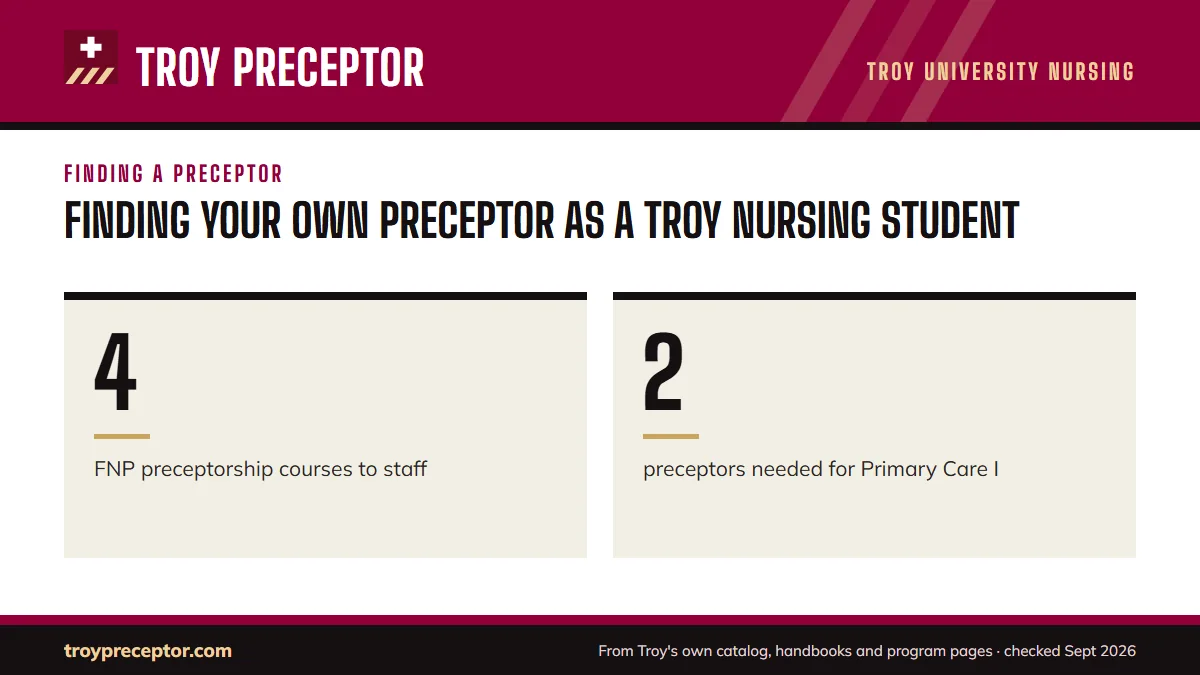
Troy offers each FNP-specific course once a year, in a fixed order that opens with NSG 6619 each fall, and clinical courses run in every semester but summer. A preceptor who falls through late can therefore cost more than one semester. Mapping all four FNP preceptorships at the start, including two preceptors for Primary Care I and a site for the internship, the first course where hospital hours are allowed, gives you room to recruit without a deadline at your back. HINL students have three practicums to map, and DNP Nurse Leader students add NSG 8880 to those same three.
If your clinicals will happen outside Alabama, the license comes before the search. Troy holds any out-of-state preceptor request until you prove licensure in that state, and some states add steps of their own (out-of-state requests).
Why Troy students let us run the search
Recruiting is the one part of Troy's process that rests entirely on you, and it is the part we do best. We contact clinicians in your area who meet the rules for your exact course, confirm their credentials and experience against Troy's list, keep you out of your own workplace, and keep a running record of each preceptor and site so that none reaches a third course.
When someone agrees, we hand you what the packet needs and brief the preceptor on the agreements, the schedule form and faculty visits, so nothing surprises them later. Approval of each preceptor and site stays with Troy faculty, and what we prepare for that review is complete and built around Troy's rules from the first draft. Start with the form below.
Questions Troy students ask
Does Troy University find preceptors for online MSN students?
Troy's 2026-27 MSN Student Orientation Manual assigns the contact to students and the approval to faculty, and no Troy page or manual describes the school placing graduate students with preceptors. The graduate program does have working ties with agencies in several states, which can matter when your chosen site needs an agreement, but the recruiting itself is yours.
Can my Troy faculty advisor give me a list of preceptors?
Troy publishes no preceptor list or database. The DNP manual says faculty can assist DNP students by suggesting preceptors, so DNP students should ask. The MSN manual has no matching sentence, so MSN and certificate students may still ask their faculty advisor for ideas, but should plan the search as their own.
Can a relative or my supervisor at work be my preceptor?
The MSN manual rules out relatives as preceptors; that line is missing from the DNP manual's list, so DNP students should confirm with faculty. A supervisor at your job runs into a separate rule, since Troy bars clinical hours anywhere in your own employee work area or setting.
When should I begin my preceptor search?
Troy names no number of weeks. Its fixed dates are the form deadlines, and it warns that sites needing a new formal contract take longer. Because the agreements must be signed and faculty must clear you before any hours count, students who recruit before the semester opens keep more of the term for clinical time.
What if no one I contact agrees to precept me?
Keep your faculty advisor informed, widen the search to every clinician type the course allows, and check the reuse and work-setting rules before dropping a lead. Our page for students who cannot find a preceptor lays out next steps, and the form below reaches our placement desk directly.
Related pages
Last checked 2026-09-27
We check these pages against Troy's own 2026-27 MSN, DNP, AMSN and RN to BSN orientation manuals, program pages, degree maps and state authorization pages. Your faculty advisor, your course faculty and the School of Nursing have the final word.
Troy asks you to recruit your preceptor. We make that the easy part.
Tell us your Troy program, where you live and which semester your next clinical course starts. We find preceptors who meet Troy's rules for the course, check the setting against Troy's limits, and prepare everything the Preceptor Information Form and biosketch ask for, well ahead of the form deadline.
- Preceptors matched to the course: a graduate-prepared NP or physician for
NSG 6619, pediatrics and women's health forNSG 6666, adults and older adults forNSG 6668 - Preceptor Information Form details, a biosketch and a copy of the preceptor's license, ready for your faculty advisor
- In your own area, in Alabama or a state where Troy can offer clinicals, never in your own work setting
Start your placement plan
Program, city and semester is all we need to begin.