Troy's Preceptor Information Form, Preceptor Biosketch and license copy
Every Troy University graduate preceptorship starts on paper: an information form about the preceptor, a biosketch of their background and a copy of their license, all sent together to your faculty advisor. Troy does not process an incomplete set, so one missing page can hold up approval, the agreements and your start date. Here is what each piece does and how to send a set faculty can act on at once.
Get your placement plan
Tell us your Troy program and where you live. A placement advisor replies with the preceptor and site options that fit your Troy course.
Three documents, one submission
Troy's MSN Student Orientation Manual asks for three items per preceptor: the Preceptor Information Form, the Preceptor Biosketch and a photocopy of that clinician's license. The form itself must be typed, saved as a Word document and emailed to your faculty advisor as an attachment, so a handwritten page or a scanned photo does not meet the instruction.
The manual is blunt about gaps: incomplete forms are not processed. Nothing further along moves until faculty hold a full set, because approval of the preceptor and setting comes before the School of Nursing writes to the agency, and the signed agreements come before clearance. The whole sequence is laid out on our preceptorship process page.
Before you press send
- Preceptor Information Form, typed, in Word format, current version
- Preceptor Biosketch with the credential boxes and experience filled in
- A legible copy of the preceptor's current license
- All three attached to one email to your faculty advisor
The Preceptor Information Form, part by part
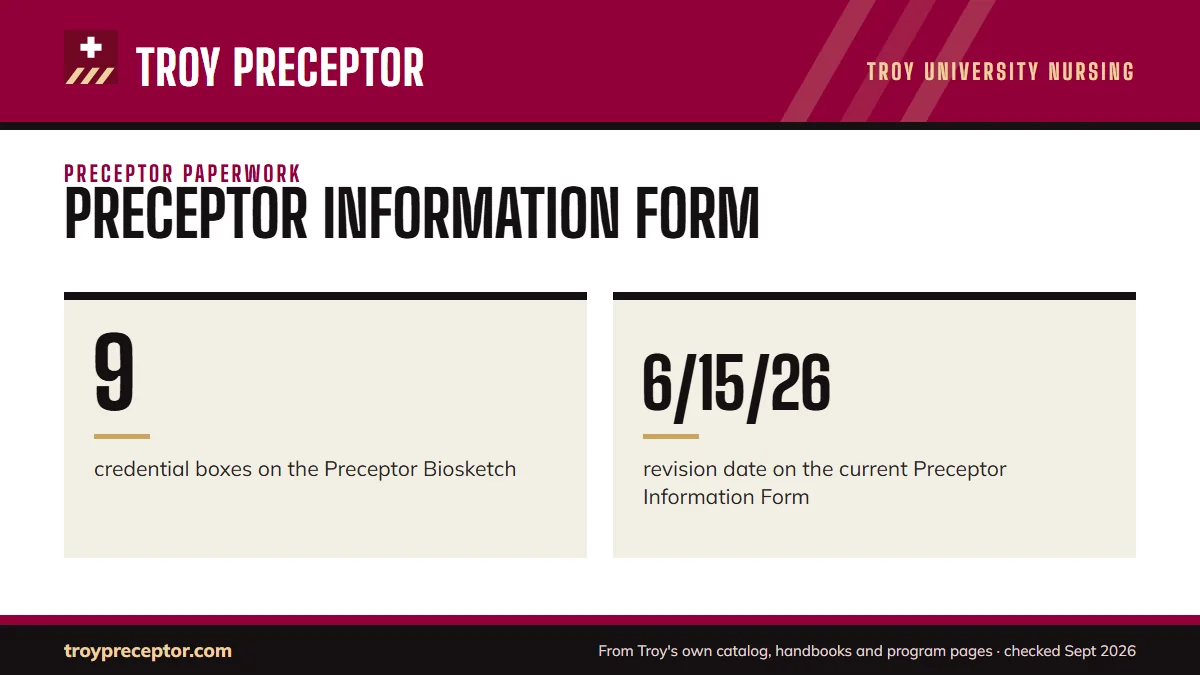
The current form carries a revision date of 6/15/2026 and sits in the MSN manual right before the biosketch. Work through it in this order.
- Program and course. Identify your track and the clinical course; post-master's certificate students tick the PMC box. The form names
NSG 6619Advanced Health Assessment and Diagnostic Reasoning, while other pages of the same manual give that course two other titles, so lead with the course number. - Preceptor. Keep the name and credentials consistent with the biosketch and license copy you attach, so faculty can read the three together.
- Setting. The form restates two setting rules: FNP students may not use a hospital setting before
NSG 6680, and HINL students can pick any setting other than the area where they are employed. - Office use. The last block belongs to the School of Nursing. It notes faculty approval, the need for a formal contract, whether Troy already has one with the site, and when the agency letter was mailed.
An older 2018 MSN version of the form, built around NSG 6613, is still reachable online. Use only the form printed in the 2026-27 manual.
The Preceptor Biosketch
The biosketch puts the preceptor's background in front of faculty next to the form. It has checkboxes for RN, FNP, AGNP, PNP, CNM, PA, MD, DO and CNS, and the experience detail beneath them is what shows whether the person fits the course.
What the biosketch needs to prove depends on the course. A nurse practitioner precepting an FNP course needs NP licensure where they practice and at least a year of NP experience, and physicians, nurse midwives and physician assistants also qualify (FNP preceptor requirements). HINL, Nurse Leader and Nursing Education preceptors are measured on their degree and years in informatics, leadership or teaching, so make both easy to find. An informatics lead with an MS in computer technology may tick none of the clinical boxes and still qualify for a HINL course.
The license copy
Attach a copy of the preceptor's current license. For a nurse practitioner precepting an FNP course, Troy requires NP licensure in the preceptor's own practice state, so the copy should show that NP license rather than an RN license alone. Physicians and physician assistants attach the license their own board issues. Check the expiration date before you send it, so the copy on file covers the semester.
The Nursing Education certificate adds its own license line: the educator preceptor needs an active, unencumbered RN license. Your license is a separate requirement. Your clinical state must have issued you an unencumbered RN license, and a request for a preceptor outside Alabama is not processed until you show that state's license (your RN license for clinicals).
Signatures, submission and timing
The DNP manual instructs DNP students to leave the preceptor's signature off the Preceptor Information Form. The preceptor's formal commitment comes later, through the preceptor and agency agreements, which a School of Nursing letter starts after faculty approve (agency agreements). The MSN manual does not repeat that DNP line, so MSN and certificate students should ask their faculty advisor how their course handles signatures.
When the form is due depends on your manual, and the MSN and DNP versions disagree; the form deadline guide sets them side by side. Whatever the date, the packet has to be complete on arrival to count. Send it only after the preceptor has accepted the course dates and hours, since a name withdrawn after approval means a new packet for someone else.
The RN to BSN version
RN to BSN students use a different document: the RN to BSN Program Preceptor Information and Acknowledgement Form, kept in Canvas rather than in the public manual. Lead faculty approve it, and Troy's program page adds that RN to BSN students choose their own preceptorship location. After approval, the site gets the preceptor and agency agreement by email and sends it back signed to the Clinical Placements Specialist.
The three preceptorships, NSG 3310, NSG 4411 and NSG 4431, each sit inside a 9-week term, which leaves little slack between approval and the end of the course. Open the form at the start of the term and gather what it asks before your preceptor's first day. More on the program is in our RN to BSN guide.
How we build your packet with you
We assemble the packet with you for every clinical course. Once a preceptor agrees, we collect the details the biosketch needs, confirm the credential and experience match the course, obtain a current copy of the license and check the setting against the work-area, reuse and hospital rules. You type and send the form from your own account, and what you send is already whole.
Faculty decide on every preceptor and site, and a packet that arrives complete is one they can act on straight away. We time the work well ahead of your deadline, so a missing detail gets fixed days early instead of on the last afternoon. If a preceptor leaves mid-course, we start on the replacement packet the same week. Tell us your course in the form below.
Questions Troy students ask
Where do I find Troy's Preceptor Information Form?
It is printed in the MSN Student Orientation Manual for 2026-27, in the Guidelines for Preceptorship/Internship Courses, with the Preceptor Biosketch right after it; the current version is dated 6/15/2026. DNP students follow the DNP manual's guidelines, while the RN to BSN program keeps a separate acknowledgement form in Canvas. Skip older copies you find through a search.
Can I fill in the Preceptor Information Form by hand?
No. Troy's instruction is a typed form, saved as a Word document and emailed to your faculty advisor as an attachment. A scan or phone photo of a handwritten page does not meet it, and an incomplete or unusable form is not processed, which can cost you days against the deadline.
What happens after I submit the form?
Faculty review the form, biosketch and license copy and decide on both the preceptor and the setting. The office-use block then records whether a formal contract is needed and whether one exists, the agency receives the School of Nursing's letter, the agreements come back signed, and faculty clear you to begin hours.
Do I need a new form if my preceptor stays for another course?
Plan on it. The MSN manual sets a form deadline for each clinical course, so expect a fresh packet each time, even for a returning preceptor. Troy also caps each preceptor at two courses across the program, so a returning preceptor's second packet is the last one that person can appear on.
What if my preceptor's credential is not one of the biosketch boxes?
That is expected for some tracks. HINL and Nurse Leader preceptors can qualify with an MS in computer technology or administration, or a bachelor's degree plus years in the field, so describe the degree and experience clearly. Our guide to HINL and leader preceptors lists each qualifying route.
Related pages
Last checked 2026-09-27
We check these pages against Troy's own 2026-27 MSN, DNP, AMSN and RN to BSN orientation manuals, program pages, degree maps and state authorization pages. Your faculty advisor, your course faculty and the School of Nursing have the final word.
Troy asks you to recruit your preceptor. We make that the easy part.
Tell us your Troy program, where you live and which semester your next clinical course starts. We find preceptors who meet Troy's rules for the course, check the setting against Troy's limits, and prepare everything the Preceptor Information Form and biosketch ask for, well ahead of the form deadline.
- Preceptors matched to the course: a graduate-prepared NP or physician for
NSG 6619, pediatrics and women's health forNSG 6666, adults and older adults forNSG 6668 - Preceptor Information Form details, a biosketch and a copy of the preceptor's license, ready for your faculty advisor
- In your own area, in Alabama or a state where Troy can offer clinicals, never in your own work setting
Start your placement plan
Program, city and semester is all we need to begin.