NSG 6666 Primary Care I: two preceptors, one semester
NSG 6666, Primary Care I Preceptorship, is Troy University's second FNP preceptorship: 3 semester hours and 180 clinical hours in pediatrics and women's health. It is the one FNP course where Troy's MSN manual requires two preceptors, so the recruiting, the approvals and possibly the agency agreements all come twice in a single semester.
Find both NSG 6666 preceptors
Tell us where you live and when your Primary Care I semester starts.
Where Primary Care I falls in the sequence
NSG 6666 follows NSG 6619 in Troy's fixed FNP order. Troy offers FNP-specific courses once a year and schedules no clinical courses in summer, which puts Primary Care I, for a full-time Fall starter, most likely in the Spring of year one. Troy does not publish that as a planner; the semester planner for your cohort in Canvas has the exact placement.
Troy's APEA fee list ties the second clinical semester to NSG 6665, a course the manual names only by number, and the 2021-22 catalog listed both NSG 6665 and NSG 6666 among the FNP specialty courses.
The timing has a practical edge. The MSN manual wants this course's forms in a month after classes start, and DNP FNP students work to the drop date instead (form deadlines). Either way, the search for two Primary Care I preceptors is best run while you are still completing NSG 6619 hours the semester before.
Two preceptors: what Troy sets and what faculty decide
Item 10 in the MSN manual's preceptorship guidelines requires two preceptors for NSG 6666. The manual does not say how the 180 hours divide between them, or whether one preceptor should cover pediatrics and the other women's health. Those are questions for your course faculty, and it pays to ask before you commit either preceptor to a number of days.
Each preceptor has to meet Troy's FNP standard on their own. One well-qualified preceptor does not carry a second who falls short, and faculty approve each preceptor and each setting separately.
Two preceptors also means two schedules to coordinate. Both feed into the clinical schedule form you file once the preceptors agree to dates, and faculty must hear straight away if either one changes.
Who fits pediatrics and women's health
Troy's list of acceptable FNP preceptors is short: licensed NPs with a year or more of NP practice, MDs and DOs, nurse midwives, and PAs. The MSN manual adds a bar on relatives, and FNP preceptor requirements has the detail.
Credentials on Troy's Preceptor Biosketch that often suit this course
- PNP: a pediatric NP; with NP licensure and a year of practice behind them, they meet Troy's NP rule.
- CNM: a certified nurse midwife, a group Troy's manuals name outright as FNP preceptors.
- FNP: a family nurse practitioner whose practice sees children, women or both.
- MD or DO: a physician, which covers pediatricians and obstetrician-gynecologists.
- PA: a physician assistant in a pediatric, family or women's health practice.
The setting rule still applies. Hospital settings stay closed to FNP students until NSG 6680, so inpatient pediatric units and labor and delivery floors are out for this course, as is anywhere you are on staff.
Double the paperwork, one deadline
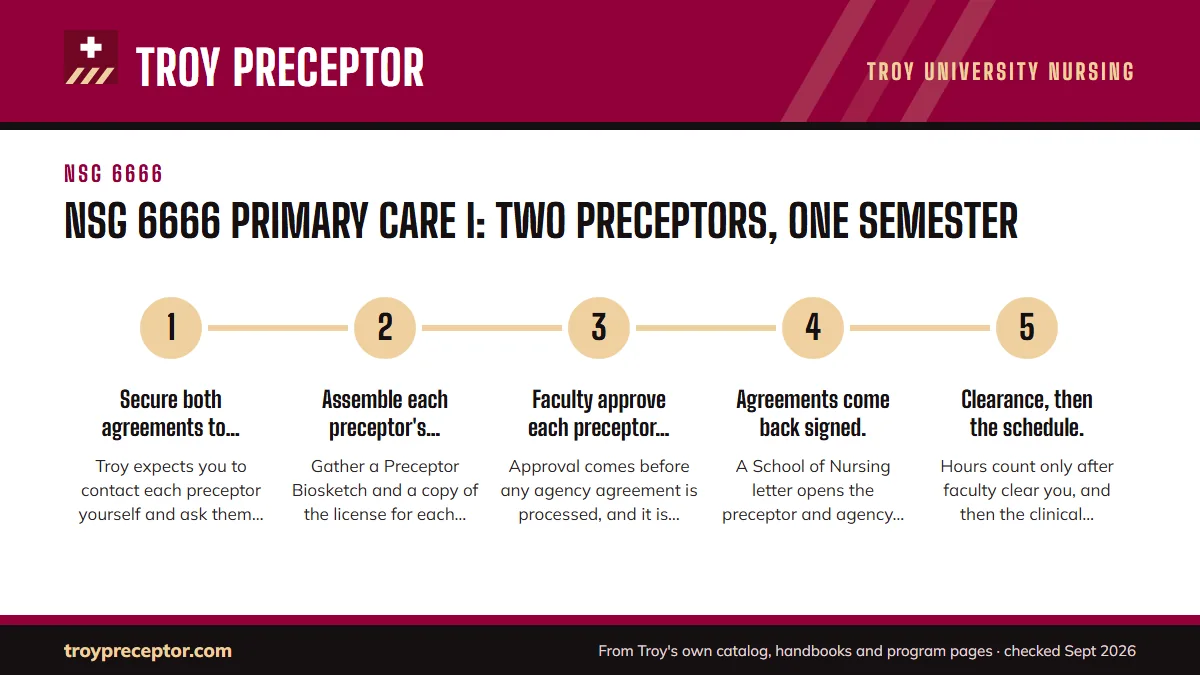
- Secure both agreements to serve.Troy expects you to contact each preceptor yourself and ask them to precept. Confirm both before you send anything to your faculty advisor.
- Assemble each preceptor's package.Gather a Preceptor Biosketch and a copy of the license for each preceptor, and complete the typed Preceptor Information Form the way your faculty advisor asks for a two-preceptor course. The fields are covered on the Preceptor Information Form guide.
- Faculty approve each preceptor and setting.Approval comes before any agency agreement is processed, and it is given per preceptor and per setting.
- Agreements come back signed.A School of Nursing letter opens the preceptor and agency agreements. Two preceptors at two agencies can mean two sets, and an agency with no formal contract takes longer (agency agreements).
- Clearance, then the schedule.Hours count only after faculty clear you, and then the clinical schedule form lists both preceptors' dates.
Troy does not process incomplete forms. A missing license copy for your second preceptor can stall the whole NSG 6666 submission.
Reuse and variety across Primary Care I and II
Troy caps each preceptor and each site at two uses in the whole program and wants you to see a range of preceptors and settings. NSG 6666 spends two of your preceptor choices in one semester, so it helps to plan it together with NSG 6668, the adult and geriatric course that follows.
A family practice preceptor who sees all ages could serve in both primary care courses, but the second course would be that preceptor's last with you, and your faculty advisor still judges whether the mix is varied enough. The limit and the employer rule are laid out on work setting and reuse rules.
DNP FNP students should note one difference. The MSN manual's bar on related preceptors does not appear in the DNP manual's FNP list, so check with your faculty advisor before assuming either version applies to you.
Two NSG 6666 preceptors, found together
Recruiting one preceptor takes real time in a busy semester; recruiting two, with different specialties, while logging NSG 6619 hours is a heavy load to carry alone. We run both searches at once, in your own area, and look for preceptors whose practices together cover pediatrics and women's health with room for 180 hours.
Each candidate is checked against Troy's FNP standard, your workplace and the twice-per-program limit before you ever make the ask. Both biosketches and license copies land with you before the one-month mark, and you know early if either site needs a new formal contract. Troy faculty decide on both preceptors and both settings; we see to it that each file reaches them complete and in line with the manual. Send us your details through the form below.
Questions Troy students ask
Does Troy's NSG 6666 really need two preceptors?
Yes. Troy's MSN Student Orientation Manual, in item 10 of its preceptorship guidelines, says Primary Care I needs two. The manual leaves the split of the 180 hours to the course, so ask your course faculty how they expect the time divided and whether each preceptor should cover one population.
How many clinical hours is NSG 6666?
180 hours for 3 semester hours in the MSN manual, echoed by the DNP manual's course list. Elsewhere the DNP manual's progression section sets 135 hours for each early FNP course, a gap worth raising with your faculty advisor before you schedule. The 780-hour FNP page walks through both.
Can a nurse midwife precept NSG 6666?
Yes. Troy's MSN and DNP manuals list nurse midwives among the professionals who may precept FNP students, and the Preceptor Biosketch carries a CNM box for that credential. The midwife's practice still has to be outside a hospital setting for this course and outside the area where you work.
Can my NSG 6619 preceptor also precept NSG 6666?
Troy permits two uses of any preceptor or site across the program, so it can work if that practice fits pediatrics or women's health and faculty approve it. It would be that preceptor's second and final use, and you would still need a second preceptor for the course.
When should I start looking for NSG 6666 preceptors?
Before the semester begins. Under the MSN manual the forms are due a month into the course; under the DNP manual, by the drop date. Troy sets no lead time in weeks, but it warns that agencies without a formal contract take longer, so begin while NSG 6619 is still running.
Related pages
Last checked 2026-09-27
We check these pages against Troy's own 2026-27 MSN, DNP, AMSN and RN to BSN orientation manuals, program pages, degree maps and state authorization pages. Your faculty advisor, your course faculty and the School of Nursing have the final word.
Troy asks you to recruit your preceptor. We make that the easy part.
Tell us your Troy program, where you live and which semester your next clinical course starts. We find preceptors who meet Troy's rules for the course, check the setting against Troy's limits, and prepare everything the Preceptor Information Form and biosketch ask for, well ahead of the form deadline.
- Preceptors matched to the course: a graduate-prepared NP or physician for
NSG 6619, pediatrics and women's health forNSG 6666, adults and older adults forNSG 6668 - Preceptor Information Form details, a biosketch and a copy of the preceptor's license, ready for your faculty advisor
- In your own area, in Alabama or a state where Troy can offer clinicals, never in your own work setting
Start your placement plan
Program, city and semester is all we need to begin.