Who pays for what in a Troy University clinical placement
Under Troy University's manuals, the student carries most clinical expenses: the ViewPoint Screening package and the yearly checks and screens, APEA and Shadow Health in the FNP, a lab fee attached to each clinical course starting Fall 2026, and every trip to the site. Professional liability insurance is the one item Troy's documents disagree on. Below, each item is matched to whoever pays it, and Troy's manuals carry the current amounts.
Get your placement plan
Tell us your Troy program and where you live. A placement advisor replies with the preceptor and site options that fit your Troy course.
The short list: who covers each item
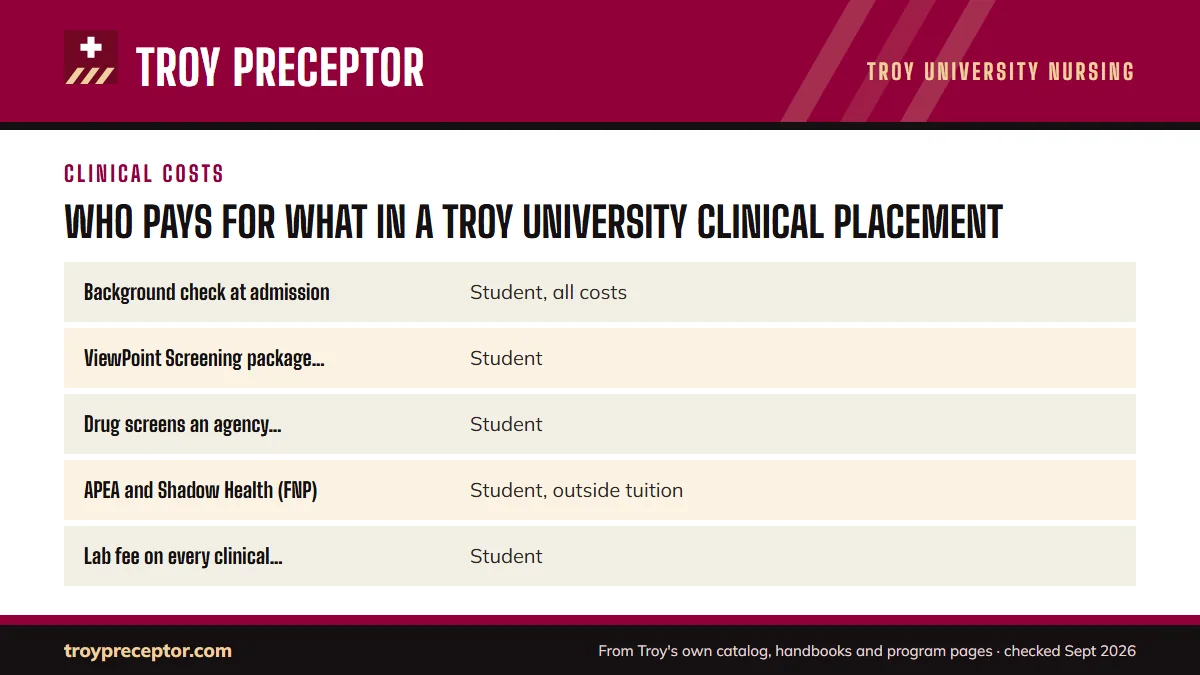
Troy's 2026-27 MSN Student Orientation Manual carries most of this information in its fees, background check and drug screen sections, with the RN to BSN manual and the DNP manual filling the gaps. Because amounts shift between academic years, the table gives the payer and the source instead of a figure.
| Item | Who pays | Where Troy says so |
|---|---|---|
| Background check at admission | Student, all costs | MSN manual, Criminal Background Check |
| ViewPoint Screening package, then a yearly check and drug test | Student | MSN manual, clinical requirements |
| Drug screens an agency requires, screens for cause, and retests | Student | MSN manual, Drug Screen Policy |
| APEA and Shadow Health (FNP) | Student, outside tuition | MSN manual, Fees |
| Lab fee on every clinical course, from Fall 2026 | Student | MSN manual, Fees |
RN to BSN clinical course fee for NSG 3310, NSG 4411 and NSG 4431 | Student | RN to BSN manual, Program Cost |
| Transportation, meals and overnight stays for clinicals | Student | MSN manual |
| Health insurance, with proof each clinical semester | Student's own coverage; coverage through TROY is available | MSN manual |
| Professional liability insurance | Troy's documents conflict | DNP manual against MSN manual |
Compliance costs: ViewPoint, checks and screens
Admission to Troy's graduate nursing programs is pending a background check, and every cost of it falls to the student. Before your first clinical experience you buy the ViewPoint Screening package, which covers the background check, the drug test collected by Quest and the health portal that stores your documents. After that, the check and the drug test repeat every year at your expense.
Extra testing lands on the same bill. A clinical agency's affiliation agreement can call for further drug testing, faculty can require a screen for cause, and retests follow the same rule. The MSN program web page lists different vendors, LabCorp for the drug test and Certified Background for verification, a conflict covered on the ViewPoint Screening guide; either way, the student is the payer.
The rest of the compliance list, from titers, the yearly flu shot and TB testing to the annual physical on Troy's form and a hands-on CPR card, goes into ViewPoint too. Troy's manuals require these items without listing them among Troy charges, so you obtain each one yourself and upload the proof.
Course charges: the lab fee, APEA and Shadow Health
From Fall 2026, Troy charges a lab fee on all clinical courses, per the Fees section of the MSN manual. In the RN to BSN, the program's own manual lists a clinical course fee for its three practicums, NSG 3310, NSG 4411 and NSG 4431, under Program Cost.
FNP students also pay for APEA, which Troy requires as nurse practitioner certification preparation, and for Shadow Health, both billed outside tuition. The MSN manual bundles APEA by clinical semester: NSG 6619 in semester one, then NSG 6665, NSG 6667 and NSG 6670 in semesters two to four. The online student systems page explains what each platform does.
These charges attach to the course itself, not to the preceptor or site you choose. Where you train changes your travel bill; it does not change what Troy charges for the course.
Insurance: health coverage and the liability conflict
Health insurance is required before clinical courses, and proof is resubmitted every semester you are in one. If you lack a plan, the MSN manual points to coverage offered through TROY.
Professional liability insurance is where Troy's documents part ways. According to the 2026-27 DNP manual, Troy University supplies it. Neither the 2026-27 MSN manual nor the MSN web page mentions it. The 2025-26 Graduate Catalog puts it on the list of items clinical students must keep current and says a policy can be had through the School of Nursing, and the 2021-22 catalog described it as required and offered through the School.
Ask your faculty advisor whether your track needs a policy and whether Troy's coverage applies to you before a clinical agency asks for proof. The requirement itself is covered in physical exam, CPR and insurance.
Liability coverage differs by document: the DNP manual says Troy provides it and the MSN manual is silent. Get your faculty advisor's answer before an agency asks.
Travel, time and the price of delay
Transportation, meals and any overnight stays for clinicals are the student's to pay. That makes a preceptor's location a money decision as well as a scheduling one: a practice an hour away, visited twice a week across a 180-hour primary care course, adds up. A site across a state line adds the work of licensure in that state, which Troy needs to see before it processes the request.
The quieter cost is time. If your Preceptor Information Forms miss the deadline, Troy requires you to withdraw from both the clinical course and its paired co-requisite. Troy offers each FNP-specific course once a year, in a fixed order, so one dropped course can delay every course after it by a year. The delayed graduation page covers what that means in practice.
Troy's fee lists include compliance, courses and exam preparation, and none of them covers finding a preceptor, because Troy's manuals make contacting preceptors the student's job. Troy's documents also describe no payment or benefit for preceptors.
What shapes the price of our service
Our service sits beside Troy's charges as a separate choice. We quote once we know what you need, and our cost guide walks through the factors behind a quote. The main factors are your course and track, the number of preceptors (two for NSG 6666), your area and any state step in Troy's table, and the time left before your form deadline.
The quote covers the full search and preparation: preceptors who meet Troy's rule for your course, screened against your work setting and the twice ceiling; everything Troy's preceptor paperwork calls for; an early flag when a site needs a new formal contract; and a fresh search for a stand-in if your preceptor withdraws. A nearby preceptor also trims the travel line in the table above. Ask for a quote through the form below.
Questions Troy students ask
Does Troy charge a clinical placement fee?
Troy's manuals list charges for compliance screening, clinical courses and FNP exam preparation, but nothing for finding a preceptor, because they make contacting preceptors the student's job. The listed items are the ViewPoint Screening package, the lab fee on clinical courses from Fall 2026, the RN to BSN clinical course fee, and APEA and Shadow Health.
Do Troy nursing students cover their own background check and drug test?
The student. Admission is pending a background check whose costs are yours, the ViewPoint Screening package covers the first check and drug test, and both repeat every year at your expense. Drug screens a clinical agency requires, screens for cause and retests are also charged to the student.
Are APEA and Shadow Health included in Troy's tuition?
No. Troy's MSN manual lists APEA and Shadow Health as FNP fees outside tuition. APEA is required as nurse practitioner certification preparation and is bundled by clinical semester, beginning with NSG 6619. The manual prints the current amounts for each semester's bundle.
Is malpractice coverage part of Troy's clinical package?
That depends on which Troy document you read. For DNP students, the current DNP manual says Troy University provides the coverage. For MSN students, neither the manual nor the program web page mentions it, while the previous year's graduate catalog described a policy offered through the School of Nursing. Settle it with your faculty advisor for your own track.
Who pays for travel to clinical sites at Troy?
You do. Troy's MSN manual lists transportation, meals and any overnight stays for clinicals among the costs students carry. A preceptor near home shrinks that expense, so our searches begin in your own area and weigh the drive before any site is proposed.
Related pages
Last checked 2026-09-27
We check these pages against Troy's own 2026-27 MSN, DNP, AMSN and RN to BSN orientation manuals, program pages, degree maps and state authorization pages. Your faculty advisor, your course faculty and the School of Nursing have the final word.
Troy asks you to recruit your preceptor. We make that the easy part.
Tell us your Troy program, where you live and which semester your next clinical course starts. We find preceptors who meet Troy's rules for the course, check the setting against Troy's limits, and prepare everything the Preceptor Information Form and biosketch ask for, well ahead of the form deadline.
- Preceptors matched to the course: a graduate-prepared NP or physician for
NSG 6619, pediatrics and women's health forNSG 6666, adults and older adults forNSG 6668 - Preceptor Information Form details, a biosketch and a copy of the preceptor's license, ready for your faculty advisor
- In your own area, in Alabama or a state where Troy can offer clinicals, never in your own work setting
Start your placement plan
Program, city and semester is all we need to begin.