Your preceptor pulled out mid-semester: what Troy needs from you now
When a preceptor leaves partway through a Troy University clinical course, the hours already done and the weeks left both become urgent at once. Troy's manuals offer no shortcut for a replacement: the new preceptor goes through the same form, approval, agreements and clearance as the first. Moving on day one is what keeps the course alive.
Get your placement plan
Tell us your Troy program and where you live. A placement advisor replies with the preceptor and site options that fit your Troy course.
The first message goes to faculty
Troy's MSN manual wants faculty informed immediately whenever your clinical schedule changes, and a departing preceptor changes all of it. Email your course faculty and faculty advisor the same day with the date of your last shift, the hours you completed with that preceptor, and the dates on your clinical schedule form that will no longer happen.
There is a second reason to move quickly. Faculty may check on you unannounced, whether by phone, by video or at the site, and missing a scheduled shift while a visit happens earns a zero on the clinical evaluation. A schedule that still lists shifts with a departed preceptor stays a risk until faculty know it has changed. Our page on schedules and site visits explains how those visits work. Keep your own dated record of every hour completed so far.
What carries over and what starts again
Some things are untouched by a preceptor leaving. Your enrollment in the course, your ViewPoint Screening compliance and your RN license all stand. Hours completed after faculty cleared you, with an approved preceptor, were earned under Troy's rules; how they combine with the rest of the course is a question for course faculty, so put it in that first message.
Other things restart. The new preceptor needs their own Preceptor Information Form, biosketch and license copy, their own faculty approval and their own agreement. Until faculty clear you to work with the new preceptor, the hours you complete do not count toward the course, even at the same site. The clinical schedule form starts over too, built around the new preceptor's availability.
The replacement path, step by step
Treat the replacement as a new placement with a shorter runway. Each step depends on the one before it.
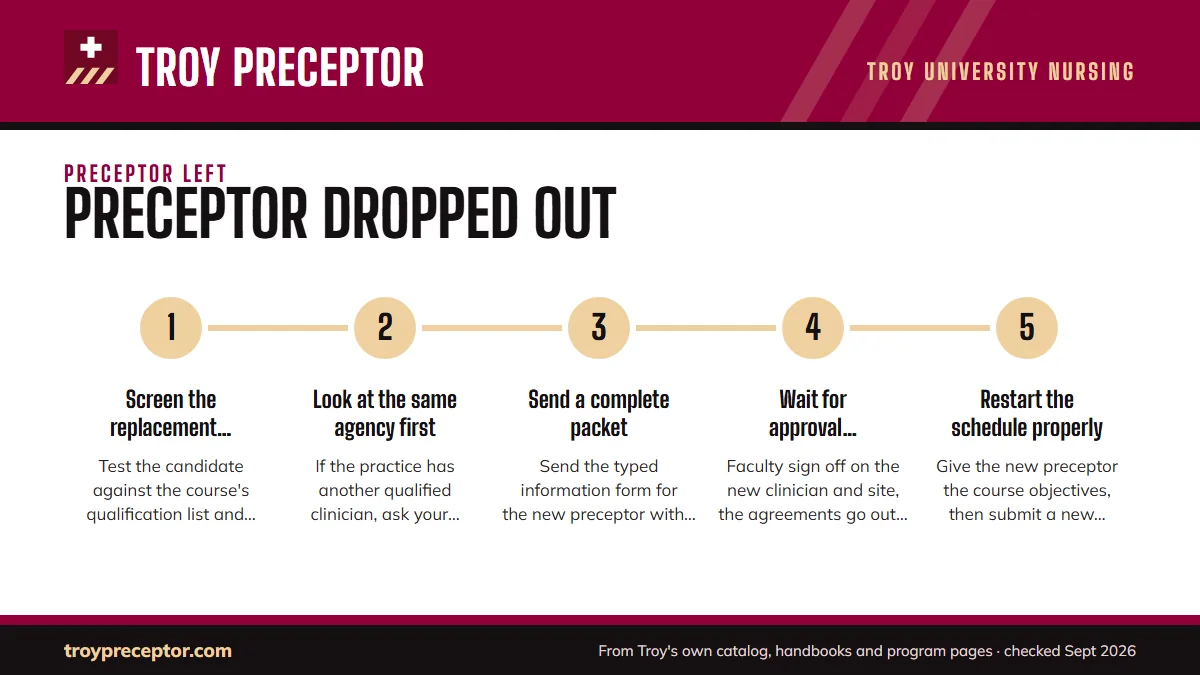
- Screen the replacement before you askTest the candidate against the course's qualification list and your place of work, and count every past preceptor and site, including the one who just left. Troy allows no preceptor or site more than twice in the program; the reuse rules page has the detail.
- Look at the same agency firstIf the practice has another qualified clinician, ask your faculty advisor whether the agency agreement already on file shortens the path. The new preceptor still needs approval and an agreement of their own.
- Send a complete packetSend the typed information form for the new preceptor with their biosketch and license copy in one email; Troy sets incomplete forms aside.
- Wait for approval, agreements and clearanceFaculty sign off on the new clinician and site, the agreements go out under a School of Nursing letter, and faculty then clear you. See approval and clearance for how those steps differ.
- Restart the schedule properlyGive the new preceptor the course objectives, then submit a new clinical schedule form once they approve your dates.
Special cases that make it harder
A few Troy rules turn a routine replacement into a harder one. Check whether any of them apply to you:
NSG 6666needs two preceptors. Losing one leaves you short of what the course requires even if the other stays, so check with course faculty before assuming the remaining preceptor can cover the rest.- FNP students before
NSG 6680cannot move to a hospital setting to finish their hours, however many shifts an inpatient unit could offer. - A replacement across a state line has to wait until you hold that state's RN license.
- HINL students have more room, since Troy lets HINL practicums run in any setting outside the student's own work area.
- RN to BSN students file a fresh acknowledgement form from Canvas for the new preceptor, and lead faculty approve it.
If the semester runs out before the hours do
Every clinical hour has to land within the enrolled course's own dates, never in a break between semesters, so the calendar sets a hard edge. If a replacement is approved late, the hours left may not fit before the last official day.
Troy's 2025-26 Graduate Catalog gives three routes when that happens. Practicum and internship courses can carry an In-Progress (IP) grade, with one calendar year allowed to clear it. An Incomplete can be requested on the Incomplete Grade Request form when documented circumstances beyond your control get in the way, and it carries its own deadline. A drop is possible up to the point 65% of the way through the course. Each has costs, and our page on falling behind on hours compares them side by side.
How we replace a Troy preceptor mid-semester
A mid-semester replacement is a race against the calendar, and we start it the day you tell us. We recruit nearby clinicians who fit your course, rule out your employer's settings and anyone Troy's two-use cap would block, and put first the ones whose calendars can absorb your remaining hours.
We assemble the replacement's paperwork details so the faculty advisor sees no gaps, and tell you straight away if the new agency may need its own formal contract with Troy. Troy faculty decide on the replacement; we make sure what they review already meets the course. Tell us your course, the hours left and your semester end date in the form below.
Questions Troy students ask
Do the hours I completed with my first preceptor still count?
Hours completed after faculty cleared you, with an approved preceptor, were earned under Troy's rules. Troy's manuals do not spell out a procedure for a preceptor who leaves mid-course, so ask course faculty in writing how those hours carry into the rest of the course, and keep your own dated record of each one.
Is there a deadline for a replacement preceptor's form?
The manuals set form deadlines by course: the last drop day for NSG 6619 and DNP courses, and one month after the first class day for later MSN clinical courses. They describe no separate date for replacements, so ask your faculty advisor which date applies and send the complete packet as fast as you can.
Can another provider at the same clinic simply take over?
Only after faculty approve them. Troy requires faculty approval of every preceptor, so a colleague who steps in still needs a Preceptor Information Form, biosketch and license copy of their own, and you need clearance before hours with them count. The existing agency agreement may help the timing, so ask.
Does the preceptor who left count toward the twice-per-program limit?
Troy's manuals cap each preceptor and site at two uses across the program without defining a partial use. Treat the departed preceptor and their site as used, and confirm with your faculty advisor before planning to return to either one in a later course.
Could a preceptor leaving hurt my clinical evaluation?
What matters most is keeping faculty informed. A student absent on a scheduled date during a faculty site visit receives a zero clinical evaluation, and the MSN manual requires you to report any schedule change at once. Reporting the departure the same day keeps your record accurate while the replacement comes together.
Related pages
Last checked 2026-09-27
We check these pages against Troy's own 2026-27 MSN, DNP, AMSN and RN to BSN orientation manuals, program pages, degree maps and state authorization pages. Your faculty advisor, your course faculty and the School of Nursing have the final word.
Troy asks you to recruit your preceptor. We make that the easy part.
Tell us your Troy program, where you live and which semester your next clinical course starts. We find preceptors who meet Troy's rules for the course, check the setting against Troy's limits, and prepare everything the Preceptor Information Form and biosketch ask for, well ahead of the form deadline.
- Preceptors matched to the course: a graduate-prepared NP or physician for
NSG 6619, pediatrics and women's health forNSG 6666, adults and older adults forNSG 6668 - Preceptor Information Form details, a biosketch and a copy of the preceptor's license, ready for your faculty advisor
- In your own area, in Alabama or a state where Troy can offer clinicals, never in your own work setting
Start your placement plan
Program, city and semester is all we need to begin.