NSG 6619, the first FNP preceptorship at Troy University
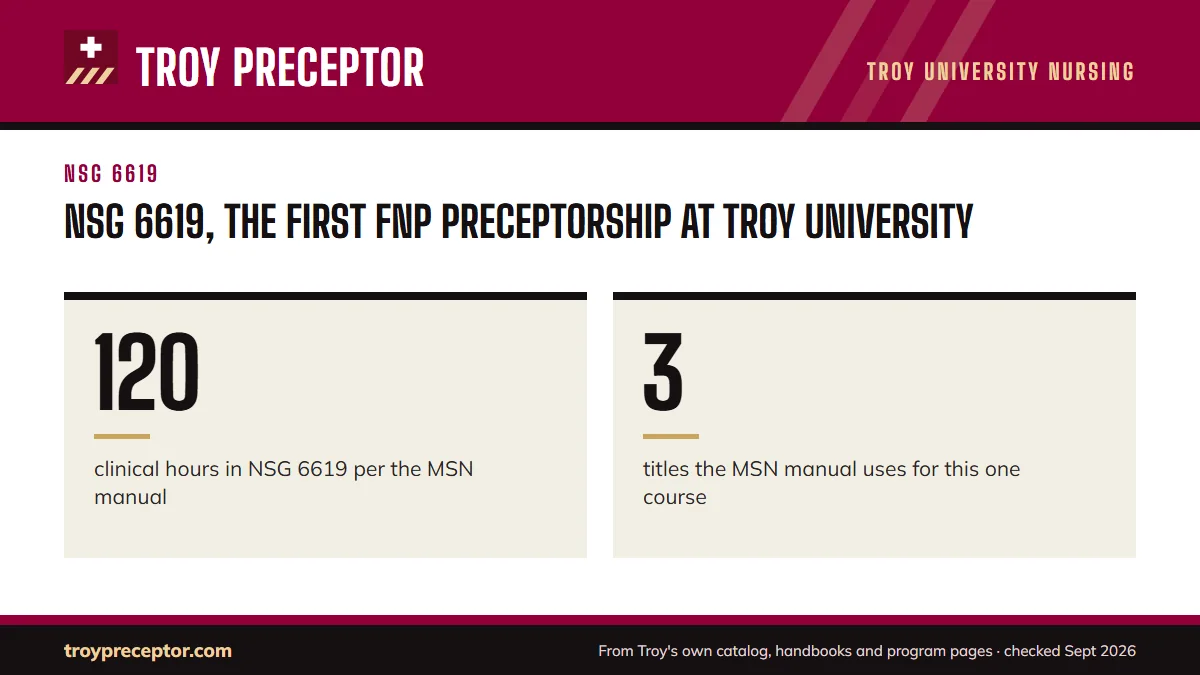
NSG 6619 is where Troy University FNP students first work beside a preceptor: 3 semester hours and 120 clinical hours of head-to-toe examinations, taken in Fall. Two pharmacology and pathophysiology courses come first or alongside it, its preceptor forms run on a different deadline from later MSN clinical courses, and Troy's own manual gives it three titles.
Find your NSG 6619 preceptor
Tell us where you live and which Fall you start the course.
What NSG 6619 covers and who takes it
Troy's MSN Student Orientation Manual describes NSG 6619 as a 3-credit, 120-hour preceptorship built around head-to-toe examinations. It is the first of four FNP preceptorships, and everyone on the FNP pathway takes it: MSN and post-master's certificate students, plus DNP students who entered after the BSN and chose the FNP track. Because FNP courses run once a year in a fixed sequence, NSG 6619 sets the pace for the three that follow.
The detailed objectives come from your course faculty. Troy asks you to hand those objectives to your preceptor before the first shift, and once the preceptor agrees to the dates, you file the clinical schedule form.
The first semester also brings the FNP study tools. Troy requires APEA as certification preparation and ties the first APEA semester to NSG 6619, Shadow Health is FNP courseware billed outside tuition, and a lab fee applies to every clinical course from Fall 2026. What each costs a student is covered on placement costs.
One course, three titles
The 2026-27 MSN manual refers to NSG 6619 under three different names, and older Troy documents use a different course number altogether. The table shows where each version appears.
| Where it appears | Course name |
|---|---|
| MSN manual, Academic Advisement | NSG 6619 Advanced Clinical Examination and Diagnostic Reasoning |
| MSN manual, Guidelines for Preceptorship/Internship Courses | NSG 6619 Advanced Health Assessment & Diagnostic Reasoning Preceptorship |
| MSN manual, Preceptor Information Form | NSG 6619 Advanced Health Assessment and Diagnostic Reasoning |
| 2024-25 catalog and the 2018 Preceptor Information Form | NSG 6613 Advanced Health Assessment Preceptorship |
All three current names belong to the same course number. When you approach a preceptor or complete the Preceptor Information Form, lead with NSG 6619 and use the form's own wording for the title. A mention of NSG 6613 in an older document refers to the earlier health assessment preceptorship that NSG 6619 replaced.
Prerequisites: NSG 6649 and NSG 6671
The MSN manual lists NSG 6649 Advanced Pharmacology and NSG 6671 Advanced Pathophysiology as prerequisites or co-requisites for NSG 6619, and states that no exceptions are made. Plan both into or before your first Fall; a gap here holds up the preceptorship and everything behind it.
Troy's APEA fee list muddies the names slightly, pairing a Pathophysiology QBank with NSG 6649 and a Prescribing QBank with NSG 6671, the reverse of the manual's text. Register by course number, and if the titles in your plan look swapped, ask your faculty advisor to confirm.
Registration has one more rule. Paired didactic and preceptorship courses go into Student Self-Service together, in one submission, so check the pairing for your cohort before you submit.
A later deadline that still runs tight
The MSN manual sets the NSG 6619 form deadline at the last date Troy allows a drop without academic penalty, while each later MSN clinical course gets a month from its first class day. Doctoral students work to that same drop date in every course, so this is the one FNP course where the two manuals line up. The full comparison is on form deadlines.
On paper that is generous: Troy's graduate catalog sets the last drop day at 65% of a course's length. In practice, hours only count after faculty approve the preceptor, the agreements come back and you are cleared. Forms sent near the drop date leave roughly a third of the semester for 120 hours, which in a 16-week semester is under six weeks, or more than 20 hours a week.
Missing it has a hard consequence under the MSN manual: you must withdraw from both the clinical course and its co-requisite, or faculty withdraw you.
The NSG 6619 deadline is the last drop day, but hours before clearance do not count. Aim to have your preceptor approved in the first weeks of Fall, not at the deadline.
Compliance and your license come first
In the FNP sequence, NSG 6619 is the first course that needs the full compliance file in place, so it is worth finishing well before you contact preceptors. Troy wants the background check done before your first clinical experience, and every document in ViewPoint Screening must stay current from registration day to the final day of the semester. ViewPoint Screening lists each upload.
Your RN license matters just as early. Troy needs it unencumbered, and valid in whichever state your hours take place, and a preceptor request in another state waits until you show that state's license. The detail is on RN license for clinicals. If your clinicals will be outside Alabama, check where Troy can offer them on clinicals by state before you start calling practices.
Choosing a preceptor for head-to-toe exams
Troy's FNP preceptor standard applies from this first course. That means a graduate-prepared NP holding NP licensure where they practice and a minimum of one year in the NP role; physicians with an MD or DO, nurse midwives and PAs qualify too. The MSN manual rules out relatives. The full standard is on FNP preceptor requirements.
The setting has limits too. FNP students have no hospital hours before NSG 6680, and your own employer's unit is off the table in every course.
Think one course ahead when you choose. Troy lets a preceptor or site appear at most twice across the program and expects variety, so a strong NSG 6619 preceptor whose practice also sees adults and older adults could return once for NSG 6668. The limit is explained on work setting and reuse rules.
Your first Troy preceptor, found and ready early
We treat NSG 6619 as the course that sets up the whole FNP sequence. We find a preceptor in your own area who meets Troy's FNP standard, has the clinic days to carry 120 hours and practices outside your workplace, and we note whether the same practice could fit a later course.
Everything the Preceptor Information Form needs, along with the Preceptor Biosketch and the license copy, comes to you ahead of the drop date, so your advisor can act and clearance can land early in the semester. Should the practice need a fresh formal contract with Troy, you know at the outset. The approval decision belongs to Troy faculty; our job is a submission that arrives whole, accurate and within the manual's rules, so it does not bounce back. Use the form below to begin.
Questions Troy students ask
Is NSG 6619 the same course as NSG 6613 at Troy?
NSG 6613 Advanced Health Assessment Preceptorship appears in the 2024-25 catalog and a 2018 Troy preceptor form. Troy's 2026-27 manuals use NSG 6619 for the first FNP preceptorship in its place. If your transcript or plan shows NSG 6613, ask your faculty advisor how it maps to your current program of study.
How many clinical hours is NSG 6619?
120, according to the MSN manual and the course list in the DNP manual. Another part of the DNP manual, its Post BSN-DNP Progression section along with item 11, sets 135 hours apiece for the opening three FNP preceptorships. Ask your faculty advisor which applies to your section; the 780-hour FNP page explains the gap.
Can I take NSG 6619 in Spring instead of Fall?
Fall is the semester Troy's MSN manual assigns to NSG 6619, and each FNP-specific course is offered only once a year, in order. Students who start in Spring or Summer take longer than the five-semester minimum. The semester planner in Canvas shows where NSG 6619 falls for your start and your full-time or part-time status.
Can NSG 6619 hours take place in a hospital?
No. Troy's MSN manual allows FNP students no hospital-setting hours until NSG 6680, the FNP Internship. For NSG 6619, look for a practice outside the hospital and outside the area where you are employed, with a preceptor who has room for 120 hours in the semester.
Who approves my NSG 6619 preceptor?
Your course faculty, acting as your faculty advisor, sign off on the preceptor and on the setting; no agency agreement moves until they do. Next the School of Nursing mails a letter to open the preceptor and agency agreements, and your hours can begin once faculty clear you.
Related pages
Last checked 2026-09-27
We check these pages against Troy's own 2026-27 MSN, DNP, AMSN and RN to BSN orientation manuals, program pages, degree maps and state authorization pages. Your faculty advisor, your course faculty and the School of Nursing have the final word.
Troy asks you to recruit your preceptor. We make that the easy part.
Tell us your Troy program, where you live and which semester your next clinical course starts. We find preceptors who meet Troy's rules for the course, check the setting against Troy's limits, and prepare everything the Preceptor Information Form and biosketch ask for, well ahead of the form deadline.
- Preceptors matched to the course: a graduate-prepared NP or physician for
NSG 6619, pediatrics and women's health forNSG 6666, adults and older adults forNSG 6668 - Preceptor Information Form details, a biosketch and a copy of the preceptor's license, ready for your faculty advisor
- In your own area, in Alabama or a state where Troy can offer clinicals, never in your own work setting
Start your placement plan
Program, city and semester is all we need to begin.