Troy's post-master's FNP and HINL certificates: MSN clinicals, shorter coursework
If you already hold a master's, Troy University's post-master's certificates put you in the same clinical courses as MSN students, under the same MSN Student Orientation Manual 2026-27 sentence: "Students must contact preceptors to ask them to serve in that capacity; faculty must approve all preceptors." The coursework is shorter, the clinical hours are not. We find the preceptors for each certificate course and keep them inside Troy's rules.
Get your placement plan
Tell us your Troy program and where you live. A placement advisor replies with the preceptor and site options that fit your Troy course.
Two certificates, the MSN's clinical hours
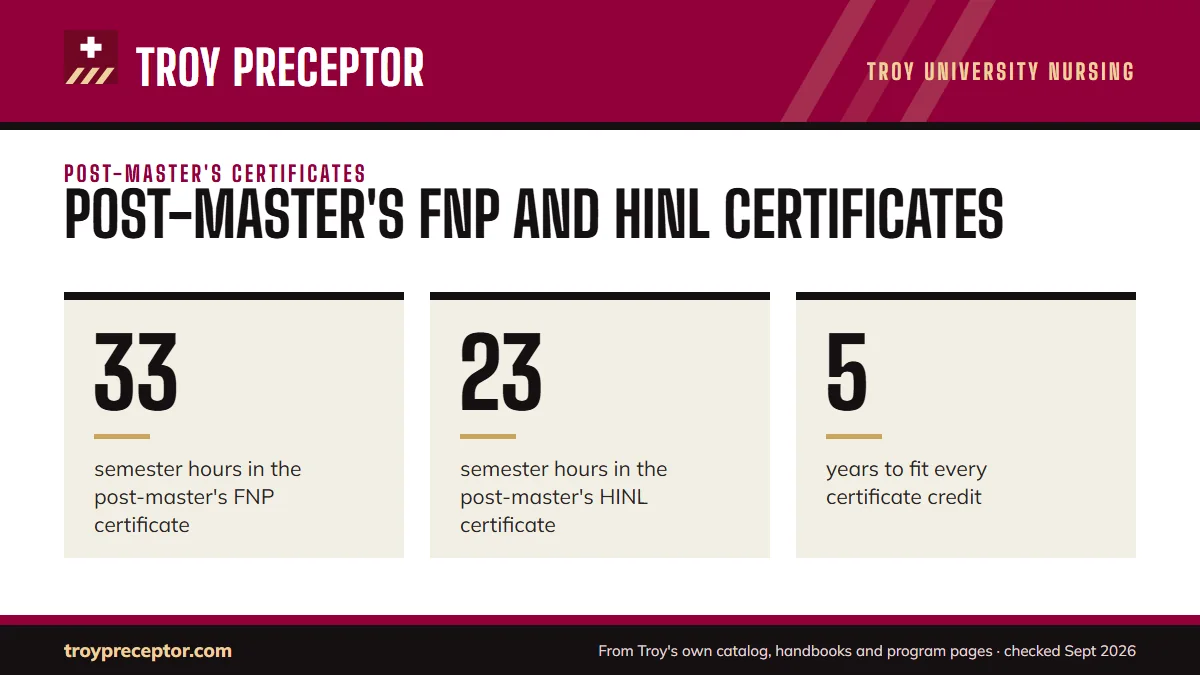
Troy offers three online post-master's certificates, and two of them mirror an MSN track. The FNP and HINL certificates carry fewer credits than their MSN tracks, but each keeps every hour of the matching MSN clinical load.
| Certificate | Certificate credits | MSN track credits | Clinical hours | Practicum courses |
|---|---|---|---|---|
| Post-master's FNP | 33 | 47 | 780 | NSG 6619, NSG 6666, NSG 6668, NSG 6680 |
| Post-master's HINL | 23 | 37 | 480 | NSG 6630, NSG 6636, NSG 6637 |
| Post-master's Nursing Education | 15 | No MSN track | 180 | NSG 6676 |
The MSN manual says FNP certificate students take the clinical courses alongside MSN students. The award is a certificate rather than a second degree, and certificate students do not take part in graduation ceremonies. The Nursing Education certificate follows a different pattern, with a single educator preceptorship, and has its own guide.
How certificate students fit into Troy's system
Troy treats certificate students as their own group in the paperwork. The Preceptor Information Form carries a PMC checkbox, so mark it each time you submit, and Troy assigns faculty advisors by track (FNP, HINL or post-master's certificate) and by nearest campus. Your advisor receives your preceptor documents and is the first person to ask about your plan of study.
Two time rules matter. The MSN manual requires every credit to fall within five years of certificate completion, and the 2025-26 Graduate Catalog gives five semesters for the post-master's FNP certificate. That catalog also sets the licensing condition for the FNP certificate: an unencumbered RN license for whichever state will host your clinical experiences.
Each certificate's complete course list is printed in the Graduate Catalog, while your advisor signs off on the plan of study itself. Clinical courses are a different matter: the hour totals match the MSN tracks exactly, so plan on completing every preceptorship listed in the table above.
The FNP certificate's four preceptorships
FNP certificate students move through the same fixed sequence as MSN students. NSG 6619 comes first, in Fall, and needs NSG 6649 and NSG 6671 as prerequisites or co-requisites with no exceptions, so ask early how your plan handles pharmacology and pathophysiology. NSG 6666 follows with two preceptors across pediatrics and women's health, then NSG 6668 for adults and older adults, then the 300-hour NSG 6680 internship, the first course where hospital-setting hours are allowed.
Because each FNP course is offered only annually and no FNP clinical course runs in summer, one semester without a preceptor can push the rest of the sequence back a full year. Preceptor qualifications match the MSN track exactly and are set out on FNP preceptor requirements; the MSN side of the same path is on the MSN FNP guide.
The HINL certificate's three practicums
The HINL certificate carries NSG 6630 (120 hours), NSG 6636 (180 hours) and NSG 6637 (180 hours), matching the MSN track's 480. Its preceptors qualify through one of four informatics or leadership routes in the MSN manual: two at the master's level, and two at the bachelor's level that call for years of experience in the field.
The HINL courses accept any setting apart from your own work area. That exception matters more for certificate students than most, because a nurse returning for a second credential may already work in informatics or leadership. Ask your faculty advisor where your employer's boundary sits before you approach a colleague.
Course-by-course detail, including what each internship covers, is on the HINL practicums guide.
Rules that apply to certificate and MSN students alike
- ViewPoint Screening clearance before anything else, with every document still current on the last day of the semester.
- RN licensure in the clinical state; Troy holds an out-of-state preceptor request until it sees that state's license.
- A complete document set for your faculty advisor: Preceptor Information Form, Biosketch and license copy.
- Paperwork deadlines tied to the drop date for
NSG 6619and to the first month of class for other MSN clinical courses. - A two-use ceiling on any preceptor or site, and nothing in your own workplace.
- Hours count only after faculty clearance, and never during breaks between semesters.
Each item has its own page on this site; start with the license rule if you plan clinicals outside the state where you hold your license.
A preceptor from your first master's is not automatically a fit. Credential rules, the employer rule and the two-use ceiling all apply, so check with your faculty advisor how earlier placements count before relying on one.
Certificate or post-master's DNP?
Nurses with a master's sometimes weigh a certificate against Troy's DNP. The two entry routes differ. The post-master's DNP starts with 8000-level synthesis courses and expects certification in a clinical specialization (CNS, NP or CRNA). A master's in a non-clinical nursing area enters the DNP by adding the FNP or Nurse Leader track, with up to 12 hours credited, and someone whose master's is outside nursing starts the DNP at the post-BSN entry point.
Whichever road leads toward FNP practice, the four FNP preceptorships are the same: the certificate and the DNP's FNP track both run NSG 6619 through NSG 6680, and the DNP adds the synthesis project and its 1,000-hour total. Admission rules for each route come from the School of Nursing and your advisor. The post-master's DNP guide covers the doctoral side.
Why certificate students choose us
If you work while you study, a preceptor search is hard to fit around your schedule, and the employer rule is easy to trip over. We run the search as the best preceptor placement service built for Troy students: preceptors in your area who meet the FNP or HINL qualification route, outside your employer's setting, and new to your record so the two-use count stays clean.
Your certificate paperwork gets the same care as an MSN student's: we collect what the information form, the biosketch and the license copy require, keep the PMC box in view, and finish well before each deadline. If a site lacks a formal contract with Troy, you know early enough for the agreement to clear. A preceptor who drops out is replaced through a fresh search right away.
Faculty at Troy hold the approval decision for each certificate preceptor and setting. Our part is making the request complete and rule-ready before it reaches them. Tell us which certificate and which state on the contact page, or through the form that closes this page.
Questions Troy students ask
Do Troy post-master's certificate students find their own preceptors?
Yes. Troy's MSN manual puts the first contact with every preceptor on the student, certificate students included, and faculty approval follows. The manual's preceptorship guidelines cover certificate students' clinical courses, and the Preceptor Information Form has a PMC box so your faculty advisor knows which program the request belongs to.
How many clinical hours are in Troy's post-master's FNP certificate?
780, the same as the MSN FNP, spread across NSG 6619, NSG 6666, NSG 6668 and the 300-hour NSG 6680 internship. A 135-hour figure for each of the first three courses appears in the DNP manual's Progression section, so confirm your numbers with your faculty advisor. The 780-hour guide compares every figure Troy has published.
Do Troy certificate students attend graduation?
No. Troy's MSN manual says the post-master's award is a certificate, not a second degree, and that certificate students do not take part in graduation ceremonies. That has no effect on the clinical side: certificate students complete the same preceptorships and hours as MSN students in the matching track.
How long do I have to finish a Troy post-master's certificate?
The MSN manual requires all certificate credits to fall within five years of completion. The 2025-26 Graduate Catalog describes the post-master's FNP certificate as five semesters. Because FNP-specific courses come around once a year, a semester lost to a missing preceptor can add a year, which is the main risk to that timeline.
Related pages
Last checked 2026-09-27
We check these pages against Troy's own 2026-27 MSN, DNP, AMSN and RN to BSN orientation manuals, program pages, degree maps and state authorization pages. Your faculty advisor, your course faculty and the School of Nursing have the final word.
Troy asks you to recruit your preceptor. We make that the easy part.
Tell us your Troy program, where you live and which semester your next clinical course starts. We find preceptors who meet Troy's rules for the course, check the setting against Troy's limits, and prepare everything the Preceptor Information Form and biosketch ask for, well ahead of the form deadline.
- Preceptors matched to the course: a graduate-prepared NP or physician for
NSG 6619, pediatrics and women's health forNSG 6666, adults and older adults forNSG 6668 - Preceptor Information Form details, a biosketch and a copy of the preceptor's license, ready for your faculty advisor
- In your own area, in Alabama or a state where Troy can offer clinicals, never in your own work setting
Start your placement plan
Program, city and semester is all we need to begin.