Reaching 1,000 clinical hours in Troy University's DNP
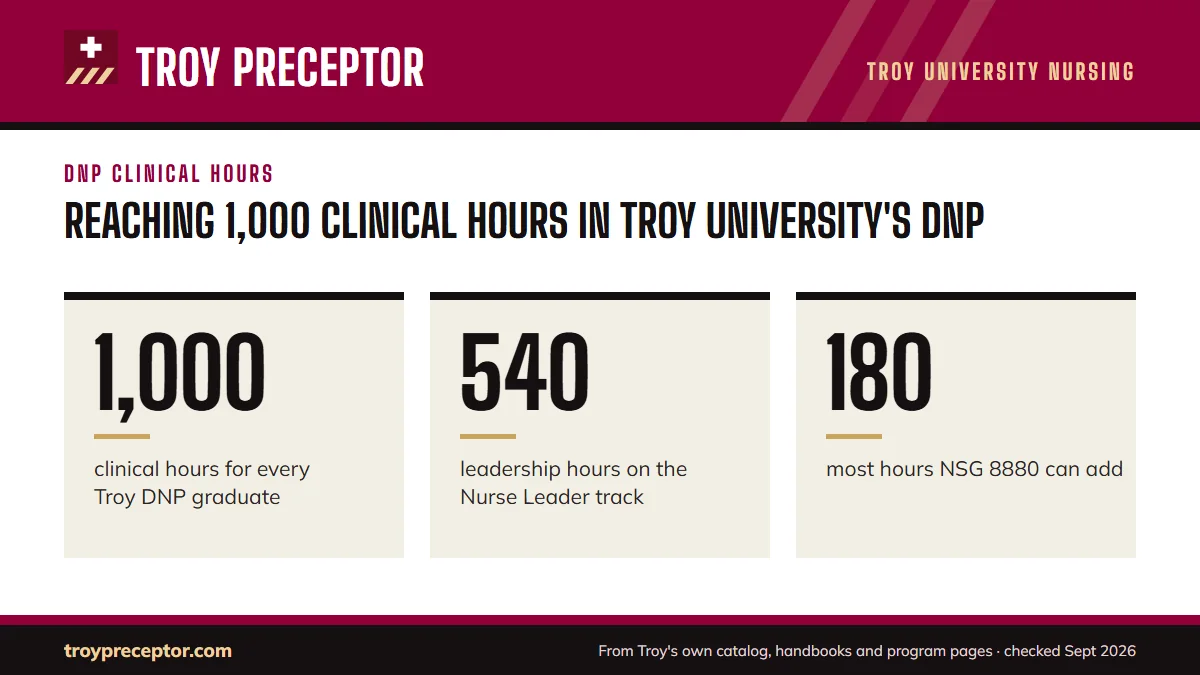
Every Troy University DNP graduate needs 1,000 clinical hours, and each entry route builds them differently. Post-BSN students start with the hours in their FNP or Nurse Leader clinical courses, post-master's students bring in hours verified from earlier graduate work, and everyone documents more in the synthesis courses, with NSG 8880 to close any gap.
Plan the hours between you and 1,000
Tell us your DNP route and how many clinical hours you have so far.
Three routes to the same total
Troy's DNP page and 2026-27 DNP manual both set the requirement at 1,000 clinical hours. What differs is where your first block of hours comes from, and so how large a balance you carry into the synthesis courses.
| Route | First block of hours | Balance by subtraction | Where the balance is documented |
|---|---|---|---|
| Post-BSN FNP track | 780 in NSG 6619, NSG 6666, NSG 6668 and NSG 6680 | 220 | NSG 8810 to NSG 8840, then NSG 8880 if still short |
| Post-BSN Nurse Leader track | 540 in NSG 6630, NSG 6636, NSG 6637 and NSG 8880 | 460 | NSG 8810 to NSG 8840 |
| Post-master's | Hours accepted on the Verification of Post-Baccalaureate Clinical Hours | Depends on your verified count | NSG 8810 to NSG 8840, then NSG 8880 at 60 hours per credit, up to 180 |
The balance column is plain arithmetic on Troy's figures, not a Troy schedule. How it spreads across the synthesis courses is something your DSP Chair and the DNP Coordinator settle with you, since the manual asks for an hours record in each one. The course sequence itself is on the DNP synthesis courses page.
Post-master's students: crediting earlier hours
For post-master's students, earlier hours arrive on one document, the Verification of Post-Baccalaureate Clinical Hours, and the DNP Program Coordinator reviews what it can credit. It belongs to the same DNP clinical requirements list as your current CNS, NP or CRNA certification, the credential post-master's entry depends on.
Your verified number sets everything that follows. Subtract it from 1,000 and you have the hours still to document in the synthesis courses and, if needed, NSG 8880. Because NSG 8880 tops out at 180 hours, a large gap is a conversation to have with the DNP Coordinator before you enroll, not in your final semester.
Gather your records early. An official statement of supervised clinical hours from your master's or post-master's program, requested before you apply, spares you a scramble when the form is due. The post-master's DNP guide covers the rest of that entry route.
NSG 8880, the Directed Professional Practicum
NSG 8880 exists to carry students who need more hours to reach 1,000. It runs from 1 to 3 semester hours, at 60 clinical hours for each semester hour.
| Credits | Clinical hours added |
|---|---|
| 1 SH | 60 |
| 2 SH | 120 |
| 3 SH | 180, the most the course allows |
For the Nurse Leader track it is part of the plan from the start. The DNP manual lists it after NSG 6630, NSG 6636 and NSG 6637, usually for 1 credit and 60 hours in a summer, which brings leadership hours to 540.
The manual is not consistent about that last step. In one place, those final 60 leadership hours may be earned in any of NSG 8830, NSG 8840 or NSG 8880; in another, Nurse Leader students are scheduled for NSG 8880 during a summer. The difference decides whether you need a summer practicum and a setting to host it, so ask the DNP Coordinator which reading fits your planner, and get the answer in writing.
The FNP figure that changes your balance
Post-BSN FNP students face a second conflict in the same manual. Its course list, like the MSN manual, gives 120, 180 and 180 hours for NSG 6619, NSG 6666 and NSG 6668. Yet the progression passage for post-BSN students, repeated at item 11, sets each of those three at 135 clock hours.
The two readings leave different balances for the synthesis courses. Add the 300 hours of NSG 6680 and the first reading gives 780, leaving 220; the second gives 705, leaving 295. That 705 equals the MSN FNP total printed in the 2021-22 Graduate Catalog. The background to both figures is on the 780-hour FNP page.
Until the DNP Coordinator confirms the figure for your cohort in writing, plan to the larger balance. Documenting a few more synthesis hours than required is a small cost; learning in your last semester that you are 75 hours short can push back graduation.
Which hours count toward the 1,000
A logged hour is not automatically a counted hour. The DNP manual's 6000-level guidelines and the MSN manual attach conditions to clinical time before a single hour is recorded.
- Faculty cleared you for the course first; time before clearance is not counted.
- The hours fell within the dates of a course you were enrolled in, never in a break between semesters.
- They happened away from the unit or facility that employs you.
- The preceptor and site had not already been used twice in your program.
- They are recorded the way your course asks, from the hours record each synthesis course requires to the reflection pages in your portfolio.
Accuracy carries weight. Misreporting hours is a conduct violation under the MSN manual, punishable by failing the course and potentially by suspension or expulsion. Log each shift yourself with its date, preceptor and site, and reconcile that log with the course record at the end of each semester. The clearance steps are on faculty approval and clearance.
Why Troy DNP students plan their hours with us
The 1,000-hour total is simple to state and easy to fall short of, because it depends on preceptors and settings being ready exactly when each course opens. We build your plan around your route from the first semester: the courses that carry your hours, the balance the synthesis courses must cover, and the point where NSG 8880 might be needed.
FNP-track students get a preceptor lined up for each 6000-level course, two of them for NSG 6666. Nurse Leader students get nurse executives and administrators with graduate preparation, plus a summer site if the planner places NSG 8880 there. For post-master's students we help line up the agency for the DNP Synthesis Project and settings that can carry extra hours.
Every preceptor, setting and project still passes through Troy faculty and your DSP Committee; what we control is that each request reaches them complete, early and inside Troy's rules. Send your route and current count with the request form, or read how it works first.
Questions Troy students ask
Do my NP program hours count toward Troy's DNP 1,000?
If you enter as a post-master's student, you list earlier post-baccalaureate clinical hours on the Verification of Post-Baccalaureate Clinical Hours, and the DNP Program Coordinator reviews which of them count. Whatever is accepted comes off the 1,000. The rest is documented in NSG 8810 to NSG 8840, and NSG 8880 can contribute as many as 180 more.
How many hours are left after the FNP courses in Troy's DNP?
On the MSN manual's figures, the four FNP courses total 780 hours, leaving 220 to document in the synthesis courses. The DNP manual's progression passage puts each of the first three courses at 135 instead, which totals 705 and leaves 295. Ask the DNP Coordinator which figure applies to your cohort, and plan to the larger balance until you know.
Is NSG 8880 required for every Troy DNP student?
No. It is built into the Nurse Leader track, usually for 1 credit and 60 hours in a summer, though one passage of the DNP manual lets those 60 hours come from NSG 8830 or NSG 8840 instead. For everyone else it is the course for students who need more hours to reach 1,000, at 60 hours per credit, up to 180.
What if I am still short of 1,000 hours near the end?
Talk to the DNP Coordinator as soon as your running total shows a gap. NSG 8880 contributes 60 hours a credit to a maximum of 180, and it needs a setting ready to host you. A gap larger than that is a question for the coordinator before your final semester, and delayed graduation explains how to replan when it pushes your finish back.
Who keeps track of my Troy DNP clinical hours?
You do, first. Every synthesis course asks you to document hours, and the portfolio you build adds reflection pages about them. How hours are entered differs by course, so take your cue from course faculty and your DSP Chair. A personal log with dates, kept alongside, helps settle any difference while the course is still open.
Related pages
Last checked 2026-09-27
We check these pages against Troy's own 2026-27 MSN, DNP, AMSN and RN to BSN orientation manuals, program pages, degree maps and state authorization pages. Your faculty advisor, your course faculty and the School of Nursing have the final word.
Troy asks you to recruit your preceptor. We make that the easy part.
Tell us your Troy program, where you live and which semester your next clinical course starts. We find preceptors who meet Troy's rules for the course, check the setting against Troy's limits, and prepare everything the Preceptor Information Form and biosketch ask for, well ahead of the form deadline.
- Preceptors matched to the course: a graduate-prepared NP or physician for
NSG 6619, pediatrics and women's health forNSG 6666, adults and older adults forNSG 6668 - Preceptor Information Form details, a biosketch and a copy of the preceptor's license, ready for your faculty advisor
- In your own area, in Alabama or a state where Troy can offer clinicals, never in your own work setting
Start your placement plan
Program, city and semester is all we need to begin.