Who can precept a Troy University FNP student
Troy University lets four kinds of clinician precept its Family Nurse Practitioner students: nurse practitioners licensed as NPs where they practice with at least one year of NP experience, physicians (MD or DO), nurse midwives and physician assistants. Troy expects graduate-level preparation, asks for two preceptors in NSG 6666, and its MSN manual rules out relatives. We bring you preceptors who pass every one of those checks before your faculty advisor opens the form.
Get your placement plan
Tell us your Troy program and where you live. A placement advisor replies with the preceptor and site options that fit your Troy course.
The four kinds of FNP preceptor Troy accepts
The FNP preceptor list sits in item 9 of the Guidelines for Preceptorship/Internship Courses in Troy's 2026-27 MSN Student Orientation Manual, and the DNP manual repeats it as item 10 for post-BSN DNP students on the FNP track. It names nurse practitioners, physicians, nurse midwives and physician assistants. Each type leaves a different paper trail, because the license copy and the Preceptor Biosketch have to show exactly what the preceptor is.
| Preceptor | What Troy asks | What the paperwork shows |
|---|---|---|
| Nurse practitioner | Licensed as an NP by the state where they practice, with at least one year of NP experience | An NP box on the biosketch (FNP, AGNP or PNP) and the NP license copy |
| Physician | MD or DO | The MD or DO box and the medical license copy |
| Nurse midwife | Named as an allowed FNP preceptor | The CNM box and the license copy |
| Physician assistant | Named as an allowed FNP preceptor | The PA box and the license copy |
The biosketch also carries RN and CNS boxes. Troy's FNP list does not name clinical nurse specialists, so a CNS candidate is a question for your faculty advisor before any form goes in.
Graduate preparation, and how the two manuals word it
Troy's MSN manual opens its preceptor guidelines by saying that preceptors in graduate clinical courses are expected to be prepared at the graduate level, with an MSN or DNP. The DNP manual keeps that expectation and adds a line the MSN manual lacks: preceptors without those degrees are considered on an individual basis.
The FNP list then names physicians and physician assistants, whose training is not an MSN or DNP. Troy does not spell out how the graduate-preparation line applies to them, so read the passages together. The FNP list tells you who may precept, and your course faculty decide whether a particular person fits when they review the packet. Faculty approval and clearance is where that call is made.
For a nurse practitioner, graduate preparation is rarely the sticking point. The details that catch students out are the license type and the experience clock, covered next.
The NP license and the one-year clock
An NP preceptor must be licensed as a nurse practitioner by the state where they practice, not only as a registered nurse. A copy of that license travels with the Preceptor Information Form and the biosketch, and incomplete packets are not processed.
The second test is time in the role: a minimum of one year practicing as an NP. Years at the bedside before NP licensure are RN experience, a different role, so an NP who finished school ten months ago falls short of Troy's bar even with a long nursing career behind them. The biosketch should make the date the NP role began easy to see.
Where the preceptor practices matters as well. Troy ties the NP license to the preceptor's own state, and it links your own RN license to the clinical state. If you would cross a state line to reach this preceptor, read out-of-state preceptor requests before you commit.
Relatives: a rule only one manual prints
Troy's MSN manual says an FNP preceptor may not be related to the student (item 9c). The DNP manual's FNP list (item 10) repeats the license and experience rules but leaves the relative rule out. Both manuals govern the same four courses, so the gap is a conflict inside Troy's own documents, not an announced exception for DNP students.
If you are a DNP student on the FNP track and a relative practices as an NP, physician, midwife or PA, ask your faculty advisor and course faculty before you ask that relative to serve. The MSN wording is the safer reading, and it is the one we apply for every student: each preceptor we bring you is unrelated to you.
Two manuals, one gap: the MSN manual bars related preceptors and the DNP manual's FNP list is silent. Settle it with your faculty advisor in writing before recruiting a family member.
What each FNP course asks of its preceptor
The same four preceptorships serve MSN students, post-master's certificate students and post-BSN DNP students on the FNP track. What shifts from course to course is the patient population, the setting and, in NSG 6666, the headcount.
| Course | Focus | Hours | Preceptor note |
|---|---|---|---|
NSG 6619 | Advanced health assessment and diagnostic reasoning; head-to-toe exams | 120 | Outside hospital settings |
NSG 6666 Primary Care I | Pediatrics and women's health | 180 | Two preceptors required |
NSG 6668 Primary Care II | Adults and older adults | 180 | Outside hospital settings |
NSG 6680 FNP Internship | Internship, 5 semester hours | 300 | First course where hospital hours are allowed |
The DNP manual's Progression section gives 135 hours for each of the first three courses, against 120 and 180 elsewhere in the same manual; the 780-hour guide lays out that conflict. For NSG 6666, choose two preceptors whose practices together cover children and women's health, and plan for two biosketches and two license copies.
Checks that reach beyond credentials
Holding the right credential is only half of the fit. Troy also bars hours in the area or setting where you work, caps any one preceptor or site at two uses across the program, and keeps FNP students out of hospital settings until NSG 6680. Those limits have their own guide: work setting and reuse rules.
Alabama's Board of Nursing rules take a similar view of who may teach advanced-practice students: APRNs, physicians, and other clinicians properly licensed for the patient population in question. Troy's list is the one your faculty apply, but a candidate who fits both is on solid ground. For how the state's collaboration rules shape which Alabama clinicians can take a student, see Alabama CRNP collaboration and preceptors.
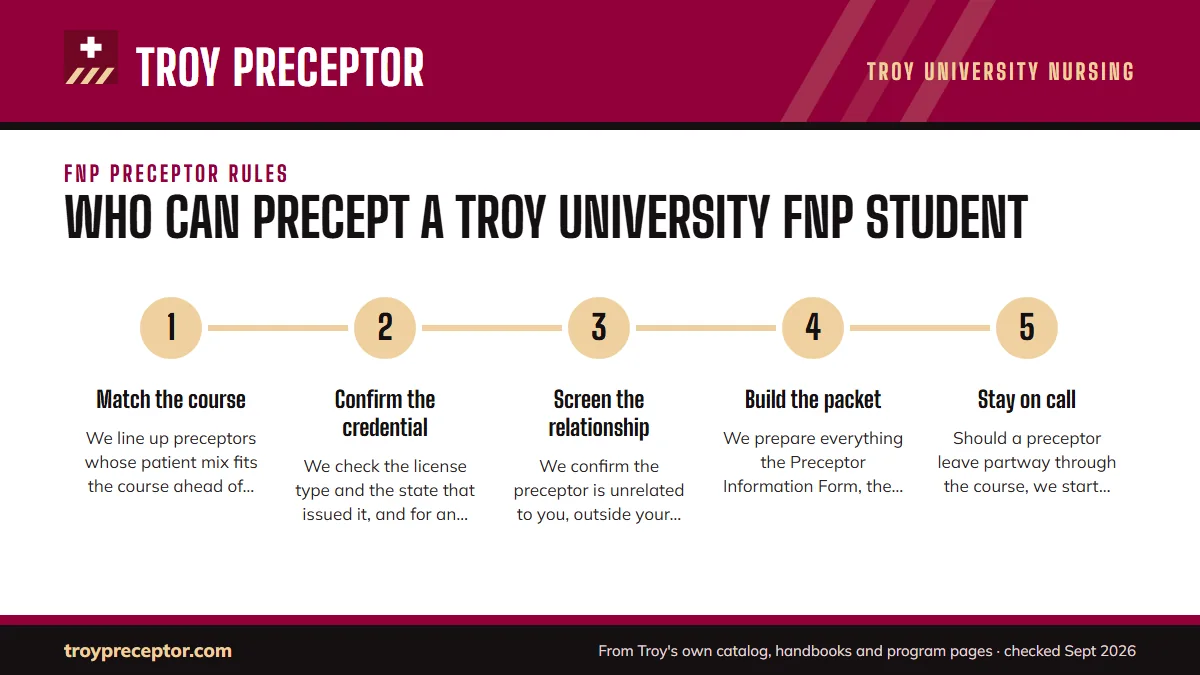
How we vet an FNP preceptor before your advisor sees it
- Match the courseWe line up preceptors whose patient mix fits the course ahead of you: head-to-toe assessment for
NSG 6619, children and women's health across two preceptors forNSG 6666, adult and older-adult primary care forNSG 6668. - Confirm the credentialWe check the license type and the state that issued it, and for an NP we confirm when the NP role began so the one-year mark is clear.
- Screen the relationshipWe confirm the preceptor is unrelated to you, outside your own work area and setting, and has not already precepted you twice.
- Build the packetWe prepare everything the Preceptor Information Form, the Preceptor Biosketch and the license copy call for, so your faculty advisor receives a complete, typed packet well ahead of the deadline.
- Stay on callShould a preceptor leave partway through the course, we start looking for a replacement right away and apply identical checks.
Troy faculty approve every FNP preceptor and setting. Our work is to make sure the packet in front of them already fits Troy's rules. Send your course and home county through the form below.
Questions Troy students ask
Can a physician assistant precept a Troy FNP student?
Yes. Troy's 2026-27 MSN and DNP manuals both name physician assistants, along with physicians (MD or DO) and nurse midwives, as allowed FNP preceptors. A PA still goes through faculty approval like anyone else, with a Preceptor Biosketch showing the PA credential and a copy of the PA's license attached to your Preceptor Information Form.
Can a newly certified NP precept me at Troy?
Troy's manuals ask for at least one year of experience as a nurse practitioner, so an NP short of that mark does not meet the written rule, however long their earlier RN career. If the anniversary falls just before your course begins, raise the timing with your faculty advisor when you submit the packet.
Can a family member be my preceptor in Troy's FNP program?
The MSN Student Orientation Manual says no: FNP preceptors may not be related to the student. The DNP manual's FNP preceptor list leaves that line out, which gives DNP students a conflict between two Troy manuals. Ask your faculty advisor before approaching a relative, and treat the MSN rule as the safe assumption.
How many students can one Troy preceptor take at a time?
Troy's manuals publish no students-per-preceptor ratio. The limit Troy does set runs the other way: you may not use the same preceptor or clinical site more than twice across your program. Whether a busy preceptor can take you alongside other learners is for the preceptor, the site and your course faculty to settle.
Does my FNP preceptor have to practice in Alabama?
No Alabama-only rule appears in Troy's manuals. The NP must be licensed where they practice, and your own RN license must be unencumbered and valid for the clinical state across the whole semester. Troy's dated 2020 clinical-availability table also lists states with extra steps, so check your state before you recruit.
Related pages
Last checked 2026-09-27
We check these pages against Troy's own 2026-27 MSN, DNP, AMSN and RN to BSN orientation manuals, program pages, degree maps and state authorization pages. Your faculty advisor, your course faculty and the School of Nursing have the final word.
Troy asks you to recruit your preceptor. We make that the easy part.
Tell us your Troy program, where you live and which semester your next clinical course starts. We find preceptors who meet Troy's rules for the course, check the setting against Troy's limits, and prepare everything the Preceptor Information Form and biosketch ask for, well ahead of the form deadline.
- Preceptors matched to the course: a graduate-prepared NP or physician for
NSG 6619, pediatrics and women's health forNSG 6666, adults and older adults forNSG 6668 - Preceptor Information Form details, a biosketch and a copy of the preceptor's license, ready for your faculty advisor
- In your own area, in Alabama or a state where Troy can offer clinicals, never in your own work setting
Start your placement plan
Program, city and semester is all we need to begin.