Troy University's DNP synthesis courses and the agency behind your project
Troy University's DNP Synthesis Project runs through four courses, NSG 8810 to NSG 8840, from naming the project to evaluating it. The step that holds students up sits in NSG 8820, where the DNP manual says students "must obtain approval from the external agency or setting" before the project can move through IRB review into implementation.
Find the agency your DNP project needs
Tell us your project topic, your state and the semester NSG 8820 begins.
Four courses, one project
The DNP manual's Outline for DNP Synthesis Courses names each course for a stage of the project, and every one of them requires clinical-hours documentation. Post-master's DNP students begin their Troy program with this sequence. Post-BSN students on the FNP or Nurse Leader track reach it after their 6000-level clinical courses.
| Course | Stage | What the manual asks for |
|---|---|---|
NSG 8810 | Synthesis of Evidence-based Practice I: Project Identification | Form your DSP Committee early, on the DNP Project Advisory Committee Form; document clinical hours |
NSG 8820 | Synthesis II: Project Development | Approval from the external agency or setting, approval of the DSP proposal, and a Troy IRB application; document clinical hours |
NSG 8830 | Synthesis III: Project Implementation | Troy IRB approval in place first, unless an exception is approved; document clinical hours |
NSG 8840 | Synthesis IV: Project Evaluation | Evaluate the project; document clinical hours |
NSG 8860 | Continuation of Doctoral Synthesis Project | Listed in the outline; ask your DSP Chair when it applies to you |
NSG 8880 | Directed Professional Practicum | 1 to 3 SH; each SH is 60 clinical hours, 180 at most, for anyone still short of 1,000 |
Your DSP Committee comes first
Early in NSG 8810 you set up a DNP Synthesis Project (DSP) Committee, naming its members on the DNP Project Advisory Committee Form. Later this chair and committee sign off on your IRB application, and at the end they run the Final Competency Evaluation, so this group shapes the project from its first outline to its final presentation.
The committee also narrows the agency search. A project on, say, depression screening in primary care or discharge teaching on a medical unit can only be approved by an organization that runs that kind of care. Settle the question, the setting it needs and the data you plan to collect with your chair before approaching anyone, so the agency hears a clear, bounded request.
Use NSG 8810 to build a short list as well. By the time NSG 8820 opens, you want at least one organization that has already heard the idea and knows who inside it would sign a letter of support.
Agency approval in NSG 8820
The DNP manual makes the agency step yours: while enrolled in NSG 8820, you secure the organization's sign-off, either as a letter of support or as approval from its IRB. Alongside it, the course asks for DSP proposal approval and a Troy IRB application, and Troy IRB approval has to be in hand ahead of NSG 8830, barring an approved exception.
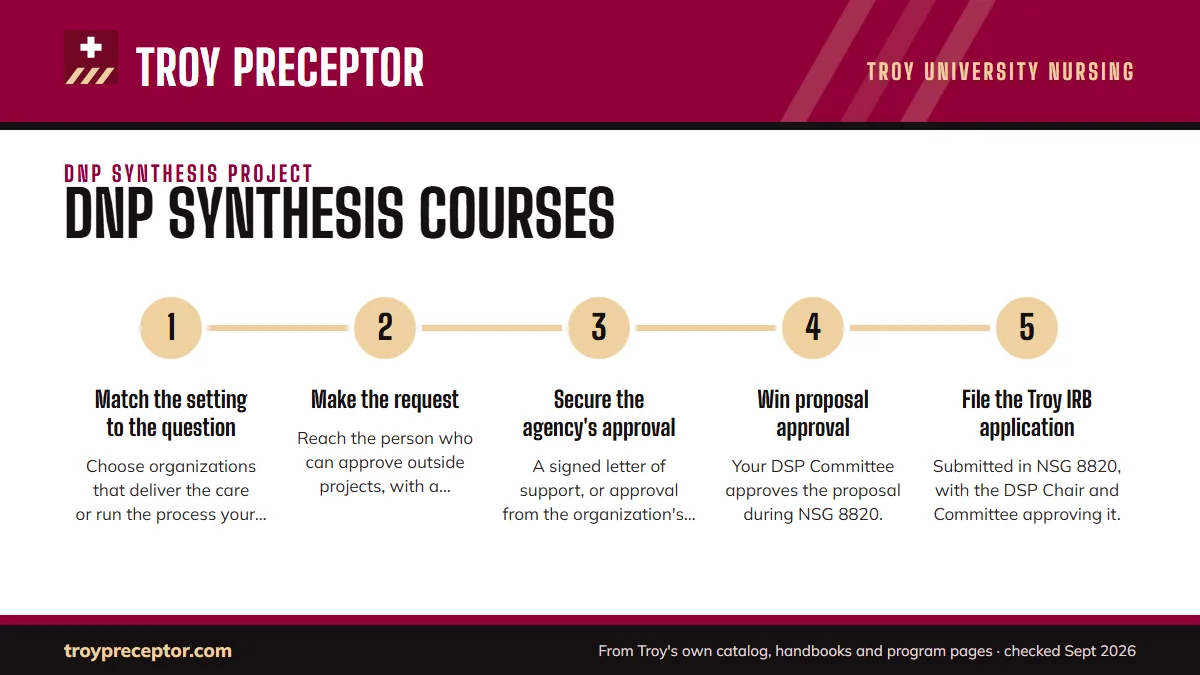
- Match the setting to the questionChoose organizations that deliver the care or run the process your project studies.
- Make the requestReach the person who can approve outside projects, with a one-page summary of your aims, your data and your time on site.
- Secure the agency's approvalA signed letter of support, or approval from the organization's own IRB where it has one.
- Win proposal approvalYour DSP Committee approves the proposal during
NSG 8820. - File the Troy IRB applicationSubmitted in
NSG 8820, with the DSP Chair and Committee approving it. - Hold IRB approval before implementingImplementation in
NSG 8830waits for Troy IRB approval unless an exception has been approved.
Without the agency's approval, the Troy IRB step and the move into NSG 8830 both wait.
Clinical hours inside the synthesis courses
Hours are part of every synthesis course: each one asks you to document them, and your DNP portfolio closes the loop with reflection pages about that clinical time. These hours count toward the 1,000 every Troy DNP graduate needs, alongside hours from 6000-level clinical courses or, for post-master's students, verified hours from earlier graduate study.
The DNP manual's preceptor guidelines are written for 6000-level courses. For the 8000-level sequence it speaks of agency approval and hours documentation instead, so ask your DSP Chair early how synthesis hours are supervised, recorded and signed off in your cohort.
If your total still falls short near the end, NSG 8880 Directed Professional Practicum is worth 60 hours for each credit, to a ceiling of 180. Nurse Leader students usually take it for one credit in a summer, though the manual words that timing two ways. The arithmetic for each route, and that conflict, are on the DNP 1,000-hour rule.
Grades, time limits and the finish line
NSG 8812 Foundations of Evidence-based Practice, the DNP research course, needs a B or better under the 2025-26 Graduate Catalog, and any research-course grade of C or below means taking the course again until a B is earned. Both attempts count in your GPA; the rest of the grade rules are on grades and progression.
Time matters too. The 2026-27 DNP manual gives a five-year limit, whereas the 2025-26 catalog allows eight years after a BSN entry and five after a master's entry; the side-by-side is on incompletes, withdrawal and time limits. A project that stalls in NSG 8820 eats into that clock.
The finish line is the Final Competency Evaluation, a presentation of your DNP Synthesis Project held by distance technology. Two writing tasks sit beside it, a national-conference abstract and a manuscript, and every DNP graduate attends convocation at the Troy campus. For post-master's students, full-time study starts in a fall semester.
Why DNP students bring us the agency search
A strong project idea still needs an organization willing to host it, and finding one while carrying coursework is where time slips away. That search is what Troy DNP students hand to us: we identify organizations whose services fit your question, reach the people who approve outside projects, and come back with names that have already heard what you plan to do.
We start during NSG 8810, so the approval request is ready before NSG 8820 opens. For each agency we prepare what a letter of support request needs, including a plain summary of the project, the setting it requires and the time you expect to spend there, and we flag early when an organization runs its own IRB. If you are short of hours later, we look for a setting that can carry NSG 8880.
Your DSP Committee and Troy's IRB make every approval decision. Our job is to put a complete, early and well-matched request in front of them. The request form on this page starts the conversation, and how it works shows the steps.
Questions Troy students ask
Does Troy assign an agency for the DNP Synthesis Project?
Troy's DNP manual places agency approval with the student during NSG 8820, so the request comes from you. Your DSP Chair and Committee guide the project itself and approve the proposal and the IRB application. Starting agency conversations during NSG 8810 gives you room if the first organization says no.
What counts as agency approval for NSG 8820?
Troy's manual names two forms it can take: a letter of support from the organization, or approval from the organization's own IRB. It sits alongside two other NSG 8820 requirements: approval of your DSP proposal and a Troy IRB application. Keep a signed copy of whatever the organization provides, since your committee and the Troy IRB will want to see it.
Can I start my DNP project before Troy IRB approval?
Plan on waiting. The DNP manual requires Troy IRB approval before NSG 8830, Project Implementation, unless an exception is approved. If the agency's own review or Troy's review runs long, talk with your DSP Chair about timing before the next semester begins, rather than collecting data early and putting the project at risk.
Can my employer be the agency for my DNP project?
The DNP manual's rule against hours in your own work area appears in its guidelines for 6000-level clinical courses, while the synthesis outline asks for sign-off from an outside agency or setting. Those passages leave the question open for the synthesis courses, so put it to your DSP Chair before you approach your own employer.
How is the Troy DNP Final Competency Evaluation held?
It is a presentation of your DNP Synthesis Project held by distance technology, run by your DSP Chair and Committee. Alongside it, Troy expects an abstract submitted to a national conference and a developed manuscript. Convocation for every DNP graduate is held on the Troy campus, so plan one trip for the ceremony.
Related pages
Last checked 2026-09-27
We check these pages against Troy's own 2026-27 MSN, DNP, AMSN and RN to BSN orientation manuals, program pages, degree maps and state authorization pages. Your faculty advisor, your course faculty and the School of Nursing have the final word.
Troy asks you to recruit your preceptor. We make that the easy part.
Tell us your Troy program, where you live and which semester your next clinical course starts. We find preceptors who meet Troy's rules for the course, check the setting against Troy's limits, and prepare everything the Preceptor Information Form and biosketch ask for, well ahead of the form deadline.
- Preceptors matched to the course: a graduate-prepared NP or physician for
NSG 6619, pediatrics and women's health forNSG 6666, adults and older adults forNSG 6668 - Preceptor Information Form details, a biosketch and a copy of the preceptor's license, ready for your faculty advisor
- In your own area, in Alabama or a state where Troy can offer clinicals, never in your own work setting
Start your placement plan
Program, city and semester is all we need to begin.