Your own search, faculty help or a placement service: choosing a route at Troy
Every Troy University preceptor ends up in the same place: a packet with your faculty advisor, waiting for approval. How the name gets there is up to you. This page compares running the search yourself, asking Troy faculty for suggestions and bringing in a placement service, so you can pick the route that fits your course, your area and your calendar.
Get your placement plan
Tell us your Troy program and where you live. A placement advisor replies with the preceptor and site options that fit your Troy course.
What stays the same on every route
Three things hold no matter who finds the name. You make or confirm the contact, because each Troy manual covering preceptor courses gives that job to the student. You send the three-part packet to your faculty advisor yourself. And Troy faculty approve the preceptor and the setting before the School of Nursing opens the agreements.
The rules hold too: no hours in your own work area, no preceptor or site more than twice, and no hospital setting for FNP hours before the NSG 6680 internship. Faculty clear you only after the agreements are signed, and hours before clearance never count. So the real decision is who does the legwork of finding someone who clears those rules in time for your deadline.
Route one: running the search yourself
A solo search suits students who already know clinicians outside their employer and have a semester or more before the next form deadline. You list practices within reach, test each clinician against the course rules, make the ask, then collect the biosketch and license copy. The method, step by step, is on our page about finding your own preceptor.
The price is time. Every practice you approach needs follow-up, a verbal yes still has to turn into paperwork, and Troy leaves an incomplete form unprocessed. Under the MSN manual, a late packet forces you out of the clinical course and the course paired with it, and faculty will withdraw you if you do not act. For a student working full shifts, that clock runs fast.
Route two: asking Troy faculty
Asking is always worth doing, but Troy's written help is narrow. The DNP manual says faculty can assist by suggesting preceptors for 6000-level clinical courses; the MSN manual has no matching sentence. No agency list or preceptor database is posted, although the MSN manual calls the graduate program's ties with clinical agencies across Alabama, Georgia, Florida and many other states good ones.
A suggested name is a lead, not a placement. You still contact the preceptor, confirm the fit and submit the packet. Signed agreements go back to the Clinical Placements Specialist, a role none of Troy's pages present as a preceptor finder. Each Troy role in a preceptorship, by title, is mapped in who does what, which helps you send each question to the right desk.
Route three: a placement service
With a placement service, the hunt for names moves to someone else. With us, that means outreach to clinicians around you who fit the course under Troy's rules, a cross-check with your employer and your full Troy history of preceptors and sites, the packet details gathered for you, and a plan dated back from your form deadline.
Troy's approval steps stay exactly where they are. You submit, faculty approve, and the School of Nursing takes care of agency agreements; our part is handing you a packet with nothing missing that suits the course before it ever reaches faculty. Should a preceptor pull out during the semester, a replacement search opens right away. How we price that work is set out on the cost page.
The three routes side by side
| Your own search | Faculty suggestions | Placement service | |
|---|---|---|---|
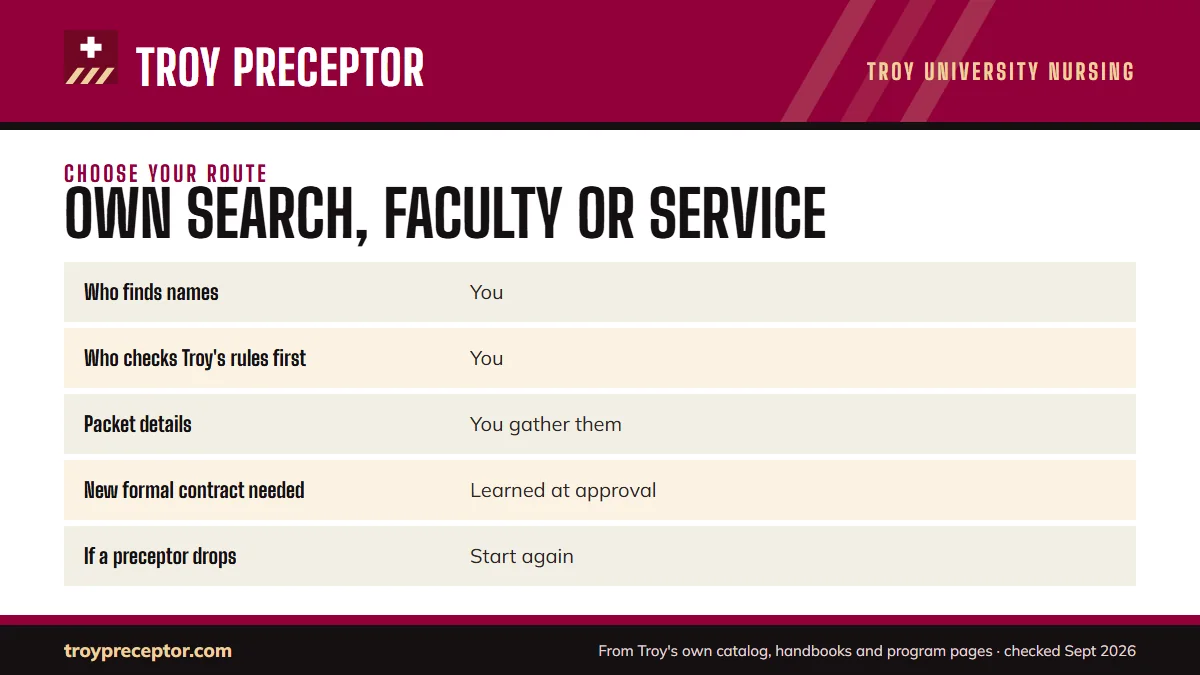
| Who finds names | You | Faculty may suggest some (DNP manual) | We do |
| Who checks Troy's rules first | You | You, with faculty input | We check before you see a name |
| Packet details | You gather them | You gather them | Gathered for you |
| New formal contract needed | Learned at approval | Learned at approval | Flagged before you submit |
| If a preceptor drops | Start again | Ask again | Replacement search starts at once |
| Fits best when | You have strong local contacts and time | You are a DNP student planning early | Deadlines are close, the market is small or several courses remain |
No route changes who decides. Troy faculty approve every preceptor and setting, wherever the name started.
Questions that point to a route
Your answers to these usually settle the choice.
- How many clinical courses are left? One practicum is a small search; the FNP sequence has four.
- How far off is the form deadline for your next course?
- Do you work for the main health system in your town, taking its settings off your list?
- Have you already used your best contacts twice?
- Do you need two preceptors at once, as
NSG 6666requires? - Will your hours happen outside Alabama, where your RN license and Troy's state table both come into play?
If several of these apply, the search will take steady effort for weeks, and that is where a placement service earns its place.
Mixing the routes
The routes combine well. Some students bring us a lead from faculty and ask us to confirm it and prepare the packet. Others handle a course where they already know a clinician and pass us the tougher searches, such as the NSG 6666 pair or the NSG 6680 internship with its first hospital hours. A post-master's DNP student might secure the project agency personally and bring us in for any other search the program calls for.
Whatever the mix, keep one running list of every preceptor and site you use, because Troy caps each at two uses across the program and a shared list keeps everyone counting the same way. The how it works page shows where we pick up.
Questions Troy students ask
Can I use a placement service for Troy clinicals?
Troy's manuals describe who contacts a preceptor and who approves one, and the approval standard is the same for every name you submit. However a candidate reaches you, you make the contact, send the packet to your faculty advisor and wait for faculty approval, exactly as with any other preceptor.
Will Troy faculty line up a preceptor if I ask?
Troy's manuals stop short of that. Faculty suggestions appear in the DNP manual only, and the MSN manual leaves the contact to you. Ask your faculty advisor anyway, especially early in the semester, and treat any name you receive as a lead you still need to confirm and document.
Can you cover my remaining courses if I found one preceptor myself?
Yes. Send us the courses already covered and the preceptors and sites on your record, and we plan what is left around them so nothing goes past Troy's two-use limit. You keep the preceptor you found, and we take on the searches you pass to us.
Can I switch routes partway through a semester?
Yes. If your own search stalls near the deadline, send us the course, the date your forms are due and every clinician you have contacted so far. We build on that list rather than starting cold, and we skip anyone who has declined or who works in your own setting.
Related pages
Last checked 2026-09-27
We check these pages against Troy's own 2026-27 MSN, DNP, AMSN and RN to BSN orientation manuals, program pages, degree maps and state authorization pages. Your faculty advisor, your course faculty and the School of Nursing have the final word.
Troy asks you to recruit your preceptor. We make that the easy part.
Tell us your Troy program, where you live and which semester your next clinical course starts. We find preceptors who meet Troy's rules for the course, check the setting against Troy's limits, and prepare everything the Preceptor Information Form and biosketch ask for, well ahead of the form deadline.
- Preceptors matched to the course: a graduate-prepared NP or physician for
NSG 6619, pediatrics and women's health forNSG 6666, adults and older adults forNSG 6668 - Preceptor Information Form details, a biosketch and a copy of the preceptor's license, ready for your faculty advisor
- In your own area, in Alabama or a state where Troy can offer clinicals, never in your own work setting
Start your placement plan
Program, city and semester is all we need to begin.