Your workplace, repeat preceptors and hospital hours: Troy's three limits
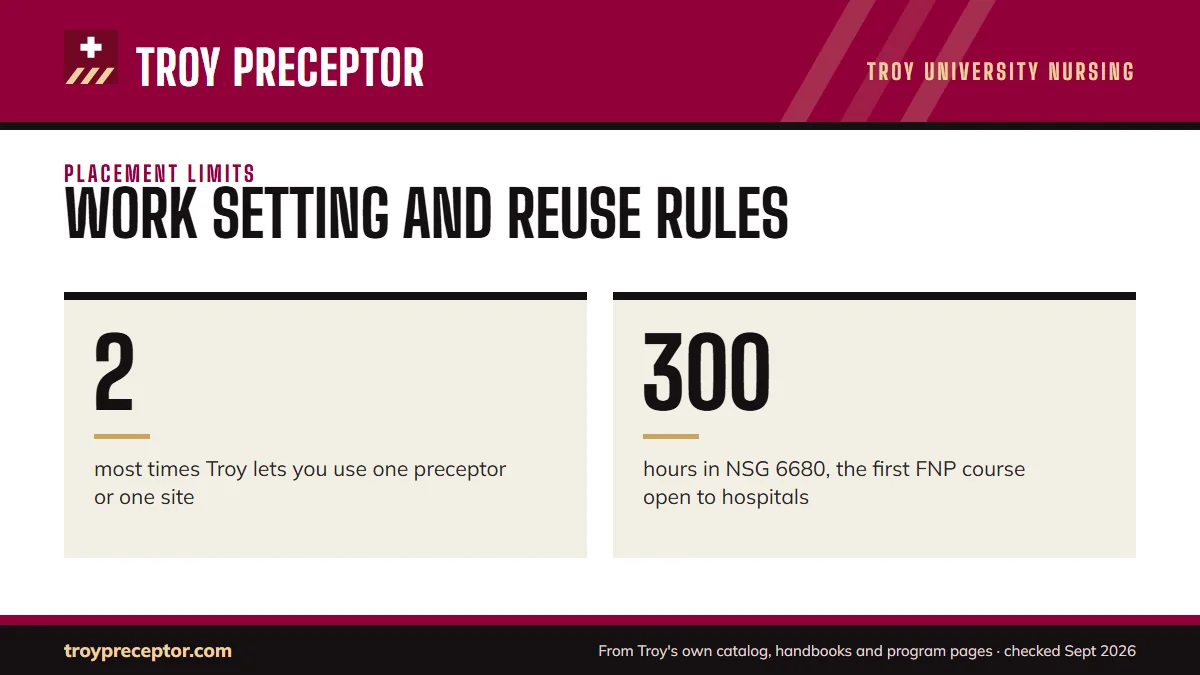
Troy University's manuals set three limits on where preceptor hours can happen: none in the area or setting where you work, no preceptor or clinical site used more than twice in your program, and, for FNP students, no hospital hours before NSG 6680. The limits reach across semesters, so plan every course against them at once. We keep a running record of each preceptor and site you use so every new placement clears all three.
Get your placement plan
Tell us your Troy program and where you live. A placement advisor replies with the preceptor and site options that fit your Troy course.
The three limits and where Troy writes them
Each limit comes from the Guidelines for Preceptorship/Internship Courses in Troy's 2026-27 manuals, and Troy prints the setting rules on the Preceptor Information Form as well, so your faculty advisor sees them again at approval.
| Limit | Who it covers | Where it appears |
|---|---|---|
| No clinical hours in the area or setting where you work as an employee | MSN, post-master's certificate, DNP and AMSN students | MSN, DNP and AMSN manuals, item 2 |
| Use a variety of preceptors and settings; no preceptor or clinical site more than twice in the program | MSN, certificate and DNP students | MSN and DNP manuals, item 3 |
No hospital-setting hours until NSG 6680 FNP Internship | FNP students | MSN Preceptor Information Form |
HINL students get the reverse of the third limit: Troy's form says they may use any setting. The first two limits still bind them, along with every other graduate student.
Not where you work
Troy's wording covers both the area and the setting where you work as an employee. Read plainly, that is wider than your own unit: a clinic you staff part time, a practice that books you per diem and a department you manage all count as places you work. Preceptor hours logged in any of them are what the rule is written to stop.
Large employers create the hard cases. If you work on one unit of a health system and a candidate practices in a separate clinic the same system owns, Troy's manuals do not say whether that counts as a different setting. Ask your faculty advisor before you recruit there, and keep the answer in writing. Troy also asks students to use a variety of settings, which makes a site outside your employer the cleaner choice whenever one exists.
The rule looks forward as well. If you change jobs mid-program, your new workplace becomes off limits from your start date, and a preceptor you had lined up there for a later course needs replacing.
Twice is the ceiling
No preceptor and no clinical site may be used more than twice across your program. The count runs across courses, not inside one: a preceptor who takes you for NSG 6619 and again for NSG 6668 is then spent, however well it went. The site has its own count, so two different preceptors at one practice use that practice up just as quickly.
FNP students need at least five preceptor slots across four courses, because NSG 6666 requires two preceptors. HINL students need at least three. The example below shows one FNP plan that stays inside the ceiling.
| Course | Preceptor | Site |
|---|---|---|
NSG 6619 | Preceptor A | Practice 1 |
NSG 6666 | Preceptors B and C | Practices 2 and 3 |
NSG 6668 | Preceptor A | Practice 1 |
NSG 6680 | Preceptor D | Hospital-based service 4 |
After NSG 6668, Preceptor A and Practice 1 have each reached two uses and are closed to you for the rest of the program. Spreading courses across different people and places also fits Troy's stated preference for variety.
FNP students and hospital hours
Troy's Preceptor Information Form says FNP students may not log hours in a hospital setting until NSG 6680 FNP Internship, the 300-hour final course. Until then, NSG 6619, NSG 6666 and NSG 6668 run outside hospitals, which suits what they teach: head-to-toe assessment, pediatrics and women's health, and adults and older adults in primary care.
Troy's manuals do not define a hospital setting. An outpatient practice inside a hospital building, or a hospital-owned clinic across town, is the kind of case to settle with your faculty advisor before you recruit. Hours that turn out not to count cannot be made up after the course ends, because Troy counts clinical hours only inside the course you are enrolled in.
NSG 6680 is the first course where a hospital-based preceptor becomes an option. The work-setting limit and the twice ceiling apply to it exactly as they did before. The FNP internship page covers the course itself.
Planning the whole program from the start
Because the limits stretch across semesters, the best time to plan them is before your first preceptorship. FNP-specific courses run once a year in sequence, with clinical courses every semester except summer, so a preceptor you save for the internship may be a year away when you first meet.
Keep a running record of
- Every employer and unit you work in during the program, including per diem and part-time roles
- Each preceptor you have used, with the course and semester
- Each clinical site, counted separately from the preceptors who worked there
- For FNP students, any setting your faculty advisor has ruled in or out as a hospital
That record earns its keep when a preceptor leaves mid-semester. A replacement has to clear the same three limits, and knowing your counts saves days. See when a preceptor drops out.
How we apply the limits to every match
Every search we run starts from your record: where you work, who has precepted you and which sites you have used. We screen candidates against all three limits before we contact them, so the preceptor you meet is one Troy's rules allow for the course you are entering. We also plan ahead, holding strong candidates for the later courses where they fit best, such as a hospital-based preceptor for the internship.
The result reaches your faculty advisor as a complete packet for the Preceptor Information Form, well ahead of the deadline. Troy faculty approve every preceptor and setting; the limits are already checked by the time they look. Share your employer, past preceptors and upcoming course with us using the form below, and we will map the options still open to you.
Questions Troy students ask
Can I do Troy clinical hours in a different department of my hospital?
Troy bars hours in the area or setting where you work as an employee, and its manuals do not define how far a setting reaches inside a large employer. A different department of the same hospital may well fall inside that line. Ask your faculty advisor before recruiting there, and save the reply.
Can I use the same preceptor for two Troy FNP courses?
Yes, up to twice in the program. A preceptor who takes you for NSG 6619 and NSG 6668 has then reached Troy's limit and cannot precept you for NSG 6680. The same cap applies to each clinical site, counted separately from the preceptors who practice there.
Why are Troy FNP students kept out of hospitals before the internship?
Troy's Preceptor Information Form states the rule without giving a reason: FNP students may not log hours in a hospital setting until NSG 6680. The earlier courses center on assessment and primary care across the lifespan, which outpatient practices cover. From the internship on, hospital-based preceptors become an option.
Do Troy HINL students have the hospital restriction?
No. Troy's form says HINL students may use any setting, so hospital informatics, quality or administration departments are open from the first practicum. HINL students still may not train in their own work area or setting, and they still may not use any preceptor or site more than twice.
Do the reuse rules apply to Troy DNP students?
Yes. The DNP manual repeats the own-work-setting rule and the twice ceiling for its 6000-level clinical courses, as items 2 and 3. Because post-BSN DNP students in the FNP track sit the same four FNP courses as MSN students, confirm with your faculty advisor that the hospital rule applies to you the same way.
Related pages
Last checked 2026-09-27
We check these pages against Troy's own 2026-27 MSN, DNP, AMSN and RN to BSN orientation manuals, program pages, degree maps and state authorization pages. Your faculty advisor, your course faculty and the School of Nursing have the final word.
Troy asks you to recruit your preceptor. We make that the easy part.
Tell us your Troy program, where you live and which semester your next clinical course starts. We find preceptors who meet Troy's rules for the course, check the setting against Troy's limits, and prepare everything the Preceptor Information Form and biosketch ask for, well ahead of the form deadline.
- Preceptors matched to the course: a graduate-prepared NP or physician for
NSG 6619, pediatrics and women's health forNSG 6666, adults and older adults forNSG 6668 - Preceptor Information Form details, a biosketch and a copy of the preceptor's license, ready for your faculty advisor
- In your own area, in Alabama or a state where Troy can offer clinicals, never in your own work setting
Start your placement plan
Program, city and semester is all we need to begin.