NSG 6668 Primary Care II: adults and older adults
NSG 6668, Primary Care II Preceptorship, is the third of Troy University's four FNP preceptorships, worth 3 semester hours and built on 180 clinical hours with adults and older adults. On the full-time plan that opens in Fall, it most likely follows the summer without clinical courses, which makes that summer the natural window to secure the preceptor.
Find your NSG 6668 preceptor
Tell us where you live and which semester Primary Care II starts.
Primary Care II in Troy's FNP order
Troy's MSN manual lists NSG 6668 third, after NSG 6666 and before the internship, and describes its focus as adults and geriatrics. Every FNP-pathway student meets it in the same sequence, whether enrolled in the MSN, the certificate or the DNP.
With no clinical courses in summer, a student on the full-time Fall plan most likely reaches Primary Care II in the Fall of year two. Troy does not print that as a planner, so confirm it against your cohort's semester planner in Canvas. Troy's APEA fee list ties the third clinical semester to NSG 6667, a course named by number only, and the 2021-22 catalog listed NSG 6667 and NSG 6668 side by side among the specialty courses.
Finishing NSG 6668 brings you to 480 of the 780 FNP hours. The remaining 300 sit in a single course, NSG 6680.
Using the summer gap well
Summer is quiet on the clinical side. Troy's MSN manual counts clinical hours only inside the course you are registered for and never over a semester break, which leaves summer shifts outside NSG 6668. What summer can hold is everything that comes before the hours.
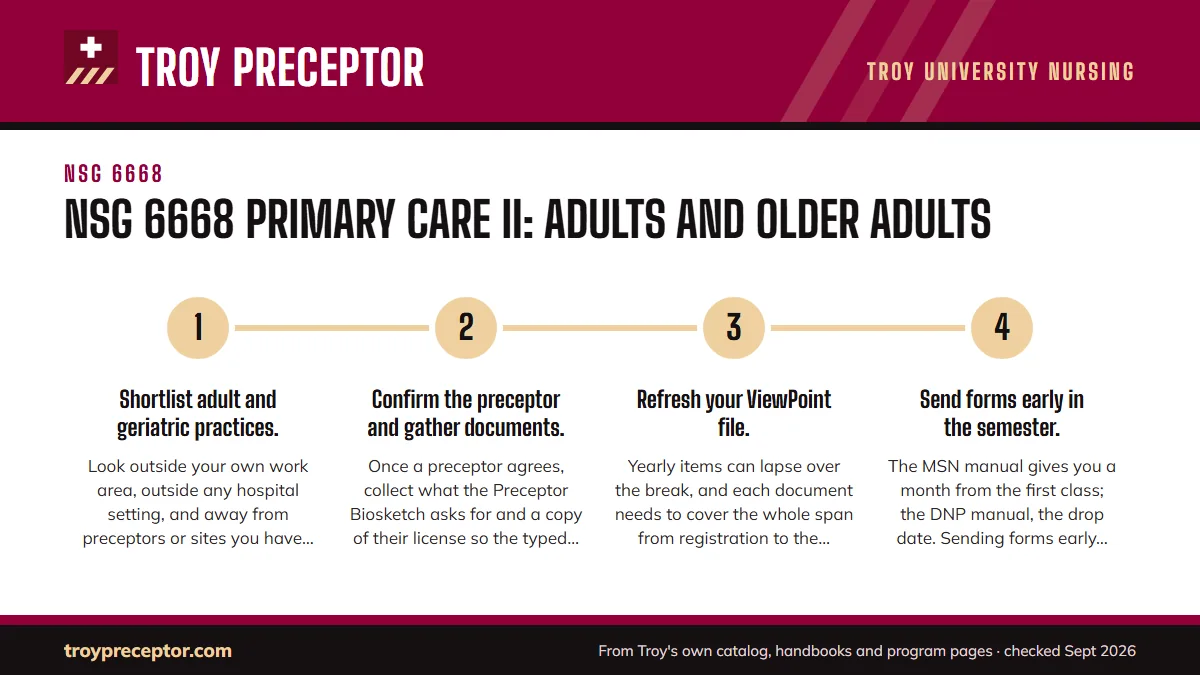
- Shortlist adult and geriatric practices.Look outside your own work area, outside any hospital setting, and away from preceptors or sites you have already used twice.
- Confirm the preceptor and gather documents.Once a preceptor agrees, collect what the Preceptor Biosketch asks for and a copy of their license so the typed Preceptor Information Form can go to your faculty advisor promptly.
- Refresh your ViewPoint file.Yearly items can lapse over the break, and each document needs to cover the whole span from registration to the semester's close. ViewPoint Screening has the list.
- Send forms early in the semester.The MSN manual gives you a month from the first class; the DNP manual, the drop date. Sending forms early brings clearance forward.
Who can precept adults and older adults
Troy accepts four kinds of FNP preceptor: NPs licensed for NP practice in their state with one year or more in that role, physicians holding an MD or DO, nurse midwives, and PAs. Relatives are excluded under the MSN manual; FNP preceptor requirements gives the complete standard.
Credentials on the Preceptor Biosketch that often suit Primary Care II
- AGNP: an adult-gerontology NP, eligible under Troy's NP rule after a year of licensed NP practice.
- FNP: a family nurse practitioner with a steady adult and older-adult caseload.
- MD or DO: a physician, which includes internists, family physicians and geriatricians.
- PA: a physician assistant in an adult, family or geriatric practice.
The biosketch also has a CNS box, but clinical nurse specialists are not among the professions Troy's manuals list for FNP courses, so ask your faculty advisor before relying on one. Where a site serving older adults sits close to hospital care, ask whether faculty would treat it as a hospital setting before you commit.
The twice rule starts to bite
By the time you reach NSG 6668, you may already have worked with three preceptors: one in NSG 6619 and two in NSG 6666. Troy's limit is two uses per preceptor and per site over the whole program, alongside an expectation of varied preceptors and settings, so this is the course where earlier choices start to narrow your options.
The limit covers sites as well as people. A clinic you have already used twice is off the list even if a new preceptor works there, and a preceptor from an earlier course who returns here is using their final slot with you. A short record of every preceptor and site, with the course each served, makes the check simple. The limit and the employer bar are explained in full at work setting and reuse rules.
Before you ask a past preceptor back for NSG 6668, count their uses and the site's. Two is the most Troy allows across the whole program.
Making 180 hours fit a preceptor's week
NSG 6668 carries 180 hours for 3 semester hours, the same load as Primary Care I, but Troy does not require a second preceptor here. With one preceptor, the whole total sits on one person's clinic calendar, so ask early how many days a week they can take a student and for how many weeks. Clinic hours, days off and the preceptor's own leave all shape how quickly 180 hours add up.
Counting starts only at clearance. Should approval and agreements eat up the opening month, the hours must fit what remains, and the weekly arithmetic on the clinical hours page makes the effect plain. If one preceptor cannot cover it all, ask your course faculty whether adding a second approved preceptor is an option, and report any schedule change to them right away.
An NSG 6668 preceptor with room in the schedule
We use the summer the way Troy's calendar allows: to find, confirm and document your Primary Care II preceptor before the semester starts. We search your own area for adult and geriatric practices where a preceptor meets Troy's FNP standard and has the clinic days for 180 hours.
Every candidate is checked against your earlier preceptors and sites, so the twice rule is settled before you ask, and against your workplace. The biosketch details and license copy come ready for your faculty advisor, and a site that needs a new formal contract is flagged before it can cost you weeks. Faculty at Troy make the approval call; what we deliver is a submission with nothing missing and nothing outside the rules. Tell us about your semester in the form below.
Questions Troy students ask
What does Troy's NSG 6668 focus on?
Troy's MSN manual describes Primary Care II as the adult and geriatric preceptorship, carrying 3 credits and 180 hours. Pediatrics and women's health belong to NSG 6666, Primary Care I. Your course faculty supply the detailed objectives, which you pass to your preceptor before your first shift.
Can I complete NSG 6668 hours over the summer?
No. Hours belong inside an enrolled course under Troy's MSN manual, break weeks never count, and the FNP clinical calendar skips summer altogether. Spend the summer recruiting and preparing forms, then begin logging after the semester opens and faculty clear you.
Can an adult-gerontology NP precept NSG 6668?
Yes, if they meet Troy's NP rule: licensed as an NP where they practice, with a year or more of NP experience. The Preceptor Biosketch even includes an AGNP box. Your course faculty still approve the individual and the setting before any agreement is started.
How many clinical hours is NSG 6668?
180 in the MSN manual. The DNP manual agrees in its course list but, in its progression section, puts 135 on each of the first three FNP courses. Your faculty advisor settles which number your section uses, and the 780-hour FNP page lays the two side by side.
Can I do NSG 6668 at the clinic where I work?
Not in the unit or setting that employs you; Troy's manuals rule that out. Whether a separate practice in the same health system counts as a different setting is for your faculty advisor to judge, so describe it before you approach a preceptor there.
Related pages
Last checked 2026-09-27
We check these pages against Troy's own 2026-27 MSN, DNP, AMSN and RN to BSN orientation manuals, program pages, degree maps and state authorization pages. Your faculty advisor, your course faculty and the School of Nursing have the final word.
Troy asks you to recruit your preceptor. We make that the easy part.
Tell us your Troy program, where you live and which semester your next clinical course starts. We find preceptors who meet Troy's rules for the course, check the setting against Troy's limits, and prepare everything the Preceptor Information Form and biosketch ask for, well ahead of the form deadline.
- Preceptors matched to the course: a graduate-prepared NP or physician for
NSG 6619, pediatrics and women's health forNSG 6666, adults and older adults forNSG 6668 - Preceptor Information Form details, a biosketch and a copy of the preceptor's license, ready for your faculty advisor
- In your own area, in Alabama or a state where Troy can offer clinicals, never in your own work setting
Start your placement plan
Program, city and semester is all we need to begin.