Preceptor and agency agreements at Troy: the letter, the contract and the wait
Once faculty approve your preceptor and setting, Troy University's School of Nursing sends the clinical agency a letter that starts two agreements, one with the preceptor and one with the agency. You cannot start until both come back signed. Where Troy has no formal contract with a site that needs one, the process takes longer, which is why Troy tells students to apply early.
Get your placement plan
Tell us your Troy program and where you live. A placement advisor replies with the preceptor and site options that fit your Troy course.
What the School of Nursing's letter starts
The agreements are the School of Nursing's step rather than yours, but they sit squarely between approval and your first clinical hour. The MSN, DNP and AMSN manuals describe the same order: faculty sign off on the preceptor and clinical site, then a School of Nursing letter goes to the agency to begin the preceptor and agency agreements. Those agreements must be signed and returned to the School of Nursing before you start.
One agreement is with your preceptor and one is with the agency where the hours happen, and both have to be back. A willing preceptor at a site whose paperwork is still unsigned does not yet give you a start date. That is also why faculty clearance, covered in our guide to approval and clearance, comes only after the agreements.
Formal contracts: the step that runs long
The office-use block on the Preceptor Information Form tracks two contract questions for each request: does this agency need a formal contract, and does Troy already have one with it? The same block logs when the School of Nursing's letter was mailed. For an agency that needs a contract Troy has never signed, the MSN manual says the wait stretches out and advises applying early.
Troy gives no number of weeks for that longer route. The same manual notes that Troy's graduate nursing program is on good terms with clinical agencies at home in Alabama, next door in Georgia and Florida, and well beyond, though no roster of those agencies is published. Asking a site early whether it already holds an agreement with Troy is the quickest way to learn which route you are on.
A site that needs a brand-new formal contract with Troy is the slowest path to clearance, so ask the contract question before you submit the form, not after approval.
DNP students: what clearance waits on
The DNP manual names three things the School of Nursing must have in hand before clearing a DNP student: each preceptor's signed contract, clinical documents brought up to date, and the student's clinical schedule. Those are three separate threads, and a signed preceptor contract will not clear you if a compliance document has lapsed or the schedule is missing.
Every DNP student reaches a different kind of agency approval in the synthesis courses. In NSG 8820 the project site itself has to approve your DNP Synthesis Project, through a letter of support or an IRB approval, while your proposal is approved and your Troy IRB application goes in; NSG 8830 then waits on Troy IRB approval unless an exception is granted. That is project approval rather than a preceptor agreement, and our DNP synthesis courses guide covers it.
What agencies can add on their side
An agreement can bring the agency's own requirements with it. Troy's MSN manual says agencies may add immunization requirements beyond Troy's list, and the student must meet them. Its drug screen policy notes that further testing can happen under an agency affiliation agreement, at the student's expense. Treat any agency extra as part of the same checklist and finish it before your planned start.
Troy's compliance paperwork anticipates this. The Permission to Release Records form you sign lets Troy pass your records to clinical agencies, and your uploads in ViewPoint Screening must not lapse between registration and the close of the term. Some large health systems also publish their own student onboarding steps; our guide to Alabama NP preceptors describes what several of them ask of schools.
The RN to BSN agreement
The RN to BSN manual covers the agreement step in one line: after approval, the agreement goes out to the site by email, and the site returns it, signed, to the Clinical Placements Specialist. Lead faculty must first approve the RN to BSN acknowledgement form in Canvas; the agreement comes after.
With each preceptorship inside a 9-week term, a site that is slow to sign eats straight into the time you have for hours. RN to BSN students gain the most from asking a site at the first conversation whether it has signed a Troy agreement before and who signs on its behalf. If the Flexible Option applies to you, ask lead faculty how its 8-hour shadow experiences in NSG 4411 and NSG 4431 are set up.
Keeping the agreement stage moving
You cannot sign for the School of Nursing, but you can remove most of the friction around its letter.
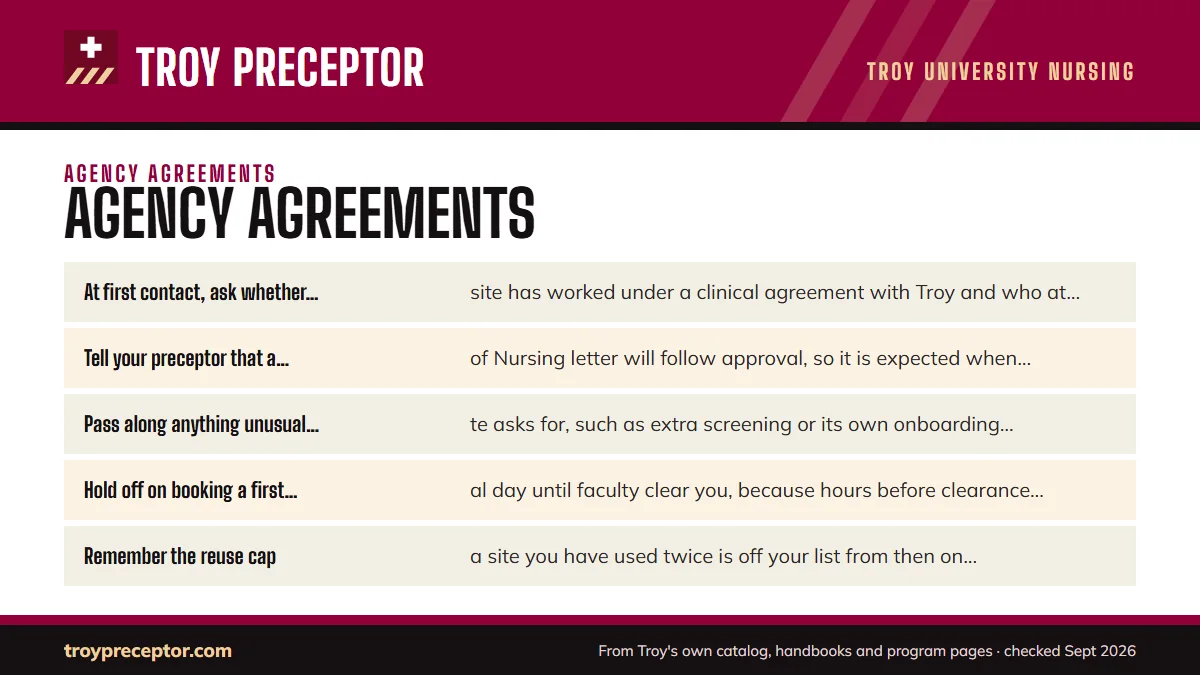
- At first contact, ask whether the site has worked under a clinical agreement with Troy and who at the site signs agreements.
- Tell your preceptor that a School of Nursing letter will follow approval, so it is expected when it arrives.
- Pass along anything unusual the site asks for, such as extra screening or its own onboarding modules, to your faculty advisor early.
- Hold off on booking a first clinical day until faculty clear you, because hours before clearance do not count.
- Remember the reuse cap: a site you have used twice is off your list from then on, whatever its contract status.
How we handle the contract question for you
We raise the contract question at the very first contact with a site. Before you send any form, we ask whether the agency has hosted Troy students under a formal contract, who signs for it, and what the site adds in onboarding or screening. If a site will need a new contract, you hear it from us at the start, while there is still time to apply early or choose a different site.
We also brief your preceptor on the School of Nursing's letter and the two agreements, so the paperwork is expected when it lands. Approval belongs to Troy faculty and the agreements to the School of Nursing; we make sure everything feeding into both is complete and inside Troy's rules. Use the form below to start.
Questions Troy students ask
Who sends the agreement to my Troy clinical site?
The School of Nursing, after faculty approve your preceptor and setting. Its letter starts the preceptor and agency agreements, which return signed to the School of Nursing before you begin. RN to BSN agreements travel by email to the site and back to the Clinical Placements Specialist. Your part is making sure the site expects it.
How long does a new clinical contract take at Troy?
Troy publishes no set number of weeks. The MSN manual says the process takes longer where Troy has no existing formal contract with an agency that requires one, and advises an early start for such sites. Treat a site with no Troy agreement as the long route and raise it before you submit your form.
Can I start hours while the agreement is being signed?
No. Troy's manuals want both agreements signed and back in the School of Nursing's hands before your first day, with faculty clearance after that. Hours completed before clearance do not count toward the course, even if your preceptor was present and willing.
Does Troy already have agreements with clinics and hospitals near me?
Troy's MSN manual speaks of strong ties between its graduate program and agencies at home and in other states, yet names none of them. Ask each site directly whether it has signed a Troy agreement. FNP students should also remember that hospital hours are not allowed before NSG 6680.
What if my clinical site is outside Alabama?
The license comes first: an out-of-state preceptor request waits at Troy until you hold that state's RN license. Some states add steps of their own, such as Oregon, where Troy's 2020 table says Troy must petition the state board before students do clinicals there. Our out-of-state requests guide covers each step.
Related pages
Last checked 2026-09-27
We check these pages against Troy's own 2026-27 MSN, DNP, AMSN and RN to BSN orientation manuals, program pages, degree maps and state authorization pages. Your faculty advisor, your course faculty and the School of Nursing have the final word.
Troy asks you to recruit your preceptor. We make that the easy part.
Tell us your Troy program, where you live and which semester your next clinical course starts. We find preceptors who meet Troy's rules for the course, check the setting against Troy's limits, and prepare everything the Preceptor Information Form and biosketch ask for, well ahead of the form deadline.
- Preceptors matched to the course: a graduate-prepared NP or physician for
NSG 6619, pediatrics and women's health forNSG 6666, adults and older adults forNSG 6668 - Preceptor Information Form details, a biosketch and a copy of the preceptor's license, ready for your faculty advisor
- In your own area, in Alabama or a state where Troy can offer clinicals, never in your own work setting
Start your placement plan
Program, city and semester is all we need to begin.