Troy's clinical schedule form and unannounced site visits
Once Troy University faculty clear you to start, you give your preceptor the course objectives, agree your clinical days, submit the clinical schedule form and report every change at once. Faculty can check in without warning by phone, video or in person, and missing a scheduled day during a visit earns a zero on your clinical evaluation. We set up schedules with your preceptor that stand up to that kind of check.
Get your placement plan
Tell us your Troy program and where you live. A placement advisor replies with the preceptor and site options that fit your Troy course.
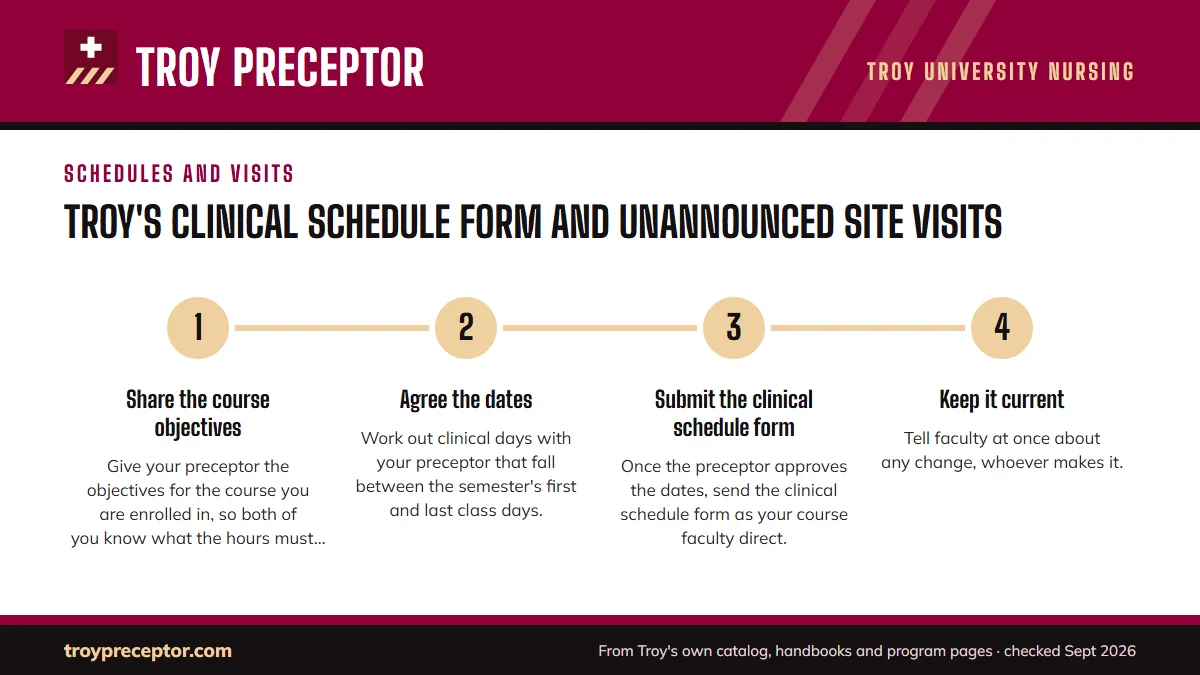
From clearance to your first clinical day
The schedule comes after approval and agreements. Troy faculty first approve your preceptor and setting, the School of Nursing sends the letter that starts the preceptor and agency agreements, and those come back signed before you begin. Faculty then clear you, and hours worked before clearance do not count; faculty approval and clearance covers that stretch. Items 7 and 8 of the MSN manual's guidelines then set the order below.
- Share the course objectivesGive your preceptor the objectives for the course you are enrolled in, so both of you know what the hours must cover.
- Agree the datesWork out clinical days with your preceptor that fall between the semester's first and last class days.
- Submit the clinical schedule formOnce the preceptor approves the dates, send the clinical schedule form as your course faculty direct.
- Keep it currentTell faculty at once about any change, whoever makes it.
DNP students meet a slightly different order. The DNP manual says the School of Nursing must hold signed contracts from preceptors, updated clinical documents and a clinical schedule before it clears students, so for them the schedule is part of what clearance waits on.
Hours belong inside your enrolled course
Troy counts clinical hours only when they fall inside the course you are registered for. There are no clinicals during semester breaks, so hours cannot be banked in the weeks before a semester opens or finished after it closes. Graduate nursing runs on Fall, Spring and Summer semesters, and FNP clinical courses run every semester except summer.
That has a planning edge. A preceptor who can take you only on limited days needs enough weeks inside the semester to reach the course total: 120 hours for NSG 6619, 180 for each primary care course and 300 for NSG 6680. Count the weeks between clearance and the last class day, not the whole semester, because days before clearance are lost.
Paired didactic and preceptorship courses are registered together in Student Self-Service, in a single submission, which ties your clinical window to the semester of the paired course. The academic calendar guide explains how Troy's semesters and 9-week terms differ.
Changing the schedule
Clinical schedules move. A preceptor is pulled into a meeting, a practice closes for a holiday, you fall ill. Troy's rule is simple: faculty must be told at once of any schedule change. A change you report is an ordinary part of clinical life; a change nobody reported can look like an absence the moment a faculty member calls or arrives.
Report before the affected day whenever you can, and save a copy of the message. If the change shifts your total hours, say how you will recover them inside the semester, because Troy counts nothing logged in the break after it. Your preceptor should hear the same plan, so both of you are working from one set of dates.
A change report is clearest when it gives
- The original date and the new one
- A one-line reason
- Confirmation that your preceptor agreed the new date
- Any effect on your running hour total
Unannounced site visits by phone, video or in person
Troy faculty can make unannounced site visits by phone, by video conference or in person, under item 8 of the MSN manual's guidelines and item 9 of the DNP manual's. Unannounced means exactly that: the visit can land on any scheduled day, and it may be a call to your preceptor rather than someone walking into the practice.
If you are absent on a scheduled date when a visit happens, your clinical evaluation is graded zero. That is why the schedule on file has to match where you really are, day by day. A preceptor who knows a faculty call may come, and a front desk that knows your name, both help a visit go smoothly.
Online study does not change any of this. Wherever your site is, Troy faculty can reach it by phone or video.
An absence on a scheduled date during a faculty visit means a zero on the clinical evaluation. Report schedule changes before the day, not after.
Recording hours honestly
Troy's public manuals name no clinical-hour logging platform, so your course faculty explain in Canvas how hours are documented for each course. DNP synthesis courses require clinical-hours documentation, and the DNP portfolio includes reflection pages on the hours logged.
Whatever the format, accuracy carries real weight. The MSN manual's Standards of Conduct treat false information about clinical hours as grounds for course failure, up to suspension or expulsion. Record hours on the day, match them to the schedule on file, and agree the running total with your preceptor as you go rather than at the end.
Honest records also protect you if a preceptor leaves partway through. A clean log shows exactly how many hours remain, which is the first thing a replacement preceptor and your course faculty will want to know.
How we set up a schedule that holds
We agree a working schedule with your preceptor at the time of the match, so the dates are ready the moment faculty clear you. We confirm the course total fits comfortably between clearance and the last class day, and we note the preceptor's known closures, holidays and conference weeks up front, so they are planned for rather than discovered mid-course. Where a preceptor can offer only part of the hours a course needs, we say so before you commit, not after clearance.
If a preceptor's availability changes during the semester, we move fast: a revised set of dates you can report the same day, or a replacement preceptor who meets Troy's rules for your course. For the harder cases, see behind on clinical hours or when a preceptor drops out. Tell us your course and semester in the form below.
Questions Troy students ask
Does Troy do site visits for online nursing students?
Yes. Troy's MSN and DNP manuals say faculty can make unannounced site visits by phone, video conference or in person, wherever your clinical site is. Studying online does not change the rule, and a missed scheduled day during a visit still means a zero on the clinical evaluation.
Can I do Troy clinical hours during a semester break?
No. Troy counts hours only when they fall inside the course you are enrolled in, and the manuals rule out clinicals during semester breaks. FNP clinical courses also run every semester except summer, so the summer semester carries no FNP preceptorship hours.
What happens if my preceptor cancels a clinical day?
Tell your course faculty at once, as Troy's manuals require for any schedule change, and agree a new date with your preceptor inside the semester. Reporting quickly keeps the schedule on file accurate if faculty call or visit, and leaves time to recover the hours before the course ends.
When do I submit Troy's clinical schedule form?
After faculty approve your preceptor and setting and your preceptor agrees the dates. The MSN manual has you give the preceptor the course objectives first, then submit the form. For DNP students, the School of Nursing needs a clinical schedule, signed preceptor contracts and updated documents before clearing you.
How are clinical hours logged at Troy?
Troy's public manuals do not name a logging platform. Course faculty explain the method for each course in Canvas, and DNP synthesis courses call for clinical-hours documentation plus reflection pages in the portfolio. Whatever the tool, false hour records can mean course failure, up to suspension or expulsion.
Related pages
Last checked 2026-09-27
We check these pages against Troy's own 2026-27 MSN, DNP, AMSN and RN to BSN orientation manuals, program pages, degree maps and state authorization pages. Your faculty advisor, your course faculty and the School of Nursing have the final word.
Troy asks you to recruit your preceptor. We make that the easy part.
Tell us your Troy program, where you live and which semester your next clinical course starts. We find preceptors who meet Troy's rules for the course, check the setting against Troy's limits, and prepare everything the Preceptor Information Form and biosketch ask for, well ahead of the form deadline.
- Preceptors matched to the course: a graduate-prepared NP or physician for
NSG 6619, pediatrics and women's health forNSG 6666, adults and older adults forNSG 6668 - Preceptor Information Form details, a biosketch and a copy of the preceptor's license, ready for your faculty advisor
- In your own area, in Alabama or a state where Troy can offer clinicals, never in your own work setting
Start your placement plan
Program, city and semester is all we need to begin.