Informatics and leadership preceptors for Troy students
Troy University accepts four kinds of preceptor for its Healthcare Informatics and Nursing Leadership (HINL) practicums, including non-nurses and experienced BSN or BS holders, while its DNP Nurse Leader list is shorter and asks for a graduate degree. HINL students may train in any setting outside their own work area. We find informatics and leadership preceptors who fit the exact route Troy's manual names, and prepare the paperwork around them.
Get your placement plan
Tell us your Troy program and where you live. A placement advisor replies with the preceptor and site options that fit your Troy course.
Four routes into a HINL preceptorship
Item 11 of the Guidelines for Preceptorship/Internship Courses in the 2026-27 MSN Student Orientation Manual lists who may precept NSG 6630, NSG 6636 and NSG 6637. A candidate needs to satisfy only one route. Two routes rest on a graduate degree plus current involvement in the work; the other two rest on years in the area instead.
| Route | Education | What else Troy asks |
|---|---|---|
| 1 | MSN | Directly involved in nursing informatics or in leadership and administration |
| 2 | MS in computer technology or administration | Directly involved in active clinical practice |
| 3 | BSN | Three or more years in the area, preferably certified |
| 4 | BS | Five years in the area, preferably certified |
Routes 2 and 4 are the ones open to a candidate without a nursing degree: an MS in computer technology or administration with hands in active clinical practice, or a bachelor's in another field backed by five years in informatics or leadership. The BSN and BS routes reward experience, and certification is preferred rather than required.
Reading "directly involved" and "in the area"
Troy's wording is short, so each phrase carries weight. "Directly involved" reads as current work: an MSN-prepared nurse who once ran a unit but now does something else entirely is a weaker fit than one who manages a department today. For the MS route, Troy asks for direct involvement in active clinical practice, which ties the preceptor to patient-care operations rather than to a purely technical desk.
"In the area" on the BSN and BS routes means the informatics or leadership area the practicum covers. Three years as a staff nurse would not obviously count toward it; three years as a nurse manager or clinical informatics specialist is the kind of history the biosketch should show. When a candidate sits near the line, your faculty advisor decides at approval.
Troy's packet also calls for a copy of the preceptor's license. For a candidate on a route that carries no license, such as an MS in computer technology, ask your faculty advisor what to send in its place.
DNP Nurse Leader preceptors: a shorter list
Post-BSN DNP students on the Nurse Leader track take the same three practicum courses, then NSG 8880, but item 12 of the DNP manual gives them a separate preceptor rule with two routes: an MSN or doctoral degree with direct involvement in nursing leadership or administration, or an MS in administration with direct involvement in active clinical practice. The MSN manual adds that BSN-DNP students in the HINL track need leadership or administration preceptors.
| Candidate | MSN or certificate HINL | DNP Nurse Leader |
|---|---|---|
| MSN, working as a nursing director | Yes (route 1) | Yes |
| MSN, working in nursing informatics only | Yes (route 1) | Not on the list; ask faculty |
| MS in administration, in clinical operations | Yes (route 2) | Yes |
| MS in computer technology, in clinical operations | Yes (route 2) | Not on the list |
| BSN with three years in leadership | Yes (route 3) | Individual review only |
| BS with five years in the area | Yes (route 4) | Individual review only |
"Individual review" comes from item 1 of the DNP manual, which says preceptors without an MSN or DNP are considered on an individual basis. It is a door, not a promise, so a DNP student should check the Nurse Leader list before anyone else's advice.
The practicum courses and their hours
HINL students in the MSN and the post-master's certificate complete three practicums for 480 clinical hours; the DNP Nurse Leader track adds NSG 8880 to reach 540 leadership hours inside the DNP's 1,000. What each course covers is on the HINL practicums page.
| Course | Credits | Hours | Who takes it |
|---|---|---|---|
NSG 6630 Introduction to Nursing Leadership and Technology Practicum | 2 | 120 | MSN, certificate and DNP Nurse Leader students |
NSG 6636 Advanced Nursing Practice Internship I | 3 | 180 | The same three groups |
NSG 6637 Advanced Nursing Practice Internship II | 3 | 180 | The same three groups |
NSG 8880 Directed Professional Practicum | Usually 1 | 60 | DNP Nurse Leader students, often in a summer |
For post-BSN DNP students the first practicum falls in the spring of the first year. The DNP manual also gives two versions of where the last 60 hours come from; the Nurse Leader track guide sets them side by side. Accelerated MSN students meet the same four HINL routes in NSG 6698 Nurse Leader Internship, covered with the Nursing Education and AMSN preceptors.
Any setting, with one exception
Troy's Preceptor Information Form says HINL students may use any setting, which sets them apart from FNP students, who stay out of hospitals until their internship. A hospital informatics team, a health system's quality office, a clinic network's administration or a public health agency can each host an informatics or leadership practicum, provided the preceptor meets a route above.
The exception is your own work area or setting as an employee, and the two-use cap on any preceptor or site applies here too. Both are explained in work setting and reuse rules. For a HINL student employed by a large health system, the own-setting rule shapes the search more than any other, because the obvious leadership mentors often sit inside the same organization.
Leadership preceptors also work on meeting calendars rather than patient schedules. Agree practicum days that fall inside the semester, since Troy counts no clinical hours during semester breaks.
How we find informatics and leadership preceptors
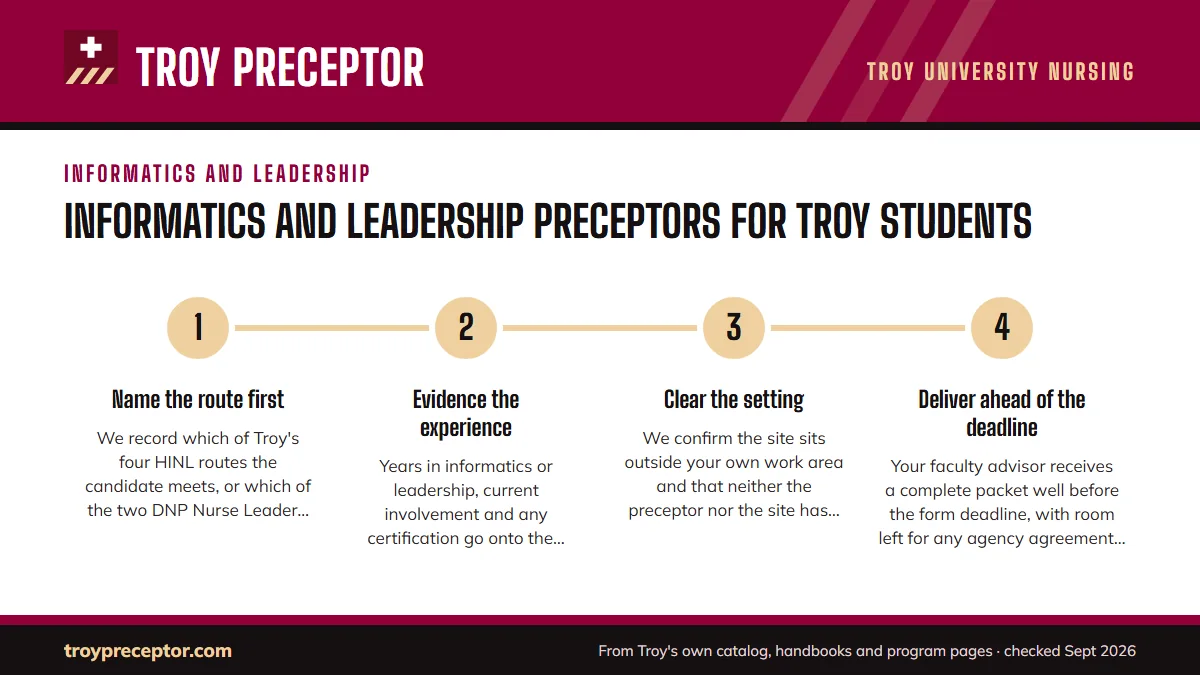
- Name the route firstWe record which of Troy's four HINL routes the candidate meets, or which of the two DNP Nurse Leader routes, before anyone is asked to commit.
- Evidence the experienceYears in informatics or leadership, current involvement and any certification go onto the Preceptor Biosketch in plain terms, with the license copy where one exists.
- Clear the settingWe confirm the site sits outside your own work area and that neither the preceptor nor the site has already been used twice in your program.
- Deliver ahead of the deadlineYour faculty advisor receives a complete packet well before the form deadline, with room left for any agency agreement the School of Nursing must start.
Your faculty advisor and course faculty approve each preceptor and setting. We make sure the informatics or leadership candidate they review already matches the route Troy wrote down. Use the form below to send us your track and home area.
Questions Troy students ask
Can someone who is not a nurse precept a Troy HINL practicum?
Yes, on two of Troy's four routes: an MS in computer technology or administration with direct involvement in active clinical practice, or a BS with five years in the area, preferably certified. Troy's packet asks for a copy of the preceptor's license, so ask your faculty advisor what to send for a candidate who holds none.
Does a Troy HINL preceptor need to be certified?
Only as a preference, and only on the BSN and BS routes, where Troy asks for three or five years in the area and says certification is preferred. MSN-prepared preceptors and MS holders qualify through their degree and direct involvement in the work, with no certification wording at all.
Can I do my HINL practicum at the hospital where I work?
Troy lets HINL students use any setting except their own work area or setting as an employee. Another employer's hospital is open to you and your own department is not. A separate unit inside your employer is worth raising with your faculty advisor first, since Troy's wording covers both area and setting.
How many clinical hours are in Troy's HINL track?
480, spread over NSG 6630 (120), NSG 6636 (180) and NSG 6637 (180), for MSN and post-master's certificate students alike. Post-BSN DNP Nurse Leader students add 60 hours in NSG 8880, for 540 leadership hours, inside the DNP's overall requirement of 1,000 clinical hours.
Can a BSN-prepared nurse manager precept a Troy DNP Nurse Leader student?
Not under the DNP manual's Nurse Leader list, which asks for an MSN or doctorate with leadership involvement, or an MS in administration in active clinical practice. The DNP manual does say preceptors without an MSN or DNP are considered individually, so a strong candidate can still be raised with your faculty advisor.
Related pages
Last checked 2026-09-27
We check these pages against Troy's own 2026-27 MSN, DNP, AMSN and RN to BSN orientation manuals, program pages, degree maps and state authorization pages. Your faculty advisor, your course faculty and the School of Nursing have the final word.
Troy asks you to recruit your preceptor. We make that the easy part.
Tell us your Troy program, where you live and which semester your next clinical course starts. We find preceptors who meet Troy's rules for the course, check the setting against Troy's limits, and prepare everything the Preceptor Information Form and biosketch ask for, well ahead of the form deadline.
- Preceptors matched to the course: a graduate-prepared NP or physician for
NSG 6619, pediatrics and women's health forNSG 6666, adults and older adults forNSG 6668 - Preceptor Information Form details, a biosketch and a copy of the preceptor's license, ready for your faculty advisor
- In your own area, in Alabama or a state where Troy can offer clinicals, never in your own work setting
Start your placement plan
Program, city and semester is all we need to begin.