Faculty approval and clearance: the two gates before Troy clinical hours count
Troy University faculty control two separate gates in every preceptorship. First they approve the preceptor and the clinical setting; later, once the agreements are back, they clear you to start. Hours you complete before clearance do not count, however good the site is.
Get your placement plan
Tell us your Troy program and where you live. A placement advisor replies with the preceptor and site options that fit your Troy course.
Approval and clearance are different decisions
Students often use the two words as if they meant the same thing, but Troy's manuals treat them as separate steps with the agency agreements in between. Approval concerns the preceptor and the site: course faculty, acting as your faculty advisor, decide whether this person in this setting fits the course. Clearance concerns you: faculty confirm that everything is in place for you to begin hours.
Approval is what lets the School of Nursing contact the agency. Clearance unlocks your clinical hours. A student with an approved preceptor and no clearance is still at zero hours for the course. The MSN Student Orientation Manual sets out both in its Guidelines for Preceptorship/Internship Courses, and the DNP manual follows the same pattern for 6000-level clinical courses.
What faculty check before approving
Faculty approve two things at once, the person and the place. Troy's manuals give them these checks, and each one is a way a request can come back to you.
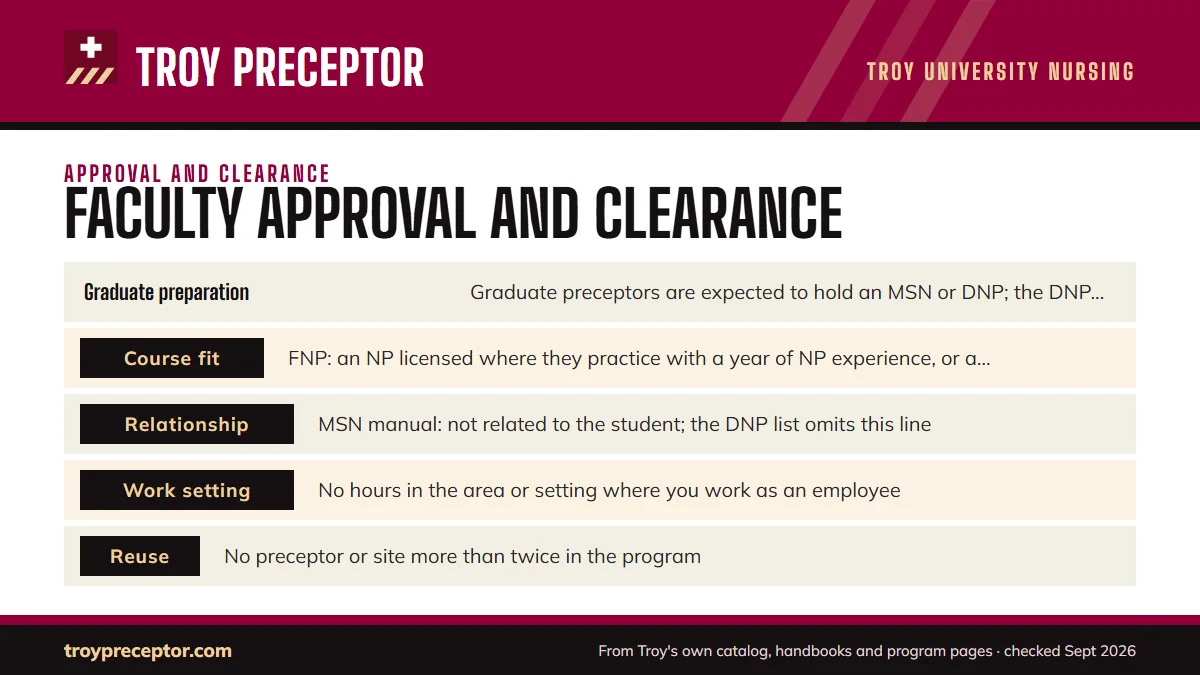
| Check | Troy's rule | How a request fails it |
|---|---|---|
| Graduate preparation | Graduate preceptors are expected to hold an MSN or DNP; the DNP manual considers others individually | A preceptor without graduate preparation and no case made for them |
| Course fit | FNP: an NP licensed where they practice with a year of NP experience, or a physician, midwife or PA; HINL, Nurse Leader and Nursing Education have their own lists | The right profession for the wrong course |
| Relationship | MSN manual: not related to the student; the DNP list omits this line | A family member as preceptor |
| Work setting | No hours in the area or setting where you work as an employee | A preceptor in your own unit or employer setting |
| Reuse | No preceptor or site more than twice in the program | A third course with the same person or site |
| Hospital timing | FNP students log no hospital hours before NSG 6680 | A hospital setting for NSG 6619, NSG 6666 or NSG 6668 |
| Completeness | Incomplete forms are not processed | A form sent without the biosketch or license copy |
RN to BSN requests go to lead faculty, whose approval of the Canvas acknowledgement form plays the same role. Each rule has its own guide: FNP preceptor requirements and work-setting and reuse rules.
What clearance waits on
Clearance follows the agreements. The MSN manual wants both agreements signed and returned before your start, and it allows no clinical hours until faculty clear you (agency agreements). For DNP students the manual spells out the file the School of Nursing needs first: preceptors' signed contracts, current clinical documents and your clinical schedule.
Your own compliance feeds the same gate. Every ViewPoint Screening document has to hold good from the day you register until the term closes, the RN license you rely on must carry no encumbrance in the clinical state for the entire term (license rule), and proof of health insurance is due again each clinical semester. Let nothing expire mid-term, because an expired item puts you back behind the gate.
Why early hours do not count
The MSN manual is direct: hours accrued before clearance do not count. That holds even when the preceptor is approved, the agency has signed and the preceptor is glad to have you start early. Hours also count only inside the course you are registered for, and never during semester breaks, so the window for counted hours runs from clearance to the end of the term.
Keep your records clean from the first day. Troy does not name a logging platform in its public manuals, and course faculty set the method for recording hours in each course. Troy treats falsified clinical hours as a conduct matter, with penalties that range from failing the course to suspension or expulsion.
An approved preceptor is not a start date. Wait for faculty clearance before your first clinical hour.
After clearance, faculty stay involved
Clearance opens the stretch of the course that faculty watch most closely. The clinical schedule form you file after your preceptor accepts your dates tells faculty where you should be and when, and they may check by phone, video conference or an in-person visit with no notice. Missing a scheduled day that coincides with a visit earns a zero on the clinical evaluation, so report every change right away (schedules and site visits). Build that schedule so every required hour lands before the term ends, since a break week adds nothing to your total.
If your preceptor leaves or the site pulls out mid-course, the replacement needs faculty approval just as the first preceptor did, so tell your faculty advisor before any hours with the new person. See our advice for the week a preceptor drops out.
DNP project approvals run on a separate track
DNP students in the synthesis courses meet approvals of a different kind, tied to the DNP Synthesis Project rather than a preceptor. The DSP Committee is formed at the start of NSG 8810, on Troy's DNP Project Advisory Committee Form. During NSG 8820 the student secures the external agency's approval, through a letter of support or IRB approval, gets the proposal approved and files a Troy IRB application.
NSG 8830 cannot begin without Troy IRB approval, barring an approved exception, and each synthesis course requires clinical hours documentation. Post-master's students also file a Verification of Post-Baccalaureate Clinical Hours with the DNP Program Coordinator, which lets earlier verified hours count toward the 1,000. Your DSP Chair and Committee sign off on the IRB application and, at the end, conduct the Final Competency Evaluation. Our DNP synthesis courses guide follows the four courses in order.
How we get you through both gates
We work to both gates from the start. For approval, we bring you a preceptor who clears every check in the table above for your exact course, and we assemble the biosketch details and license copy so faculty receive a whole packet. For clearance, we flag early whether the site needs a new formal contract and remind you which compliance items expire before the semester ends.
Faculty decide both approval and clearance; what reaches them from us is complete and already matches Troy's rules, which keeps the time between approval and your first counted hour as short as the process allows. If a preceptor falls through after approval, we line up a replacement and a fresh packet at once. Send us your course and semester through the form below.
Questions Troy students ask
How long does faculty approval of a Troy preceptor take?
Troy publishes no turnaround time for faculty review. What you control is the packet: a typed form, the biosketch and the license copy, sent together, for a preceptor and setting that pass every rule for the course. A complete, well-matched request is the one faculty can decide on without sending questions back.
Who clears me to start clinical hours at Troy?
Faculty. Clearance comes after the School of Nursing has the signed preceptor and agency agreements, and for DNP students after it also has signed preceptor contracts, current clinical paperwork and your schedule. Until faculty clear you, time at the site does not count toward the course.
Can hours from before clearance count if my preceptor signs off on them?
No. Troy's MSN manual states that hours accrued before clearance do not count, and a preceptor's signature does not change that. Recording those hours as course hours would also put you at risk under Troy's conduct standards on false clinical-hour information. Wait for clearance, then start.
Can Troy faculty turn down a preceptor I have already asked?
Yes. Faculty must approve all preceptors and settings, so a clinician who agreed to take you can still be declined if the credentials, setting, reuse count or relationship rule does not fit. Checking those points before you ask, and sending the packet early, leaves time to find someone else before your form deadline.
What if a late clearance leaves me short of hours at the end of the term?
Talk to course faculty early. Under Troy's 2025-26 Graduate Catalog, practicum and internship courses may carry an In-Progress grade, to be cleared within one calendar year, and an Incomplete by request when strict criteria are met; the instructor decides. Our page on being behind on clinical hours covers the options.
Related pages
Last checked 2026-09-27
We check these pages against Troy's own 2026-27 MSN, DNP, AMSN and RN to BSN orientation manuals, program pages, degree maps and state authorization pages. Your faculty advisor, your course faculty and the School of Nursing have the final word.
Troy asks you to recruit your preceptor. We make that the easy part.
Tell us your Troy program, where you live and which semester your next clinical course starts. We find preceptors who meet Troy's rules for the course, check the setting against Troy's limits, and prepare everything the Preceptor Information Form and biosketch ask for, well ahead of the form deadline.
- Preceptors matched to the course: a graduate-prepared NP or physician for
NSG 6619, pediatrics and women's health forNSG 6666, adults and older adults forNSG 6668 - Preceptor Information Form details, a biosketch and a copy of the preceptor's license, ready for your faculty advisor
- In your own area, in Alabama or a state where Troy can offer clinicals, never in your own work setting
Start your placement plan
Program, city and semester is all we need to begin.