How Alabama's collaborative practice rules shape your NP preceptor
In Alabama, a certified registered nurse practitioner practices in collaboration with a physician under written protocols, and those rules reach into every practice where a Troy University NP student might train. Knowing how collaboration works, what the 10 percent rule asks of newer CRNPs and what changed in 2026 helps you read a practice and ask a prospective preceptor the right questions.
Get your placement plan
Tell us your Troy program and where you live. A placement advisor replies with the preceptor and site options that fit your Troy course.
Collaboration, in plain terms
Alabama requires CRNPs and certified nurse midwives to work in collaboration with at least one physician licensed in the state. The Alabama Board of Nursing and the Board of Medical Examiners share oversight through a Joint Committee, which recommends to both boards the collaboration rules, model protocols and the legend-drug formulary.
Collaboration is a formal relationship set down in written protocols. Rule 610-X-5-.01 says it does not mean direct on-site supervision, but it does mean the medical oversight the two boards set out. For your search, that means an Alabama NP preceptor in clinical practice always works under a signed protocol naming a collaborating physician, and the protocol shapes what the preceptor may do.
The 10 percent rule for newer CRNPs
Until a CRNP has two years, or 4,000 hours, of collaborative experience, the collaborating physician must be present for at least 10 percent of the CRNP's scheduled hours (610-X-5-.09). The ABN's advanced practice FAQ adds that time with a covering physician counts toward that share, though a covering physician cannot supply all of it. A CRNP who moves into an unfamiliar specialty restarts the 4,000-hour count.
This matters because Troy's floor for an NP preceptor is one year of NP experience, half of Alabama's two-year mark. A CRNP in the second year can meet Troy's rule while still inside the 10 percent requirement, so the physician's presence is part of the practice you would join. It is a normal arrangement, and it helps to know about it before your first clinical day.
Physician limits and practice sites
A collaborating physician can cover no more than 360 hours a week, nine full-time equivalents, across CRNPs, CNMs and PAs, counting agreements in other states (610-X-5-.05). Above four full-time equivalents, the physician runs monthly quality assurance with each new CRNP for six months. The physician must be readily available, with a pre-approved covering physician otherwise, visits remote sites twice a year and meets experienced CRNPs quarterly.
The standard protocol lists every practice site along with a formulary, an emergency plan, a referral process and a quality assurance plan. Care counts as happening where the patient is located. When you speak with a prospective preceptor, ask which sites the protocol covers, because those are the places the preceptor practices.
Prescribing and the QACSC
Alabama CRNPs prescribe legend drugs from the formulary both boards adopt, as authorized in the signed protocol (610-X-5-.12). Off-label use is allowed when it is standard of care, evidence-based, approved by the physician and documented. Prescriptions carry the collaborating physician's name and the CRNP's RN license number, and prescribing for oneself, immediate family or non-patients is barred.
Controlled substances need a QACSC under Board of Medical Examiners chapter 540-X-18. A CRNP qualifies after 12 months of active practice under approved collaborative agreements, not counting temporary approval, plus a 12-hour course (8 hours on controlled-substance prescribing and 4 of advanced pharmacology), with a collaborating physician who holds a valid ACSC. The QACSC covers Schedules III, IV and V only. Whether your preceptor holds one shapes what you see of controlled-substance prescribing in that practice.
What changed from 2024 to 2026
- January 1, 2024. Collaborating physicians must complete Board of Medical Examiners CME on the collaboration rules, and the ABN began requiring CRNPs and CNMs to finish a three-module course on collaborative practice, the approval process, and protocols, skills and professional responsibilities.
- December 2023 to May 15, 2025. The QACSC rules were amended several times, touching qualifications and required disclosures.
- January 10, 2026. The ABN moved CRNP rules on qualifications, application, authorization, temporary approval, standards, functions and reinstatement from chapter 610-X-5 into a new chapter, 610-X-9. Chapter 610-X-5 keeps the collaboration rules.
- July 13, 2026. Amendments to rules 610-X-9-.14 through -.16 made CE on Alabama's collaborative-practice rules a CRNP qualification and a renewal item.
- September 1, 2026. After a cybersecurity event and system outage, the ABN began taking paper applications for initial advanced practice approval, reinstatement and new collaborations, and asked that changes to existing collaborations wait.
One loose end remains: rule 610-X-9-.15 still points to a collaboration exemption under 610-X-5-.07, which the current compilation marks as repealed. If a practice mentions an exemption, the ABN is the place to confirm it.
After Troy: the road to Alabama CRNP approval
The same rules will govern your first job, so the order of steps is worth knowing now.
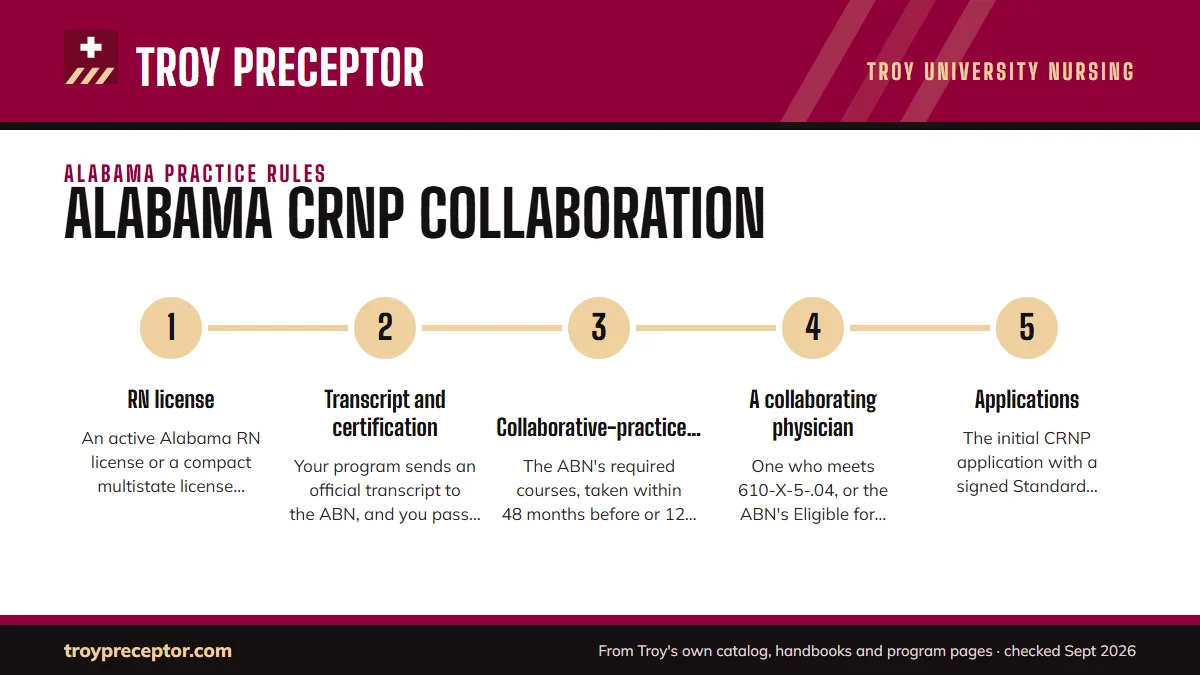
- RN licenseAn active Alabama RN license or a compact multistate license; multistate holders still apply to the ABN for advanced practice approval.
- Transcript and certificationYour program sends an official transcript to the ABN, and you pass an ABN-recognized national NP certification that matches your education.
- Collaborative-practice CEThe ABN's required courses, taken within 48 months before or 12 months after the collaboration begins.
- A collaborating physicianOne who meets 610-X-5-.04, or the ABN's Eligible for Collaboration application if you have none yet.
- ApplicationsThe initial CRNP application with a signed Standard Protocol and Quality Assurance Plan; the physician files a Commencement of Collaborative Practice form with the BME, which cites about two to three weeks for processing.
- Temporary, then full approvalTemporary approval follows the BME's confirmation, and full approval comes monthly or on Joint Committee dates. Your first 4,000 hours then run under the 10 percent rule.
Putting these rules to work in your search
We use Alabama's rules before a name ever reaches you. For each Alabama candidate we confirm approval status, the practice sites on the protocol and time in collaborative practice, then check the fit against Troy's list for the course in FNP preceptor requirements. Troy also accepts physicians (MD or DO) as FNP preceptors, so a practice's collaborating physician can be a candidate in their own right, subject to faculty approval.
Troy faculty approve every preceptor and setting, and the packet you send already answers the questions they are likely to ask. For the wider Alabama picture, see Alabama NP preceptors and the Alabama state guide.
Questions Troy students ask
Can a CRNP in their first two years precept a Troy student?
Troy asks for at least one year of NP experience, so a CRNP past the first year can qualify for Troy while Alabama's 10 percent physician presence rule still applies to their practice. The collaborating physician's time on site is simply part of how that practice runs, and your faculty advisor makes the final call.
Where are Alabama's CRNP rules now?
Since January 10, 2026, the ABN's CRNP rules on qualifications, applications, approval and practice standards sit in chapter 610-X-9 of the Alabama Administrative Code. The collaboration rules stayed in chapter 610-X-5, and controlled-substance rules for CRNPs sit with the Board of Medical Examiners in chapter 540-X-18.
Can Alabama NPs practice without a collaborating physician?
Alabama's current rules still require collaboration for CRNPs in clinical practice. The ABN's advanced practice FAQ names one designation that needs no collaboration, Faculty Only. A CRNP preceptor seeing patients will therefore have a collaborating physician named in a signed protocol, which is worth asking about during your first conversation.
What is a Graduate Registered Nurse Practitioner in Alabama?
A provisional approval for an Alabama-licensed RN who has applied for the first NP certification exam. It lasts up to six months, requires on-site supervision and physician review of every case, and ends when full approval arrives or if the exam is failed, under rule 610-X-9-.17(2).
Does the 2026 ABN outage affect precepting?
It affects paperwork around collaborations. Since September 1, 2026, the ABN has taken paper applications for initial approvals, reinstatements and new collaborations, and it asked that changes to or terminations of existing collaborations be held until its system is back. Troy's own preceptor paperwork goes to your faculty advisor as usual.
Related pages
Last checked 2026-09-27
We check these pages against Troy's own 2026-27 MSN, DNP, AMSN and RN to BSN orientation manuals, program pages, degree maps and state authorization pages. Your faculty advisor, your course faculty and the School of Nursing have the final word.
Troy asks you to recruit your preceptor. We make that the easy part.
Tell us your Troy program, where you live and which semester your next clinical course starts. We find preceptors who meet Troy's rules for the course, check the setting against Troy's limits, and prepare everything the Preceptor Information Form and biosketch ask for, well ahead of the form deadline.
- Preceptors matched to the course: a graduate-prepared NP or physician for
NSG 6619, pediatrics and women's health forNSG 6666, adults and older adults forNSG 6668 - Preceptor Information Form details, a biosketch and a copy of the preceptor's license, ready for your faculty advisor
- In your own area, in Alabama or a state where Troy can offer clinicals, never in your own work setting
Start your placement plan
Program, city and semester is all we need to begin.