Troy University nursing clinicals in Alabama, Troy's home state
Alabama is home to Troy University's School of Nursing, and Troy's online nursing disclosure lists it as a state where the RN to BSN, MSN and DNP can offer clinical experiences. What shapes an Alabama search is state law: every CRNP practices in collaboration with a physician, the Board of Nursing defines who may precept, and shortage designations differ sharply across Pike, Montgomery and Houston counties.
Get your placement plan
Tell us your Troy program and where you live. A placement advisor replies with the preceptor and site options that fit your Troy course.
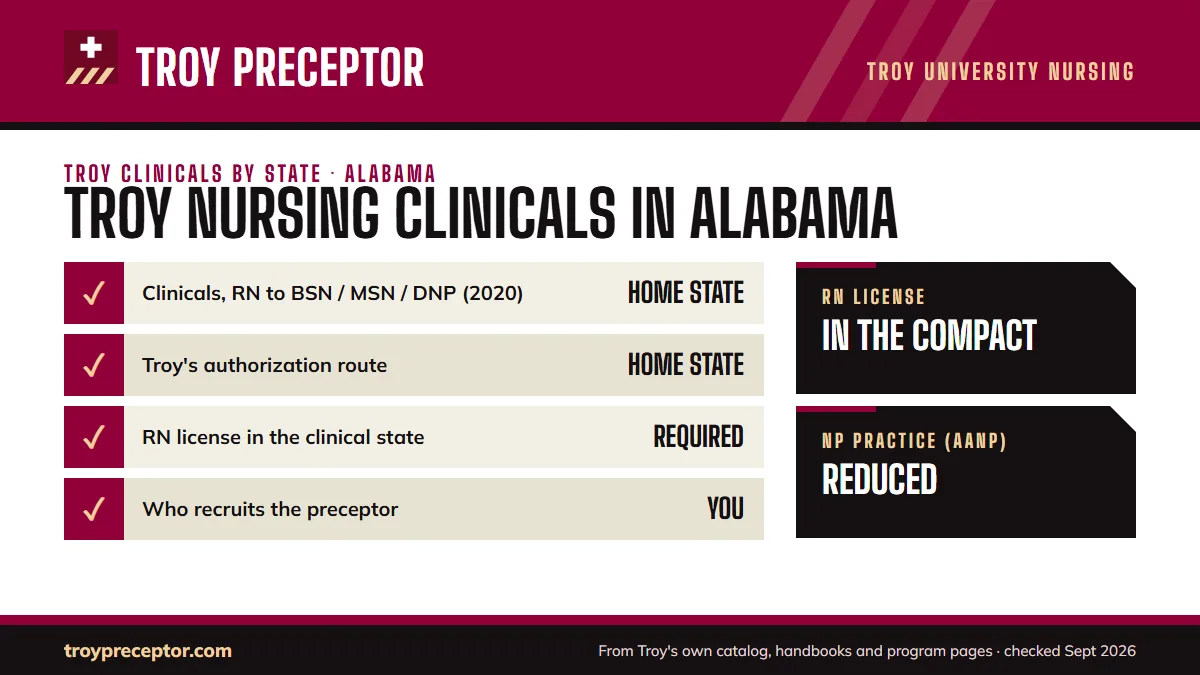
What Troy says about Alabama
Alabama reads Yes on Troy's Online Nursing Programs disclosure, which asks one thing of each state on behalf of Troy's online RN to BSN, MSN and DNP: can clinical experiences happen there? Alabama's row, like the other 50, is dated 12/15/2020 and is not a licensure determination, so put anything unusual about your county or track to Troy's Clinical Placements Specialist and its Coordinator of State Authorizations before the search begins.
| Troy source | What it says for Alabama |
|---|---|
| Online Nursing Programs disclosure | Yes, with no added note; last updated 12/15/2020 |
| State authorization page and NC-SARA directory | Authorized by the Alabama Commission on Higher Education, which also serves as Alabama's SARA portal agency |
| MSN Student Orientation Manual 2026-27 | Students recruit their own preceptors and faculty approve each one; the graduate program reports good relationships with Alabama agencies |
| 2025-26 Graduate Catalog | DNP students hold an unencumbered RN license in Alabama or in the state where clinical practice will occur |
Alabama's Yes comes with no board petition or extra filing, but it clears no individual site: each preceptor and setting still needs faculty approval and signed agreements. The clinicals-by-state table compares every state.
Troy's campuses and where online students train
Troy's School of Nursing belongs to the College of Health Sciences and teaches on three Alabama campuses. Jones Hall on the Troy campus is the heart of the program, where a hospital lab holds 30 beds beside five advanced simulation rooms. Montgomery runs the ASN out of Bartlett Hall's nursing labs, while Dothan offers the BSN alongside Troy and the hybrid Accelerated MSN, launched in August 2026, with its simulation lab in Adams Hall.
Online graduate students meet those campuses mostly through faculty office hours, held online and on all three. The 2025-26 graduate catalog and the DNP manual add Phenix City as a faculty base, which Troy's accreditation page omits.
Clinical hours follow your address rather than a campus. The catalog tells FNP students they finish clinical requirements in their own locale, with a limited number of mandatory on-campus requirements, and the HINL track has none. Campus programs are tied to geography instead: BSN sites sit inside a 60-mile radius of the Troy and Dothan campuses, and ASN facilities within about 50 miles of Montgomery.
Collaborative practice, the rule behind every Alabama NP preceptor
Every Alabama CRNP practices in collaboration with at least one Alabama-licensed physician, under written protocols set by chapter 610-X-5 of the Board of Nursing's rules. The physician need not be on site at all times. A Joint Committee drawn from the nursing and medical boards recommends the rules, model protocols and drug formulary, and AANP counts Alabama among its reduced-practice states because of this collaboration requirement.
- The 10% rule. A CRNP with less than 4,000 hours, about two years, of collaborative experience needs the physician present for at least 10% of scheduled hours. Time with an approved covering physician counts, though that physician cannot supply all of it.
- Physician capacity. A single physician's collaboration and supervision load tops out at 360 hours weekly (nine FTEs) spread over CRNPs, nurse midwives and PAs, out-of-state agreements counted.
- Controlled substances. Prescribing them takes a QACSC from the Board of Medical Examiners, open after 12 months of approved collaborative practice and a 12-hour course, and limited to Schedules III, IV and V.
- The 2026 reorganization. On January 10, 2026 the Board moved CRNP qualifications, applications, approvals, standards and reinstatement into a new chapter, 610-X-9, leaving collaboration in 610-X-5. Since July 13, 2026, CE on the collaborative-practice rules is both a qualification and a renewal item.
Our collaboration guide explains how each of these rules plays out on a clinical day.
What the Alabama Board of Nursing says about preceptors
The Board's definition of an advanced practice preceptor is wide. Rule 610-X-3-.01(9) covers an APRN, a physician, or another licensed clinician suited to the population being taught. Troy's FNP list fits inside it: NPs past their first year of NP practice, plus physicians, PAs and nurse midwives, with graduate preparation expected. The FNP preceptor requirements page sets out Troy's side.
Rule 610-X-3-.05(2) asks APRN programs to ensure that clinical agencies and preceptors are "provided for and/or available to students." No Board rule hands the preceptor search to students or forbids it, which leaves the question to Troy's manuals, and the MSN manual settles it: you ask preceptors to serve, and faculty approve each one.
Programs based outside Alabama face an extra step under rule 610-X-3-.09: a letter of intent at least 15 days before clinicals, naming the student, the clinical supervisor, the facility and responsible faculty, plus an annual out-of-state program fee. Troy is an Alabama program, so that filing belongs to other schools. The Board's license rule reaches everyone, though: post-licensure students who train in the state must hold either an Alabama RN license or a multistate one.
What Alabama health systems publish about students
Several large systems post their own student rules. Each speaks only for that system, so read it before you approach a clinician who works there.
- Southeast Health, Dothan. Its student page gives first call to the affiliated Alabama College of Osteopathic Medicine, takes other schools' students when resources permit, and points nurse practitioner students to an email inquiry.
- Huntsville Hospital. Before a first shift, NP and nurse-midwife students complete learning modules, tests and affirmations and an NP and Nurse Midwife Clinical Student Registration form, then wear a non-employee badge that expires each August 31.
- Piedmont Healthcare, Columbus, Georgia, near Phenix City. Schools submit every rotation request through ACEMAPP during set months (August for spring, February for summer, April for fall); students do not.
- UAB, Birmingham. UAB School of Nursing's pages, written for its own students, treat all UAB clinics as a committed network reached through its Office of Clinical Placement.
With the big systems routing requests through schools and their own affiliations, independent practices, community clinics and physician offices outside your workplace become the natural first asks. Finding NP preceptors in Alabama goes deeper on each system.
Shortage areas around Troy, Montgomery and Dothan
HRSA's shortage designations pull Troy's three campus counties in different directions.
| County | Primary care | Mental health |
|---|---|---|
| Pike (Troy) | Low-income population HPSA, score 19, rural; Southeast Alabama Rural Health Associates FQHC, score 19 | MHCA-15 catchment area, score 17, rural; the same FQHC, score 21 |
| Montgomery | Low-income population HPSA, score 17; Health Services Inc FQHC, score 20 | Health Services Inc FQHC, score 22; MHCA-14 proposed for withdrawal |
| Houston (Dothan) | No designated primary care HPSA; its low-income designation was withdrawn in 2018 | MHCA-19, proposed for withdrawal |
HRSA withdrew Montgomery's broader Montgomery/Prattville low-income primary care HPSA on January 2, 2024, and the county also holds a small correctional designation at Kilby Correctional Facility.
Rural designation ties into Alabama's Preceptor Tax Incentive Program (Act 2023-519, Code of Alabama 40-18-520 to -527). It gives uncompensated community-based preceptors, advanced practice nurses among them, a state income tax credit from tax year 2024 until September 29, 2031, counted in 160-hour rotations, at most 12 a year. Rotations must sit in medically underserved rural parts of Alabama and support programs physically located in the state and registered with AHEC, and the Alabama Statewide AHEC Program Office decides each claim. The Montgomery, Dothan and Troy guide works county by county.
Licensing in Alabama, during the program and after it
During the program, your RN license must be unencumbered and valid in Alabama for every day of each semester: an Alabama license, or a multistate one from another Compact state, since Alabama joined the Nurse Licensure Compact on January 1, 2020. Alabama has not enacted the APRN Compact; Troy's wording is on the license rule page.
After graduation, an FNP becomes an Alabama CRNP in roughly this order:
- Transcript and certificationTroy sends an official transcript to the Board (no faxes), and you pass a Board-recognized national NP certification.
- Optional provisional statusAfter applying for the first certification exam, an Alabama RN can work as a Graduate Registered Nurse Practitioner for up to six months, supervised on site.
- Collaborative-practice CEFinish the Board's three required courses, no earlier than 48 months before the collaboration starts and no later than 12 months after.
- Physician, protocol and applicationSecure a collaborating physician or file the Eligible for Collaboration application, then file the initial CRNP application, including a signed Standard Protocol and a Quality Assurance Plan for each collaboration.
- BME filing and temporary approvalThe physician files the Commencement of Collaborative Practice form with the Board of Medical Examiners (about two to three weeks); temporary approval follows, limited to the standard protocol and formulary.
- Full approval and renewalComplete applications are approved monthly, others on Joint Committee dates; renewal takes 6 pharmacology contact hours each biennium.
Two current facts affect timing. Since a system outage on September 1, 2026, the Board has accepted first-time approvals, reinstatements and new collaborations on paper, with changes to current collaborations on hold. The NP workforce has also shifted: the Board's FY2024 annual report counted 6,583 active CRNPs at the close of September 2024, against 8,758 twelve months earlier, and 1,279 more approved yet outside any collaborative agreement.
Why Troy students in Alabama choose us
Alabama's rules are our daily work: collaboration, the 10% rule for newer CRNPs, the shortage map around Troy's campuses and the systems that take requests only from schools. We search from your county outward, check each candidate's NP license, experience and practice setting against Troy's rules, keep your workplace and any twice-used preceptor off the list, and gather everything your Preceptor Information Form and biosketch call for, plus the license copy, well before your deadline. Troy faculty approve every Alabama preceptor and setting, and what lands on their desk is ready for that decision. Start your Alabama search.
Questions Troy students ask
Can I do Alabama clinicals on a multistate license from Georgia or Florida?
For graduate and RN to BSN students training in Alabama, the Board of Nursing takes an Alabama RN license or a Compact multistate license, and Georgia and Florida both issue multistate licenses. Troy adds its own condition, a license good in Alabama for every day of the term, so show your faculty advisor the multistate status early.
Can a newer Alabama CRNP precept me?
Troy's floor is one year of NP practice, so a CRNP beyond it can qualify even while Alabama's 10% rule still applies. That rule keeps the physician on site for a tenth or more of scheduled hours until the CRNP logs 4,000 collaborative hours. It sits alongside Troy's own approval of the preceptor.
Why can't my Alabama NP preceptor prescribe Schedule II drugs?
Alabama CRNPs who prescribe controlled substances do it under a QACSC from the Board of Medical Examiners, and that certificate covers Schedules III, IV and V only. Schedules I and II are barred, and so is ordering stock supply. The certificate also ends automatically if the collaborating physician's own controlled substances certificate lapses or is restricted.
Does Alabama's preceptor tax credit apply to a Montgomery practice?
It depends on where the rotation happens. The credit is limited to uncompensated preceptors working in medically underserved rural areas of Alabama, for programs physically located in the state and registered with AHEC. Whether a particular Montgomery or Dothan address qualifies is for the Alabama Statewide AHEC Program Office to decide; preceptors register once and pre-certify the credit in My Alabama Taxes.
Does the Board of Nursing outage delay my Troy placement?
The outage reported from September 1, 2026 concerns the Board's advanced practice processing: paper filings for initial approval, reinstatement and new collaborations, and a pause on changes to existing ones. Your placement runs through Troy's faculty approval and the School of Nursing's agreements. If a prospective preceptor is changing collaborating physicians this fall, ask how the pause affects their schedule.
Related pages
Last checked 2026-09-27
We check these pages against Troy's own 2026-27 MSN, DNP, AMSN and RN to BSN orientation manuals, program pages, degree maps and state authorization pages. Your faculty advisor, your course faculty and the School of Nursing have the final word.
Troy asks you to recruit your preceptor. We make that the easy part.
Tell us your Troy program, where you live and which semester your next clinical course starts. We find preceptors who meet Troy's rules for the course, check the setting against Troy's limits, and prepare everything the Preceptor Information Form and biosketch ask for, well ahead of the form deadline.
- Preceptors matched to the course: a graduate-prepared NP or physician for
NSG 6619, pediatrics and women's health forNSG 6666, adults and older adults forNSG 6668 - Preceptor Information Form details, a biosketch and a copy of the preceptor's license, ready for your faculty advisor
- In your own area, in Alabama or a state where Troy can offer clinicals, never in your own work setting
Start your placement plan
Program, city and semester is all we need to begin.