Preceptors in Montgomery, Dothan and Troy
Troy University's nursing campuses sit in Troy, Dothan and Montgomery, and for students who live nearby those regions are the natural place to look for a preceptor. The three counties behind those cities look very different in federal shortage data, while Troy's preceptor rules apply the same way in each. Here are the county facts, what Troy asks of a local preceptor, and how our search runs close to home.
Get your placement plan
Tell us your Troy program and where you live. A placement advisor replies with the preceptor and site options that fit your Troy course.
Three campuses, clinicals where you live
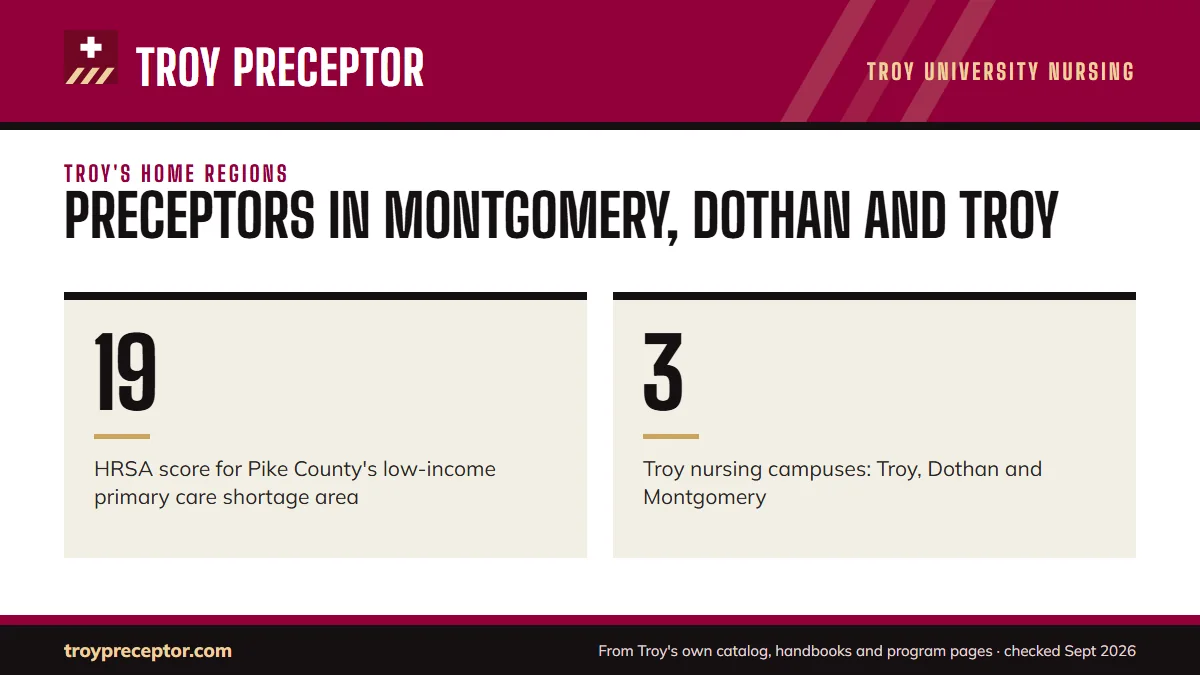
Each campus hosts different programs. The Troy campus holds Jones Hall, whose 30-bed hospital lab sits alongside five advanced simulation rooms; Dothan offers the BSN alongside Troy and runs the Accelerated MSN; Montgomery houses the ASN, with nursing labs in Bartlett Hall. MSN faculty keep office hours online and on all three campuses.
For the online graduate programs, your address matters more than the nearest campus. Troy's 2025-26 graduate catalog says of the MSN FNP: "Students complete clinical requirements in their locale." The prelicensure programs work by radius instead: Troy says BSN clinical sites sit inside a 60-mile radius of Troy and/or Dothan, and the catalog puts ASN clinical facilities within roughly 50 miles of Montgomery.
Shortage designations, county by county
Federal shortage data draw a sharp line between the three counties. Pike and Montgomery carry designated primary care shortage areas; Houston County, home to Dothan, has none.
| County (city) | Primary care | Mental health | Dental |
|---|---|---|---|
| Pike (Troy) | Low-income population, score 19, rural; Southeast Alabama Rural Health Associates FQHC, score 19 | Catchment area 15, score 17, rural; the same FQHC, score 21 | Low-income population, score 19, rural; the same FQHC, score 25 |
| Montgomery (Montgomery) | Low-income population, score 17; Health Services Inc FQHC, score 20; Kilby Correctional Facility, score 3 | Health Services Inc FQHC, score 22; catchment area 14 proposed for withdrawal | Health Services Inc FQHC, score 25; low-income designation proposed for withdrawal |
| Houston (Dothan) | None designated | Catchment area 19 proposed for withdrawal | None designated |
Pike County and the city of Troy
Pike County holds two primary care designations. One covers its low-income population, marked rural and designated in 2018 with a score of 19; the other is a facility designation for Southeast Alabama Rural Health Associates, a federally qualified health center, also scored 19. The county also sits in mental health catchment area 15, a rural geographic designation, and carries dental designations.
In plain terms, HRSA counts the county's low-income residents as short of primary care clinicians, and primary care is the focus of Troy's NSG 6666 and NSG 6668. Alabama's preceptor tax credit is aimed at rotations in medically underserved rural areas; whether any Pike County practice qualifies is for the preceptor to confirm with the Alabama Statewide AHEC Program Office, as our Alabama NP preceptors page explains.
Montgomery
Montgomery County's primary care designations today are a low-income population shortage area scored 17 and designated in 2022, a facility designation for Health Services Inc scored 20, and a correctional designation for Kilby Correctional Facility. A larger low-income designation covering Montgomery and Prattville was withdrawn on January 2, 2024, and mental health catchment area 14 is proposed for withdrawal.
The Montgomery metro area counted 388,747 residents in the Census Bureau's 2025 estimate. For ASN clinical experiences, Troy's own ASN page lists three hospitals: Jackson Hospital, Regional Medical Center of Central Alabama and Baptist Medical Center South, and Troy built its LPN to RN pathway with Baptist Health. Those are prelicensure ties that Troy itself describes, separate from graduate preceptorships, where you still recruit each preceptor.
Dothan and Houston County
HRSA's files show no designated primary care or dental shortage area in Houston County. Its low-income primary care designation was withdrawn on July 2, 2018, and its only mental health designation, catchment area 19, is proposed for withdrawal. Dothan is also where Troy runs the Accelerated MSN, whose preceptor courses, NSG 5549 and NSG 6698, follow the AMSN manual's own rules.
Southeast Health, based in Dothan, says on its student opportunities page that rotations mostly serve students of its affiliated osteopathic medical school, that students from other institutions are accepted when resources permit, and that NP students should inquire by email. Troy's own pages describe a Nurse Student Apprenticeship with Flowers Hospital and the Baptist Health system for selected BSN students; that is a BSN program, apart from NP preceptorships.
What Troy asks of a preceptor close to home
Troy's rules are the same in every county, but in a smaller market they narrow the field faster. No hours may fall in your own work area or setting, so if you work for the main hospital or clinic group in town, its settings drop off your list. Each preceptor and each site can appear at most twice across your program, which matters when only a handful of practices sit within reach.
FNP students wait for NSG 6680 before any hospital hours count, NSG 6666 needs two preceptors, and an NP preceptor needs a year of NP experience. For clinicals in Alabama, your RN license must be an Alabama or multistate license. The work-setting and reuse rules page explains the limits in full.
How our search runs in Troy's home regions
We begin in your home county and widen by drive time, which can mean crossing into a neighboring county or, near a border, into another state, where Troy's license rule comes into play. Before you hear a name we check the course fit, your work setting, your reuse count and the preceptor's license, and we look at how the practice's collaborating physician arrangement works, covered on our CRNP collaboration page.
Then we gather what your packet needs so it reaches your faculty advisor complete and early. Troy faculty approve every local preceptor and setting, and agency agreements run through the School of Nursing. For the rest of the state, see the Alabama guide.
Questions Troy students ask
Can I do FNP clinicals at the Dothan hospital where I work?
Not in your own work area or setting, which Troy rules out for graduate clinicals. FNP students also log no hospital hours before NSG 6680, so the first three FNP preceptorships happen outside hospitals in any case. A practice run by a different organization, outside your own setting, can work if faculty approve it.
Does it matter which campus my faculty advisor works from?
Not for the paperwork. You email the preceptor packet to your faculty advisor wherever they are based, the Clinical Placements Specialist works from the Troy Campus, and the School of Nursing's admissions office in Montgomery helps graduate nursing students with admissions and registration. Faculty site visits can happen by phone or video as well as in person.
Can I do HINL practicums at a hospital near my campus?
Yes, as long as it is not where you work. Troy lets HINL students use any setting, unlike FNP students, so a hospital's informatics or leadership department can host NSG 6630, NSG 6636 or NSG 6637. The preceptor must meet one of Troy's HINL options, such as an MSN with direct involvement in informatics or leadership.
I live near Phenix City. Where should I look?
The DNP manual still lists Phenix City as a faculty base, though current MSN pages name only Troy, Dothan and Montgomery. Across the state line, Piedmont Healthcare in Columbus takes rotation requests only from schools, through ACEMAPP, in set windows. Clinicals in Georgia need an RN license valid there, and Troy's 2020 table lists Georgia as available.
Related pages
Last checked 2026-09-27
We check these pages against Troy's own 2026-27 MSN, DNP, AMSN and RN to BSN orientation manuals, program pages, degree maps and state authorization pages. Your faculty advisor, your course faculty and the School of Nursing have the final word.
Troy asks you to recruit your preceptor. We make that the easy part.
Tell us your Troy program, where you live and which semester your next clinical course starts. We find preceptors who meet Troy's rules for the course, check the setting against Troy's limits, and prepare everything the Preceptor Information Form and biosketch ask for, well ahead of the form deadline.
- Preceptors matched to the course: a graduate-prepared NP or physician for
NSG 6619, pediatrics and women's health forNSG 6666, adults and older adults forNSG 6668 - Preceptor Information Form details, a biosketch and a copy of the preceptor's license, ready for your faculty advisor
- In your own area, in Alabama or a state where Troy can offer clinicals, never in your own work setting
Start your placement plan
Program, city and semester is all we need to begin.