The three HINL practicums at Troy University, course by course
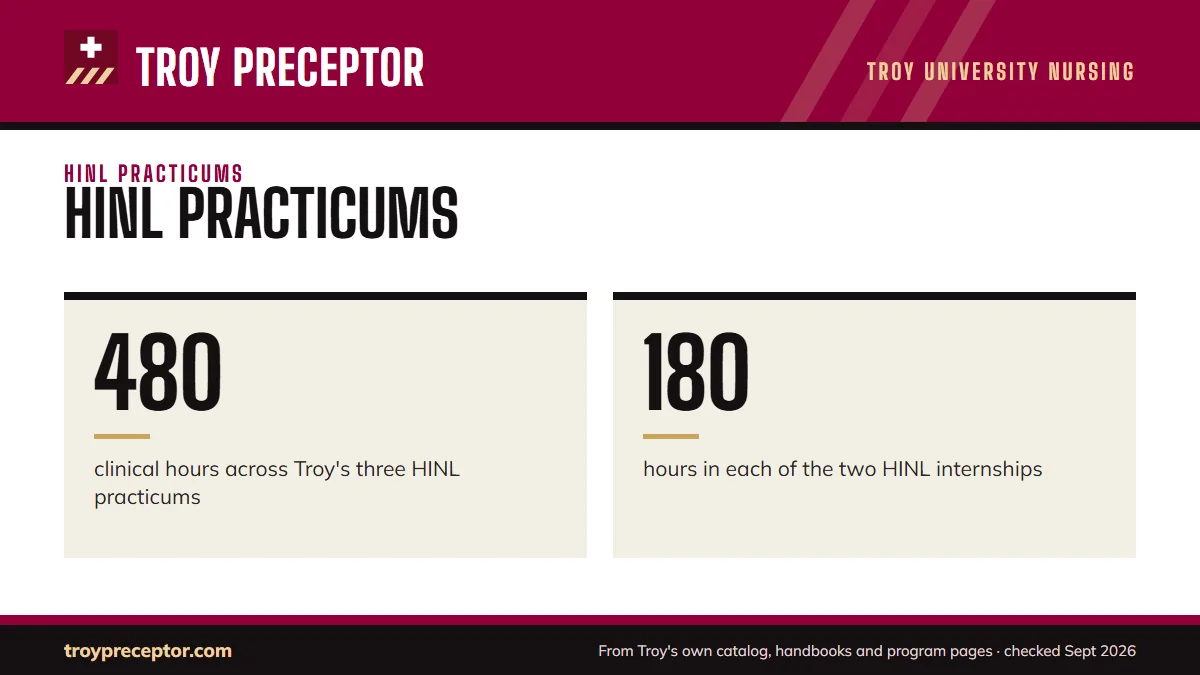
Troy University's Healthcare Informatics and Nursing Leadership track places its 480 clinical hours in three practicums: NSG 6630 for 120 hours, then NSG 6636 and NSG 6637 for 180 hours each. You recruit an informatics or leadership preceptor for every one and faculty approve each choice, so the real planning job is covering all three without running into Troy's reuse and work-setting rules.
Line up preceptors for all three practicums
Tell us your state, your track and the semester your first HINL practicum begins.
The three practicums at a glance
Three kinds of Troy learners sit in these courses: MSN HINL students, those earning the post-master's HINL certificate, and DNP students who entered with a BSN and chose the Nurse Leader track. The MSN manual's Progression section gives the 480-hour total for the first two groups. The DNP manual prints the course-by-course split, because Nurse Leader students take the same three courses and then add NSG 8880.
| Course | Title | Credits | Clinical hours |
|---|---|---|---|
NSG 6630 | Introduction to Nursing Leadership and Technology Practicum | 2 SH | 120 |
NSG 6636 | Advanced Nursing Practice Internship I | 3 SH | 180 |
NSG 6637 | Advanced Nursing Practice Internship II | 3 SH | 180 |
NSG 8880 | Directed Professional Practicum (DNP Nurse Leader track only) | Usually 1 SH | 60 |
Each course works out to 60 hours of practicum time for every credit, so the credits on your schedule are a fair guide to how much time a preceptor must give you. For the Nurse Leader track, the three practicums plus NSG 8880 make 540 leadership hours; how the rest of the DNP's hours are built is on the 1,000-hour rule.
NSG 6630: the first practicum
NSG 6630 is the lightest of the three, at 2 credits and 120 hours, and its title pairs leadership with technology. A preceptor whose own work crosses both lines suits it well, for example a nurse manager leading a documentation change or an informatics nurse who also supervises staff. Troy qualifies preceptors by degree, experience and direct involvement in the field rather than by job title, so look at what the person actually does.
It is also where your paperwork routine begins. Because NSG 6630 is not NSG 6619, the MSN manual gives you a month from the course's opening class to get your preceptor's information form, biosketch and license copy to your faculty advisor. Missing that month forces a drop of both the practicum and the course paired with it. DNP students work to an earlier line, their semester's final no-penalty drop date; the form deadlines page compares the two.
MSN students find the semester for NSG 6630 in the planners posted in Canvas, since the manual's text gives the HINL total without naming a term for each practicum. Nurse Leader students can expect their first leadership practicum in their first spring, according to the DNP manual.
NSG 6636 and NSG 6637: the two internships
The two internships carry equal weight, 3 credits and 180 hours apiece, and share a name: Advanced Nursing Practice Internship I and II. Between them they hold three quarters of your HINL hours. That makes a preceptor's calendar as important as their credentials.
Spread over a 16-week semester, 180 hours comes to roughly 11 hours a week from the day faculty clear you, and more if clearance arrives late. A preceptor who can host you for one afternoon a week will struggle to carry an internship alone, so ask how many hours a week they can realistically offer before you send any forms.
The second internship can go deeper into the same kind of work or open a different side of informatics or leadership. Both approaches fit Troy's rules, as long as the preceptor and site counts in the next section stay within limits. Whichever you choose, every hour has to land between the course's first and last days, with none in the breaks between semesters, and your clinical schedule form should match what you actually do.
Planning preceptors across all three courses
Two rules shape the plan. Troy's manuals allow no preceptor or clinical site more than twice in the program, and no practicum hours in the unit or facility that employs you. With three practicums and a two-use limit, no single preceptor can take you all the way through.
Workable patterns
- One preceptor for
NSG 6630andNSG 6636, a second forNSG 6637. - One preceptor for
NSG 6630, a second who carries both internships. - Three preceptors, one per course, which leaves the most room if someone steps away mid-program.
The site count matters as much as the person. Two different preceptors at the same organization still use up that organization's two slots, so a third practicum there is out. Troy's manuals also ask for a variety of preceptors and settings, so confirm with your faculty advisor that they would approve the same preceptor twice in a row before you build a plan around it. The full wording of both limits is on work setting and reuse rules.
If you already work in informatics or nursing administration, the department that looks ideal for a practicum may be your own work area, where Troy allows no practicum hours.
Who can precept you, by learner
The same three courses serve different students, and the preceptor rules follow the student's manual. The Preceptor Information Form lets HINL students use any setting, so the FNP limit on hospital hours before NSG 6680 has no bearing on these courses.
| Learner | Who may precept | Source |
|---|---|---|
| MSN HINL and HINL certificate students | Any one of four routes: an MSN with direct involvement in nursing informatics or leadership and administration; an MS in computer technology or administration in active clinical practice; a BSN with 3 or more years in the area; a BS with 5 years in the area (certification preferred for both bachelor's routes) | MSN manual, item 11 |
| DNP Nurse Leader students | An MSN or doctorate with direct involvement in nursing leadership and administration, or an MS in administration with direct involvement in active clinical practice | DNP manual, item 12 |
Accelerated MSN students in NSG 6698 Nurse Leader Internship | The same options as the HINL list | AMSN manual, item 7 |
On top of these routes, Troy's general expectation is a graduate-prepared preceptor, and each name still needs faculty sign-off. How to weigh the routes against each other is covered on HINL and leader preceptors.
Why HINL students choose us
The right HINL preceptor usually works away from the bedside, in a clinical informatics group, a quality office or a nursing administration suite, places students rarely see from the outside. We know how to reach those teams, and we match every candidate to one of Troy's qualification routes before you hear the name.
We plan the three practicums as one sequence rather than three separate searches. That means a preceptor pattern that respects the two-use limit, sites outside your own work area, and weekly availability that can actually carry 180 hours. For each course we gather what your information form, biosketch and license copy call for, weeks before the one-month mark, and we raise a flag early when an organization will need a new formal contract with Troy. If a preceptor leaves partway through, we source a replacement.
Sign-off on each preceptor and setting belongs to Troy faculty; our part is handing them a HINL packet with nothing missing and nothing outside Troy's rules. Send your state and start term from the contact page, or use the request form on this page.
Questions Troy students ask
Can the same preceptor supervise both Troy HINL internships?
Troy's manuals allow a preceptor or site up to twice in the program, so one preceptor could in principle cover NSG 6636 and NSG 6637. That preceptor then cannot be used again, and the manuals also ask for a variety of preceptors and settings. Check with your faculty advisor before counting on it, since approval is given course by course.
Do Troy HINL practicums have to be in a hospital?
No. The Preceptor Information Form lets HINL students use any setting, unlike FNP students, who wait until NSG 6680 for hospital hours. A health department, a health plan's clinical operations team, a long-term care organization or a hospital informatics office can all work, provided the preceptor meets one of Troy's HINL routes and the setting is not where you are employed.
How many hours a week does NSG 6630 take?
NSG 6630 requires 120 clinical hours. Over a full 16-week semester that is about 7.5 hours a week, but the count starts only when faculty clear you, and hours before clearance do not count. If approval and agreements take the first month, the same 120 hours must fit into about 12 weeks, or 10 hours a week.
Are the HINL practicums different for Troy DNP Nurse Leader students?
The courses are the same, but the rules around them follow the DNP manual. Preceptors need an MSN or doctorate in nursing leadership and administration, or an MS in administration in active practice, and every form is due by the semester's final no-penalty drop date. Nurse Leader students then add NSG 8880 for 540 leadership hours. See the Nurse Leader track.
Does the HINL post-master's certificate use the same practicums?
Yes. Troy's MSN manual lists the post-master's HINL certificate at 23 semester hours and 480 clinical hours, built on the same three practicums MSN HINL students take. The preceptor routes, the any-setting rule and the one-month form deadline all apply. The wider certificate picture is on post-master's certificates.
Related pages
Last checked 2026-09-27
We check these pages against Troy's own 2026-27 MSN, DNP, AMSN and RN to BSN orientation manuals, program pages, degree maps and state authorization pages. Your faculty advisor, your course faculty and the School of Nursing have the final word.
Troy asks you to recruit your preceptor. We make that the easy part.
Tell us your Troy program, where you live and which semester your next clinical course starts. We find preceptors who meet Troy's rules for the course, check the setting against Troy's limits, and prepare everything the Preceptor Information Form and biosketch ask for, well ahead of the form deadline.
- Preceptors matched to the course: a graduate-prepared NP or physician for
NSG 6619, pediatrics and women's health forNSG 6666, adults and older adults forNSG 6668 - Preceptor Information Form details, a biosketch and a copy of the preceptor's license, ready for your faculty advisor
- In your own area, in Alabama or a state where Troy can offer clinicals, never in your own work setting
Start your placement plan
Program, city and semester is all we need to begin.