Troy's Nursing Education certificate and its NSG 6676 preceptorship
The Nursing Education certificate at Troy University, a post-master's option, has one clinical course, NSG 6676, and the MSN Student Orientation Manual 2026-27 puts the preceptor search in your hands: "Students must contact preceptors to ask them to serve in that capacity; faculty must approve all preceptors." Your preceptor must be an experienced nurse educator in academia. We find that educator for you, outside your own institution, with everything your faculty advisor needs to review the request.
Get your placement plan
Tell us your Troy program and where you live. A placement advisor replies with the preceptor and site options that fit your Troy course.
The certificate in five courses
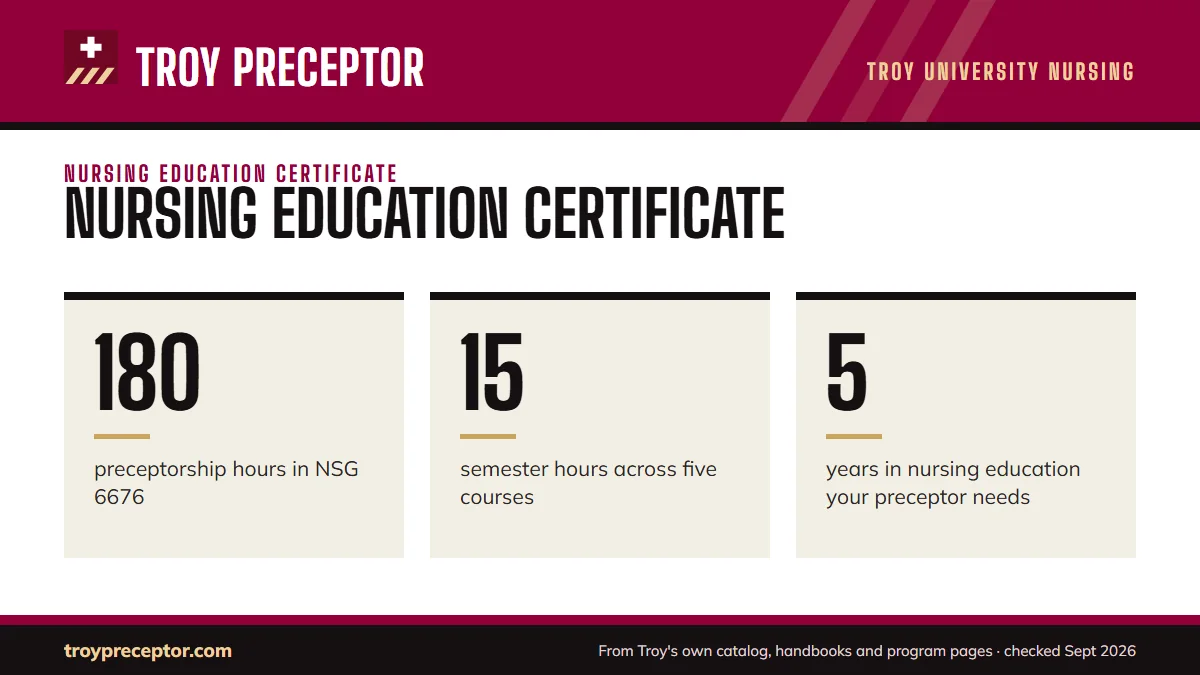
Troy's MSN page lists Nursing Education among its online post-master's certificates: five courses worth 15 semester hours, with 180 hours of clinical practice. Troy offers it to students at either the master's or the doctoral level, and graduates are eligible to apply for the relevant specialty certification exam. Troy does not name that exam or its sponsor, so ask your faculty advisor which one your plans point toward.
Four of the five courses are coursework. The fifth, NSG 6676 Nursing Education Preceptorship, carries 3 semester hours and all 180 clinical hours. The catalog prints the full course list; the order you take them in is settled with your faculty advisor, who is matched to you by track and campus.
The MSN manual's time limit covers this certificate too: the whole certificate has to be completed with all credits inside a five-year window. With only one preceptorship, that limit is rarely the problem. The real pressure point is finding the right educator for the semester you schedule NSG 6676.
NSG 6676: one preceptorship, all 180 hours
Most graduate nursing tracks spread their clinical hours over several courses and several preceptors. This certificate puts the whole clinical requirement in one semester with one course, so a single preceptor relationship carries the full 180 hours. If that preceptor becomes unavailable mid-semester, there is no later course to absorb the shortfall.
Those hours must fall inside the semester you are enrolled in NSG 6676, and Troy allows no clinical hours during semester breaks. Academic preceptors work on their own institution's calendar, with exam weeks, breaks and term starts that may not line up with Troy's semester. Mapping the overlap before you ask anyone to commit is the simplest way to protect the 180 hours.
The clinical schedule form comes after your preceptor agrees to a plan built around the course objectives, and your faculty must hear at once about any change to it. Troy faculty may also check in unannounced by phone, video or in person; the schedule and site visits guide explains what an absence during one of those visits costs you.
Who can precept NSG 6676
Item 13 of the MSN manual sets a narrow rule for Nursing Education certificate preceptors. Each condition below must hold.
- Graduate preparation: an MSN or a doctorate.
- A current role as a nurse educator in academia.
- A minimum of five years spent in nursing education.
- An RN license that is active and unencumbered.
The word academia narrows the field. A school of nursing faculty member fits the plain reading, while a hospital staff development educator may not, so ask your faculty advisor before approaching someone outside a college or university. The five-year floor also rules out newer faculty, however strong their teaching.
Troy's broader rules still apply: faculty approve both the preceptor and the setting, and hours count only after faculty clear you. The AMSN's preceptor courses follow different rules again, and Nursing Education preceptors sets both side by side.
When you already teach
If you already teach in some form, as a clinical instructor, adjunct or staff educator, check this rule first. Troy's MSN manual keeps clinical hours away from the place you work, so the program where you teach is off the table for NSG 6676, even if a colleague there meets every preceptor condition.
That pushes the search to another school of nursing or another academic program. Distance matters here, because nursing education preceptorships happen where the educator teaches, and the hours require an RN license valid for that state. Troy sets aside a request for a preceptor in another state until you can show a license there, which the license rule covers.
Troy's two-use limit on preceptors and sites matters less in a one-course certificate, though it still counts any earlier use of the same preceptor or site within your program.
Your own teaching job is your work setting. Plan NSG 6676 at a different institution from the start.
Agreements with a college or university
The approval chain matches every other Troy graduate clinical course. Your faculty advisor receives the Preceptor Information Form (typed, as a Word document), the Biosketch and the license copy, and an incomplete set is not processed. Once faculty sign off on the educator and the institution, the School of Nursing mails the letter that sets the preceptor and agency agreements in motion.
Here the agency is an academic institution rather than a clinic or hospital. If Troy has no formal contract with that college and one is required, Troy warns that the paperwork runs longer and asks students to submit early. Hours only count once your faculty clear you, after the agreements are signed and returned. Agency agreements walks through each document.
Form timing follows the MSN manual: NSG 6676 is not NSG 6619, so the three documents must be in within a month of the semester's first class day, and a late set means dropping the course. Doctoral-level students should check the DNP manual's drop-date rule with their advisor; preceptor form deadlines compares both.
Why Nursing Education students choose us
Troy's rule for this certificate describes a specific person: a graduate-prepared nurse educator working in academia, with five-plus years teaching nursing and a clean RN license. We search for exactly that profile in your area, at an institution other than the one where you work, and confirm the degree, years and license before you ever send a request.
Because all 180 hours sit in one course, we also check the preceptor's teaching calendar against Troy's semester so the hours fit inside NSG 6676 with room to spare. The educator's details for the information form, the biosketch and the license copy are collected and verified by us ahead of the one-month mark, and you hear early when a college will need a new formal contract with Troy. If your preceptor has to step away, we start the search for a replacement right away.
Your Troy faculty decide on the educator and the institution. We see to it that the request they review is whole and already matches item 13. Let us know your semester and state at the contact page, or with the short form further down.
Questions Troy students ask
Could a hospital staff development educator be my NSG 6676 preceptor?
Troy's wording points elsewhere. Item 13 of the MSN manual describes the preceptor as a nurse educator working in academia, so a hospital staff development role sits outside the plain reading. If you have a strong hospital candidate, put the question to your faculty advisor before asking that person to commit any time.
Can I take Troy's Nursing Education certificate as a DNP student?
Troy's MSN page says the certificate can be taken at the master's or doctoral level. How it fits alongside DNP coursework, and which manual's form deadline governs your NSG 6676 paperwork, are questions for your faculty advisor and the DNP Coordinator before you register.
How many clinical hours does Troy's Nursing Education certificate require?
180, all in NSG 6676 Nursing Education Preceptorship, a 3-semester-hour course. The other four courses in the 15-hour certificate carry no clinical hours. Because the whole requirement sits in one semester, the preceptor you choose and that preceptor's teaching calendar matter more than in tracks that spread hours across several courses.
Can I complete NSG 6676 at the college where I teach?
No. The MSN manual bars clinical hours in your own work area or setting, and a school where you teach counts as your work setting. Look to another school of nursing or academic program, confirm your RN license is valid in that state, and leave time for Troy to set up an agreement if no formal contract exists there.
Related pages
Last checked 2026-09-27
We check these pages against Troy's own 2026-27 MSN, DNP, AMSN and RN to BSN orientation manuals, program pages, degree maps and state authorization pages. Your faculty advisor, your course faculty and the School of Nursing have the final word.
Troy asks you to recruit your preceptor. We make that the easy part.
Tell us your Troy program, where you live and which semester your next clinical course starts. We find preceptors who meet Troy's rules for the course, check the setting against Troy's limits, and prepare everything the Preceptor Information Form and biosketch ask for, well ahead of the form deadline.
- Preceptors matched to the course: a graduate-prepared NP or physician for
NSG 6619, pediatrics and women's health forNSG 6666, adults and older adults forNSG 6668 - Preceptor Information Form details, a biosketch and a copy of the preceptor's license, ready for your faculty advisor
- In your own area, in Alabama or a state where Troy can offer clinicals, never in your own work setting
Start your placement plan
Program, city and semester is all we need to begin.