Precepting a Troy University nursing student: what to expect
Troy University students recruit their own preceptors, so a request usually reaches you from the student or from us on the student's behalf. Here is who Troy accepts as a preceptor, the paperwork and your part in it, how faculty stay in touch during the rotation, and what Alabama's preceptor tax credit requires.
Offer to precept a Troy student
Tell us your credential, specialty and practice location. A placement advisor replies with the Troy course a nearby student needs and what it involves.
Who Troy accepts as a preceptor
For graduate courses, Troy's 2026-27 manuals look for preceptors holding a master's or doctorate (an MSN or DNP), and the DNP manual weighs other candidates individually. Each course then sets its own list:
| Course | Who can precept |
|---|---|
FNP: NSG 6619, NSG 6666, NSG 6668, NSG 6680 | A nurse practitioner licensed as an NP in the state of practice with at least one year of NP experience; a physician (MD or DO); a nurse midwife; or a physician assistant. NSG 6666 uses two preceptors |
HINL: NSG 6630, NSG 6636, NSG 6637 | An MSN directly involved in nursing informatics or leadership; an MS in computer technology or administration in active practice; or a BSN with 3 or more years, or a BS with 5, in the area, preferably certified |
| DNP Nurse Leader track | An MSN or doctorate with direct involvement in nursing leadership or administration, or an MS in administration in active clinical practice |
Nursing Education: NSG 6676 | An MSN- or doctorally prepared nurse educator in academia with at least 5 years in nursing education and an active, unencumbered RN license |
Accelerated MSN: NSG 5549 | A BSN plus one year as an RN, or an ASN plus two years as an RN |
The MSN manual also rules out anyone related to the student. Our pages on FNP preceptors and informatics and leadership preceptors go further into each list.
The paperwork, and your part in it
The student prepares the Preceptor Information Form, a typed Word document, and sends it to their faculty advisor with a Preceptor Biosketch and a copy of your license. Your part is accurate detail: your credential (the biosketch offers boxes for physicians with an MD or DO, for PAs, for CNMs and CNSs, for RNs, and for FNP, AGNP and PNP nurse practitioners), your practice setting and your license. An incomplete form sits unprocessed, so one missing detail holds everything up.
The DNP manual tells students not to ask you to sign the form. Signatures come later: once faculty approve you and the setting, a School of Nursing letter sets the preceptor and agency agreements in motion, and the student cannot start until both are back, signed. If your organization has no formal contract with Troy and needs one, expect that step to take longer. Our agency agreements page explains the sequence.
Before the student's first day with you
A student can start only after faculty clear them, and hours completed before clearance do not count, so hold the first shift until the student confirms clearance. The student brings you the course objectives, and once you approve the dates, the student submits a clinical schedule form to faculty.
Two calendar rules shape that schedule. Hours belong inside the student's enrolled course, and breaks between semesters are closed to clinical work. If the schedule changes later, the student must tell faculty at once. Students also cannot count hours in their own work area, and they may use the same preceptor or site no more than twice in the program, which is why a student may ask you for one or two courses rather than several.
During the rotation: faculty contact and site visits
Troy faculty evaluate the student, and they may do it without warning. Unannounced visits can come by phone, over video or in person. A student missing from a scheduled day when faculty make contact gets a zero on the clinical evaluation, so an accurate schedule protects the student as much as it helps faculty. Our page on schedules and site visits covers the detail.
Students arrive having cleared Troy's compliance items in ViewPoint Screening: a background check, a drug screen, titers, a TB test, flu vaccination, a physical, a hands-on CPR card and health insurance. Your agency may add requirements of its own, and Troy's manuals say the student must meet them, so tell the student early what your site asks for.
Alabama's Preceptor Tax Incentive Program
Act 2023-519, codified at sections 40-18-520 through -527 of the Code of Alabama, created a state income tax credit for community-based faculty preceptors, advanced practice nurses among them, who teach students without pay. The credit started with the 2024 tax year and ends on September 29, 2031. Certification comes from the Alabama Statewide AHEC Program Office, and a preceptor pre-certifies the credit through My Alabama Taxes before filing a return.
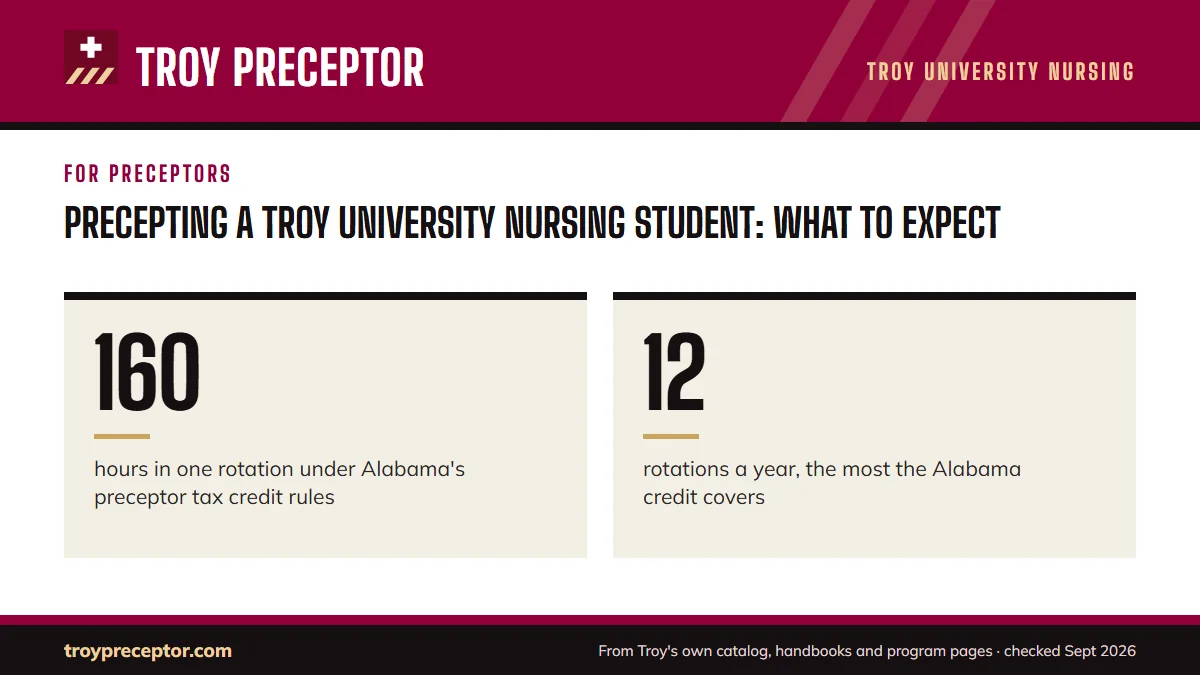
The conditions are specific. Each rotation counts as 160 hours, and hours with different students can be combined to reach it; no more than 12 rotations a year qualify. The rotations have to happen in medically underserved rural parts of Alabama, for programs based in Alabama that are registered with AHEC. Anyone paid to teach, whatever the source, falls outside the program, and preceptors register a single time. The credit stops at zero tax owed, cannot be carried to another year, and pays APRNs less per rotation than physicians.
Whether a given rotation qualifies depends on those rules and on the AHEC office's certification, so check your own eligibility with the program and your tax adviser before counting on it. Troy's 2026-27 manuals list no preceptor honorarium or other benefit of Troy's own.
Why preceptors like working with us
We bring you a student whose course, hours and dates are set out up front, so you can answer a clear request. We tell you which Troy course the student needs, what it asks of a preceptor and how many hours are involved, and we collect your biosketch details and license copy once, so you are not asked for them twice.
Before a request reaches you, we confirm the student does not work in your practice and has not already used you or your site twice. If you can take a Troy student, tell us your credential, specialty and location in the form below and a placement advisor will follow up. Alabama CRNPs may also find our page on collaboration rules and precepting useful.
Questions Troy students ask
How many hours will a Troy student need with me?
It depends on the course. Troy's MSN manual lists 120 hours for NSG 6619, 180 each for NSG 6666 and NSG 6668, and 300 for the NSG 6680 FNP Internship. The HINL practicums run 120, 180 and 180, and NSG 6676 is 180. NSG 6666 uses two preceptors, so you may share that course with a second clinician.
Do I have to sign the Preceptor Information Form?
The DNP manual tells students not to ask you to sign it. The documents that need your signature come after faculty approve you: the School of Nursing opens the preceptor and agency agreements by letter, and the student starts only once those come back signed.
Can I precept a student who works in my practice?
Not in the student's own work area or setting. Troy bars clinical hours where the student works as an employee, even when the preceptor is well qualified. A student can also use you or your site at most twice across the program, so an earlier rotation with you counts toward that limit.
Will a Troy faculty member visit my clinic?
Possibly, and without notice. Troy faculty may evaluate the student through a surprise call, a video session or a visit in person. The visits focus on the student's progress, and an accurate schedule matters, because a student missing from a scheduled day during a visit receives a zero clinical evaluation.
Does precepting a Troy student qualify me for the Alabama tax credit?
It depends on the rotation. The credit is limited to unpaid community-based preceptors teaching in medically underserved rural Alabama, for Alabama-based programs on AHEC's register, and only the Alabama Statewide AHEC Program Office can certify it. Check your eligibility with that office and a tax adviser before relying on it.
Related pages
Last checked 2026-09-27
We check these pages against Troy's own 2026-27 MSN, DNP, AMSN and RN to BSN orientation manuals, program pages, degree maps and state authorization pages. Your faculty advisor, your course faculty and the School of Nursing have the final word.
Troy asks you to recruit your preceptor. We make that the easy part.
Tell us your Troy program, where you live and which semester your next clinical course starts. We find preceptors who meet Troy's rules for the course, check the setting against Troy's limits, and prepare everything the Preceptor Information Form and biosketch ask for, well ahead of the form deadline.
- Preceptors matched to the course: a graduate-prepared NP or physician for
NSG 6619, pediatrics and women's health forNSG 6666, adults and older adults forNSG 6668 - Preceptor Information Form details, a biosketch and a copy of the preceptor's license, ready for your faculty advisor
- In your own area, in Alabama or a state where Troy can offer clinicals, never in your own work setting
Start your placement plan
Program, city and semester is all we need to begin.