Kansas clinicals for Troy University nursing students
Kansas sits in the Not yet determined column of Troy University's online nursing disclosure, a row dated 12/15/2020. The Kansas board takes a wait-and-see approach of its own: online APRN programs from other states need no Board sign-off before Kansans enroll, and KSBN examines the program only once one of its graduates seeks Kansas APRN licensure.
Get your placement plan
Tell us your Troy program and where you live. A placement advisor replies with the preceptor and site options that fit your Troy course.
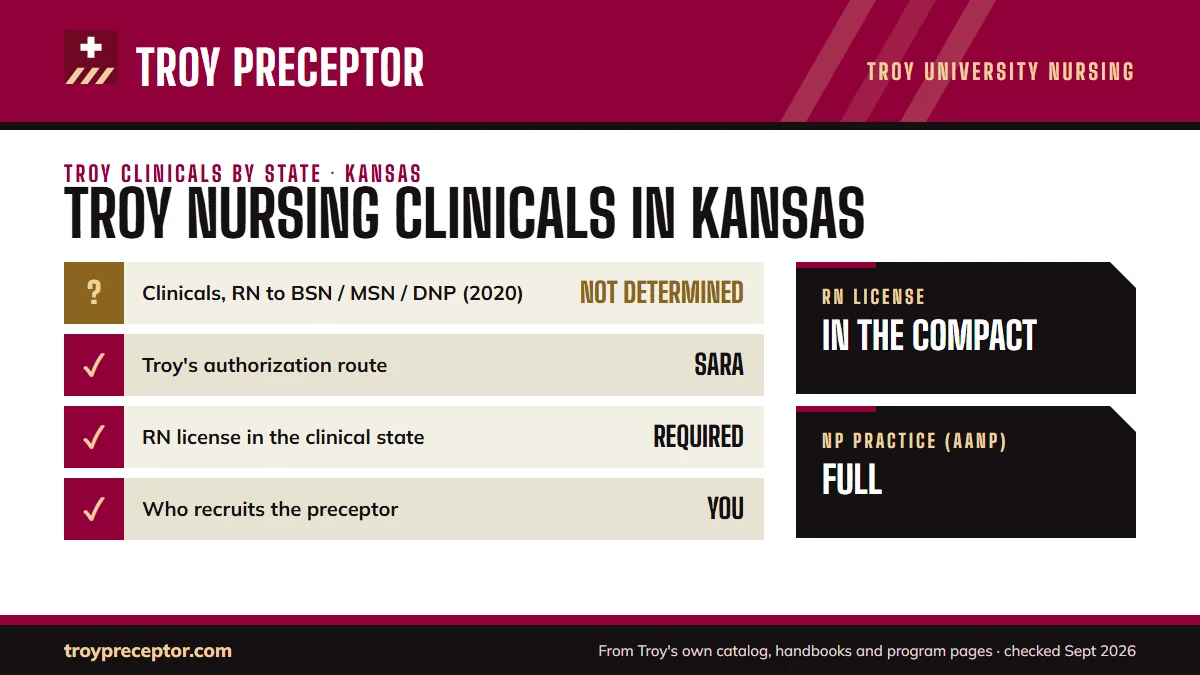
Troy's Kansas entry
A single Kansas status serves all three of Troy's online nursing programs, and in December 2020 that status was Not yet determined. The disclosure has kept that date while Troy links it as current, and it makes no statement about Kansas licensure. Troy is SARA authorized in Kansas, which concerns distance education rather than clinical placements.
So the first call is to Troy. Its Coordinator of State Authorizations tracks state positions; the Clinical Placements Specialist handles signed agreements. Get Troy's current Kansas answer from them before a single preceptor is contacted.
KSBN reviews the program when you apply, not when you enroll
The Kansas State Board of Nursing publishes a short guide for out-of-state APRN programs. It says there is no formal Board approval for such programs before Kansas students enroll; instead, KSBN reviews the program when its graduate applies for Kansas APRN licensure. The same guidance describes no clinical-placement filing for undergraduate programs, RN to BSN included.
Two more points in that guide matter for Troy students. Faculty teaching online from outside Kansas can do so without a Kansas license. Site visits are optional in Kansas, and a faculty member who does appear at a clinic is treated as a guest, in the guide's words a visitor or lay person. Troy's manuals allow unannounced faculty check-ins by phone, video or in person; for a Kansas site, your course faculty will say which form they use.
Preceptors: Kansas guidance beside Troy's rules
Where the two lists differ, as with a physician preceptor at a Kansas site, your course faculty decide what Troy will accept. The Troy side is laid out on FNP preceptor requirements, and the license rule on RN license for clinicals.
| Topic | KSBN guidance for APRN clinicals | Troy's rule |
|---|---|---|
| Preceptor license | A Kansas APRN license in the role the student is studying | FNP: an NP licensed where they practice with a year of NP experience, or a physician, nurse midwife or PA |
| Preceptor paperwork | An orientation and a signed agreement | Preceptor Information Form, Preceptor Biosketch, license copy, then SON agreements |
| Student license | An RN license Kansas recognizes: Kansas or multistate | An unencumbered RN license for the clinical state, all semester |
The checklist KSBN applies at APRN licensure
Faced with an applicant from an outside program, KSBN runs a checklist. The program must be nationally accredited and total 45 credit hours or more. Pharmacology, health assessment and pathophysiology, each at the advanced level, need three credits apiece. Then comes a clinical floor in the role and specialty: a student whose admission date falls before March 1, 2025 needs 500 hours, and later admits need 750.
Troy's 2026-27 MSN manual lists the FNP at 47 credits and 780 clinical hours, although another Troy document counts some courses differently; the 780-hour page sets out that conflict. How KSBN reads your transcript is its call, so raise Kansas licensure plans with your faculty advisor early.
Kansas City, Wichita, Topeka and Manhattan
Kansas has full practice under AANP's classification, so NPs there practice without a mandated physician agreement. Kansas's biggest population center is its slice of greater Kansas City, ahead of Wichita, Topeka and Manhattan. Stormont Vail Health in Topeka, The University of Kansas Health System, and Wichita's Ascension Via Christi and HCA-owned Wesley Healthcare are useful landmarks, described from their own sites and not as hosts for Troy students. Kansas City spills into Missouri, also Not yet determined in 2020.
Why Kansas students choose us
We match Kansas searches to both rulebooks at once: Kansas-licensed preceptors in your role wherever KSBN's guidance points that way, and Troy's criteria for every course. Each Preceptor Information Form and Biosketch reaches your faculty advisor whole, on the first submission. Send us your details.
Questions Troy students ask
Does Troy University allow online FNP clinicals in Kansas?
Kansas carries a Not yet determined label on Troy's online disclosure, in a row Troy last updated on 12/15/2020 and applies jointly to its online bachelor's completion, master's and doctoral nursing programs. Read it as an open file rather than a verdict. Troy's Coordinator of State Authorizations can give the current answer, with the Clinical Placements Specialist, before you begin recruiting a Kansas preceptor.
Do I need a Kansas RN license, or is my compact license enough?
Kansas has issued compact licenses since July 2019, and in KSBN's view an APRN student at a Kansas site practices under whatever RN license Kansas honors, a Kansas license or a multistate one. Troy's manuals ask for licensure in the clinical state without addressing compact licenses, so check with your faculty advisor before relying on the multistate card.
Does a Kansas preceptor have to be a Kansas-licensed APRN?
KSBN's guide expects APRN preceptors to be licensed as Kansas APRNs in the same role you are preparing for, and it ties supervision of APRN students to that Kansas license. Troy's own FNP list is broader and includes physicians and PAs. For a Kansas site, it is your course faculty who reconcile the two.
Will a Troy program count toward a Kansas APRN license later?
KSBN answers that at application time, not in advance. It checks accreditation, credit hours, the three advanced core courses and role-specialty clinical hours. Troy's disclosure makes no licensure determination for Kansas, so bring your transcript questions to your faculty advisor and to KSBN when you apply.
Related pages
Last checked 2026-09-27
We check these pages against Troy's own 2026-27 MSN, DNP, AMSN and RN to BSN orientation manuals, program pages, degree maps and state authorization pages. Your faculty advisor, your course faculty and the School of Nursing have the final word.
Troy asks you to recruit your preceptor. We make that the easy part.
Tell us your Troy program, where you live and which semester your next clinical course starts. We find preceptors who meet Troy's rules for the course, check the setting against Troy's limits, and prepare everything the Preceptor Information Form and biosketch ask for, well ahead of the form deadline.
- Preceptors matched to the course: a graduate-prepared NP or physician for
NSG 6619, pediatrics and women's health forNSG 6666, adults and older adults forNSG 6668 - Preceptor Information Form details, a biosketch and a copy of the preceptor's license, ready for your faculty advisor
- In your own area, in Alabama or a state where Troy can offer clinicals, never in your own work setting
Start your placement plan
Program, city and semester is all we need to begin.