Who does what in a Troy University preceptorship
In a Troy University preceptorship, you recruit the preceptor, your faculty advisor and course faculty approve and clear, the School of Nursing sends the agreements, and a handful of other roles step in for state questions, DNP projects and compliance. Knowing who owns each step keeps your questions out of the wrong inbox. We run the search and the preparation so every one of these roles receives what it needs.
Get your placement plan
Tell us your Troy program and where you live. A placement advisor replies with the preceptor and site options that fit your Troy course.
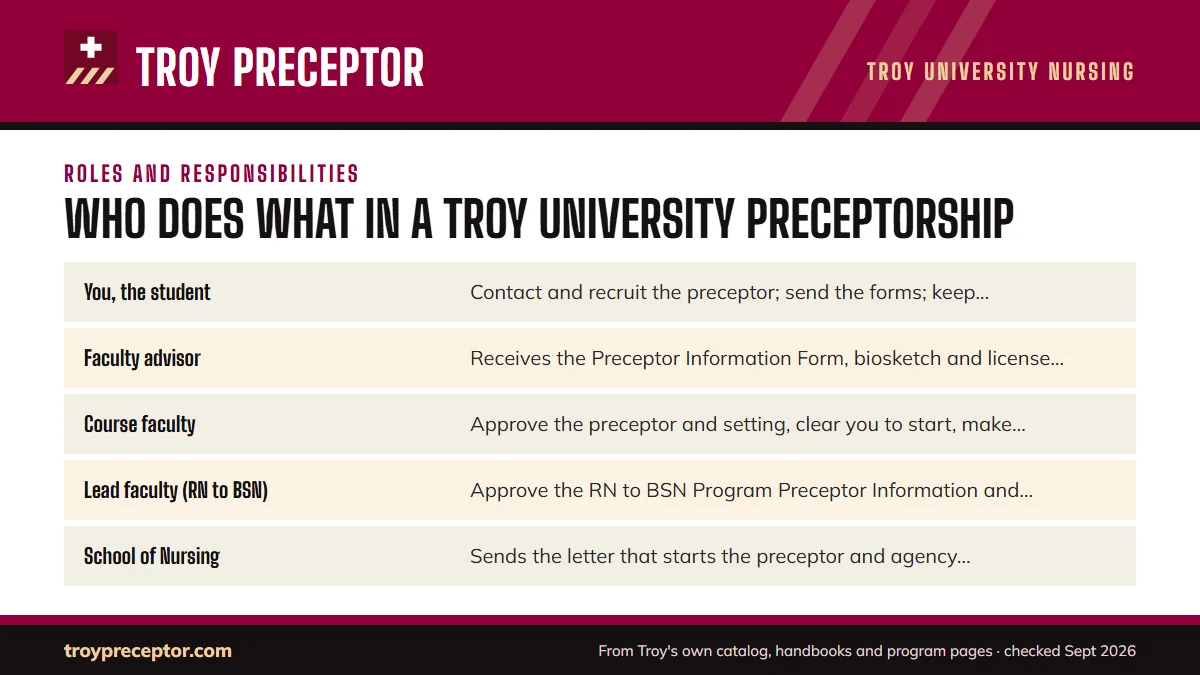
The map in one table
Troy's 2026-27 orientation manuals and its School of Nursing faculty and staff page name each role by title. Here is what each one does in a preceptorship, according to Troy's own documents.
| Role | What Troy's documents give it | When you meet it |
|---|---|---|
| You, the student | Contact and recruit the preceptor; send the forms; keep compliance current; report schedule changes | Every clinical semester |
| Faculty advisor | Receives the Preceptor Information Form, biosketch and license copy | Before each preceptorship |
| Course faculty | Approve the preceptor and setting, clear you to start, make site visits | During each clinical course |
| Lead faculty (RN to BSN) | Approve the RN to BSN Program Preceptor Information and Acknowledgement Form | Each RN to BSN preceptorship |
| School of Nursing | Sends the letter that starts the preceptor and agency agreements | After faculty approval |
| Clinical Placements Specialist | Receives signed RN to BSN agreements; named in the 2020 state table for approval steps | Agreements and out-of-state questions |
| Coordinator of State Authorizations | Answers students in states missing from Troy's lists | Before you commit to a state |
| DSP Chair and Committee | Guide the DNP Synthesis Project, approve the IRB application, run the Final Competency Evaluation | DNP synthesis courses |
Your part as the student
Troy's manuals put the first move on you. The MSN and AMSN manuals make MSN, certificate and AMSN students responsible for approaching preceptors and asking them to serve. In the DNP manual, students reach out to prospective preceptors, and faculty may offer names. The RN to BSN manual has students find qualified preceptors in approved settings and make the contact themselves.
What stays on your list all program
- Keep each ViewPoint Screening item current from the day you register until the semester closes
- Keep an unencumbered RN license for whichever state hosts your clinicals
- Send a complete, typed Preceptor Information Form packet by the deadline
- Give your preceptor the course objectives and submit the clinical schedule form
- Report any schedule change to faculty at once, and any arrest or conviction within 48 hours
- Register paired didactic and preceptorship courses together in Student Self-Service
The search is the part we run for you. The rest stays in your name, and we help you get each item right the first time.
Faculty advisor, course faculty and lead faculty
Faculty hold the approvals. The packet you send (Preceptor Information Form, biosketch and a copy of the preceptor's license) goes to your faculty advisor, and course faculty sign off on the preceptor and the clinical setting alike before any agency agreement moves. The form's office-use block records that approval, whether a formal contract is required and whether one already exists, and the date the letter went out.
After the agreements are signed, faculty clear you to begin, and hours before clearance do not count. While the course runs, faculty may check in unannounced, whether by phone, by video or on site, and they grade the clinical evaluation. In the RN to BSN, lead faculty approve the program's own Preceptor Information and Acknowledgement Form, which lives in Canvas.
The DNP manual adds one sentence the MSN manual lacks: faculty can assist by suggesting preceptors. That is the only preceptor-finding help Troy puts in writing, and the student still makes the contact. Approval itself is covered on faculty approval and clearance.
The School of Nursing and the Clinical Placements Specialist
Once faculty approve, the School of Nursing mails a letter that opens the preceptor agreement and the agency agreement; you begin only after both come back signed. Where no formal contract exists and one is required, Troy says the process takes longer. The agency agreements page explains why that argues for applying early.
Troy has one Clinical Placements Specialist, based on the Troy Campus. Troy's documents give the role two jobs. In the RN to BSN, the site gets the approved preceptor and agency agreement by email and sends it back to this role. And the 2020 clinical-availability table lists the role as the person to contact about approval steps in a number of states, from Arizona to Wisconsin.
No Troy page says the role finds or assigns preceptors. Reach it through the School of Nursing's published contact route, and read the Clinical Placements Specialist guide for how it fits with your faculty advisor.
Program leadership and admissions
Program leaders handle questions that reach past a single course. Troy lists them by title:
- Director of the School of Nursing, over every program
- MSN Program Coordinator (Online) and MSN Program Assistant Coordinator (Dothan)
- DNP Coordinator, who receives the Verification of Post-Baccalaureate Clinical Hours, and DNP Assistant Coordinator
- RN to BSN Assistant Coordinator
- Dothan BSN and AMSN Assistant Coordinator
- Director of Nursing Admissions and Records, on the Montgomery Campus, where the SON Office of Admissions handles graduate admissions and registration help
- Graduate Nursing Admissions and Progressions Committee
For a question about one preceptor, start with your faculty advisor. Coordinators come in when the question is about your program as a whole, such as the order of courses after a clinical course is dropped.
DNP project roles and roles outside the School of Nursing
Every DNP student builds a DNP Synthesis Project (DSP) Committee at the start of NSG 8810, filing Troy's advisory committee form to do it. That committee and its chair sign off on the IRB application and conduct the Final Competency Evaluation. In NSG 8820 you must also win approval from the external agency or setting, by a letter of support or IRB approval, and submit a Troy IRB application; see DNP synthesis courses.
Outside the School, the Coordinator of State Authorizations, in the Office of State Authorization within Institutional Research, Planning and Effectiveness, answers students living in states missing from Troy's lists. A University physician acts as Medical Review Officer when a drug screen is positive for a prescribed medication, and ViewPoint Screening holds your compliance documents.
The preceptor and the agency are roles too. The preceptor works from the course objectives you provide and approves your clinical schedule; the agency signs the agreements the School of Nursing sends.
Where we fit among these roles
We are the search and preparation partner at your side. We look for preceptors who satisfy Troy's rule for the course you are entering, screen them for your workplace and for past use, and put together everything Troy's paperwork asks for, so your faculty advisor receives a finished packet rather than a draft.
We raise an early flag when a site is going to need a new formal contract or when your state carries a step in Troy's table. If a preceptor leaves mid-semester, we are already looking for the next one. Every approval stays with Troy: faculty rule on each preceptor and setting, and the agreements sit with the School of Nursing. Our part is to make each of those decisions easy, because what reaches the people making them is complete and matches Troy's written rules. Tell us your program through the form below.
Questions Troy students ask
Who approves my preceptor at Troy?
Faculty. Course faculty, working through your faculty advisor, must approve both the preceptor and the clinical setting before the School of Nursing processes any agency agreement. In the RN to BSN, lead faculty approve the program's Preceptor Information and Acknowledgement Form. Approval is recorded in the office-use block of the form.
Does Troy's Clinical Placements Specialist find preceptors for students?
No Troy page says so. Troy's documents give the role signed RN to BSN agreements and the approval steps some states need under the 2020 clinical-availability table. The manuals place the preceptor search with the student, with DNP faculty able to suggest names.
Who do I ask about doing clinicals in another state?
Start with the Clinical Placements Specialist, whom Troy's 2020 table names for approval steps in several states, and add the Coordinator of State Authorizations if Troy's authorization lists leave your state out. Your faculty advisor needs your license evidence before an out-of-state preceptor request is processed.
Who receives the Verification of Post-Baccalaureate Clinical Hours?
The DNP Program Coordinator. Post-master's DNP students send it so earlier post-baccalaureate hours can count toward the 1,000 clinical hours the DNP requires. NSG 8880 then offers 60 hours per credit, up to 180, for anyone still short of the total.
Who helps Troy graduate nursing students with registration?
The SON Office of Admissions on the Montgomery Campus handles graduate nursing admissions and registration help, under the Director of Nursing Admissions and Records. A didactic course and its paired preceptorship go into Student Self-Service together, as one registration, so check both course numbers before you submit.
Related pages
Last checked 2026-09-27
We check these pages against Troy's own 2026-27 MSN, DNP, AMSN and RN to BSN orientation manuals, program pages, degree maps and state authorization pages. Your faculty advisor, your course faculty and the School of Nursing have the final word.
Troy asks you to recruit your preceptor. We make that the easy part.
Tell us your Troy program, where you live and which semester your next clinical course starts. We find preceptors who meet Troy's rules for the course, check the setting against Troy's limits, and prepare everything the Preceptor Information Form and biosketch ask for, well ahead of the form deadline.
- Preceptors matched to the course: a graduate-prepared NP or physician for
NSG 6619, pediatrics and women's health forNSG 6666, adults and older adults forNSG 6668 - Preceptor Information Form details, a biosketch and a copy of the preceptor's license, ready for your faculty advisor
- In your own area, in Alabama or a state where Troy can offer clinicals, never in your own work setting
Start your placement plan
Program, city and semester is all we need to begin.