The Clinical Placements Specialist and your faculty advisor: who handles what
Troy University's School of Nursing lists a single Clinical Placements Specialist alongside many faculty advisors, and they sit at different points in a preceptorship. Your faculty advisor receives your packet and approves the preceptor and setting. The specialist is the named contact for returned RN to BSN agreements and for several states' approval steps. Knowing which desk owns which step saves days of forwarded messages.
Get your placement plan
Tell us your Troy program and where you live. A placement advisor replies with the preceptor and site options that fit your Troy course.
One specialist, based on the Troy Campus
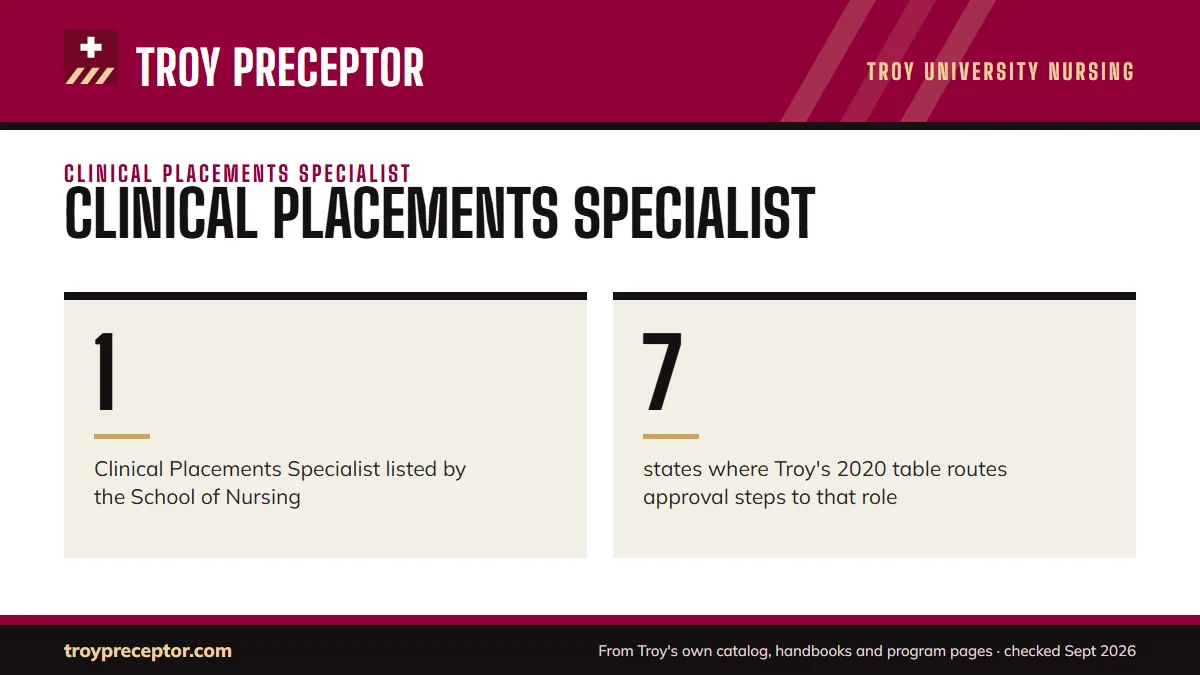
The Clinical Placements Specialist is a single staff role, listed on the School of Nursing's faculty and staff page and in the directory of every 2026-27 orientation manual. The faculty page and the MSN and DNP manuals place it on the Troy Campus. The RN to BSN manual's directory table lists the role beside a Montgomery contact line, and the table's layout makes that entry hard to read, so rely on the current manual for your program.
Because a single role appears in every program's manual, a message that names your program, course number, semester and site gets a faster answer than a general question. Address it by title. The manuals list a shared mailbox for the role, and your faculty advisor can confirm you are using the right one.
What Troy's documents say the specialist does
Troy describes the role in two places, and both concern steps that come after you have a preceptor.
- RN to BSN agreements: after approval, the site receives the combined preceptor and agency agreement by email, and the RN to BSN manual routes the signed copy back to this role.
- State approval steps: Troy's online nursing disclosure, dated 2020, sends students to this role for the approval or application process in Arizona, Montana, Tennessee, Washington, West Virginia and Wisconsin.
- Colorado: the same table says students in clinical practicums there must be covered by workers' compensation and points to the specialist.
No Troy page says the role finds, assigns or promises preceptors. Plan the search as your own and bring the specialist in where agreements and state steps begin. Since that disclosure is dated December 2020, check any state's status with the specialist before you recruit there; our clinicals by state guide shows what the table says.
What your faculty advisor decides
The MSN and DNP manuals route your packet to your faculty advisor: the typed form, the biosketch and a copy of the preceptor's license. Course faculty, acting as faculty advisor, rule on the preceptor and the clinical setting together, and that approval must exist before any agency agreement is processed. For RN to BSN students the matching step is lead faculty signing off on the acknowledgement form held in Canvas.
Faculty also hold the gates after the paperwork. They clear you to start hours, and they may observe you unannounced, on site or remotely, while the course runs (approval and clearance). When faculty offer DNP students possible names, as the DNP manual allows, those names come from this side too. MSN students are assigned an advisor by track and nearest campus.
Each step and the Troy role behind it
The work spreads across more than two desks. Here is each step with the role Troy's documents attach to it.
| Step | Who handles it | Where Troy says so |
|---|---|---|
| Contact and recruit the preceptor | You | MSN, DNP, AMSN and RN to BSN manuals |
| Receive the form, biosketch and license copy | Your faculty advisor | MSN manual, Guidelines item 4 |
| Approve the preceptor and the setting | Course faculty (faculty advisor) | MSN manual, item 5 |
| Record whether a formal contract is needed or exists | Office-use block on the form | Preceptor Information Form |
| Send the letter that starts the agreements | School of Nursing | MSN manual item 5; DNP manual item 6 |
| Receive the signed RN to BSN agreement | Clinical Placements Specialist | RN to BSN manual |
| Clear you to begin hours | Faculty | MSN manual, items 5-6 |
| Approval steps in listed states | Clinical Placements Specialist | Online nursing disclosure (2020) |
| Questions on state authorization | Coordinator of State Authorizations | State authorization page |
| Verification of Post-Baccalaureate Clinical Hours | DNP Program Coordinator | DNP manual |
The full cast, from the Director of the School of Nursing to the DSP Committee, is on our who does what page.
Which desk to ask, question by question
Sending a question to the wrong desk is the easiest way to lose a week. Match the question to the owner.
- Does this clinician qualify for my course? Your faculty advisor or course faculty.
- Is my packet complete, and has it been approved? Your faculty advisor.
- Has the site returned its agreement? RN to BSN students ask the Clinical Placements Specialist; graduate students start with the faculty advisor, since the agency agreements follow faculty approval and must be back before clearance.
- Can I do clinicals in another state? The specialist and the Coordinator of State Authorizations, once you hold a license there (out-of-state requests).
- Can I change my approved clinical days? Faculty, at once.
When a question touches both desks, such as a site in a state with its own approval step, copy your faculty advisor on the message to the specialist so both see the same facts.
How we make both desks' work easy
We prepare what each Troy desk needs to see from you. For your faculty advisor, that means a complete packet: a qualified preceptor for the exact course, biosketch details, a current license copy and a setting that clears the work-area and reuse rules. For the agreement stage, we ask the site early whether it already holds a formal contract with Troy, so nothing stalls between approval and clearance.
For students outside Alabama, we start from Troy's state steps and the license rule, then search your area. Faculty hold every approval decision; we see to it that each desk receives a request that is finished and matches Troy's rules. Share your course and state in the form below and your placement advisor will take it from there.
Questions Troy students ask
Will the Clinical Placements Specialist find me a preceptor?
Troy's pages list the role and describe it receiving signed RN to BSN agreements and handling approval steps for certain states. None says it finds or assigns preceptors, and Troy's manuals put the first contact on the student. Take agreement and state questions to the specialist, and arrive with a preceptor already in mind.
Where is Troy's Clinical Placements Specialist based?
The School of Nursing's faculty and staff page and the 2026-27 MSN and DNP manuals place the role on the Troy Campus. The RN to BSN manual's directory lists it beside a Montgomery contact line in a table that is hard to read. For an online student, using the contact route in your current manual matters more than where the office sits.
Who approves my preceptor at Troy, the specialist or faculty?
Faculty. Course faculty acting as your faculty advisor approve the preceptor and the setting for MSN, certificate and DNP courses, and lead faculty approve the RN to BSN acknowledgement form. The specialist's documented work begins after that point, with returned agreements and state approval steps. The Preceptor Information Form is what faculty review.
What should I include when I message the Clinical Placements Specialist?
Give your program, track, course number and semester, the site's name, city and state, and whether faculty have approved the preceptor yet. For a state with its own step, say so and note your license status there. A short, complete message is the easiest kind to answer in one reply.
Is the specialist the right contact for a state Troy lists as not yet determined?
Start there and with the Coordinator of State Authorizations. Troy's online clinical table marks many states not yet determined, but every row is dated December 2020, so its status may have changed. Ask before you recruit in that state, and hold the license for that state first, since out-of-state preceptor requests wait for it.
Related pages
Last checked 2026-09-27
We check these pages against Troy's own 2026-27 MSN, DNP, AMSN and RN to BSN orientation manuals, program pages, degree maps and state authorization pages. Your faculty advisor, your course faculty and the School of Nursing have the final word.
Troy asks you to recruit your preceptor. We make that the easy part.
Tell us your Troy program, where you live and which semester your next clinical course starts. We find preceptors who meet Troy's rules for the course, check the setting against Troy's limits, and prepare everything the Preceptor Information Form and biosketch ask for, well ahead of the form deadline.
- Preceptors matched to the course: a graduate-prepared NP or physician for
NSG 6619, pediatrics and women's health forNSG 6666, adults and older adults forNSG 6668 - Preceptor Information Form details, a biosketch and a copy of the preceptor's license, ready for your faculty advisor
- In your own area, in Alabama or a state where Troy can offer clinicals, never in your own work setting
Start your placement plan
Program, city and semester is all we need to begin.