Immunizations, titers and TB testing for Troy clinicals
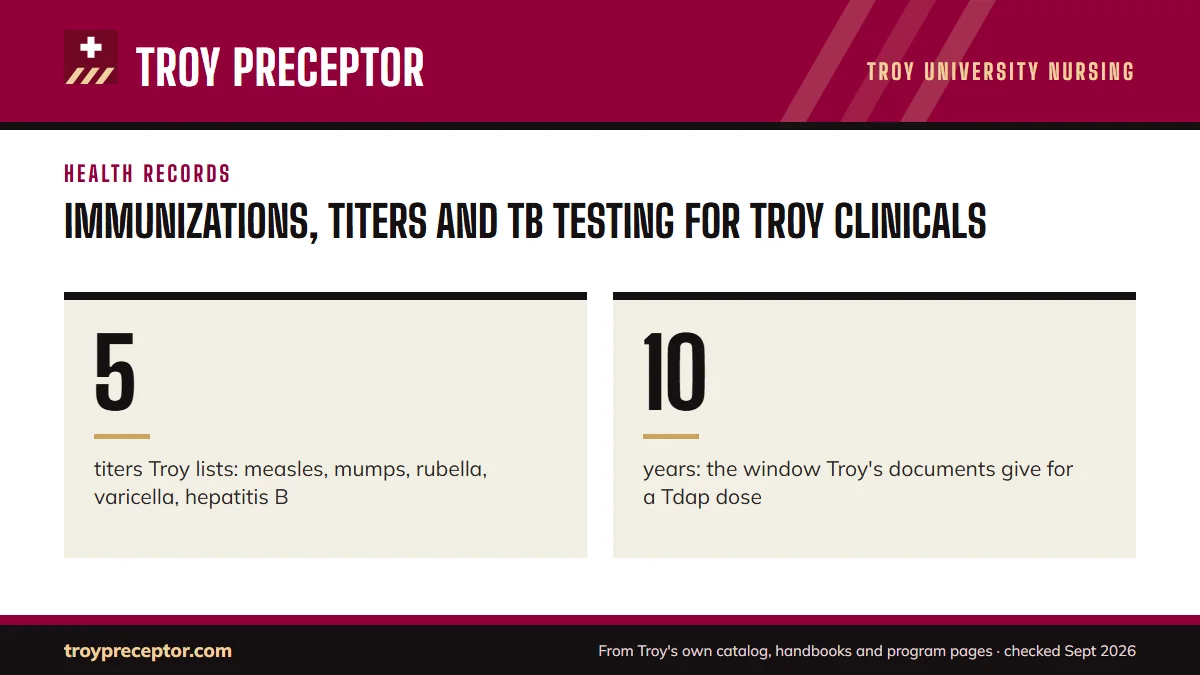
Troy University asks for titers showing immunity to measles, mumps, rubella, varicella and hepatitis B, a flu vaccine every year, Tdap within 10 years and a yearly TB result on the TB Status Verification Form. All of it goes into ViewPoint Screening and must stay current through the semester. Whether graduate students need Tdap depends on which Troy document you read.
Finishing your health records?
Tell us your course and semester. We line up a preceptor on the same timeline.
Titers: lab proof of immunity
Troy's MSN Student Orientation Manual lists titers for five diseases: measles, mumps, rubella, varicella and hepatitis B, where the test is the hepatitis B antibody. A titer is a blood test that measures antibodies, so what you upload is the lab report showing the result, not a list of the shots you received as a child. Each report goes into ViewPoint Screening.
Troy's public pages do not describe what happens when a titer comes back low or negative. If yours does, take the report to your own health care provider and to your faculty advisor promptly. Any follow-up doses or repeat testing take calendar time, and you want that time before the semester's due date, not after it.
Titers are the one item on Troy's list with no stated repeat cycle. Once you have a report that meets the requirement, keep a clean copy with your own records in case a clinical agency asks to see it directly.
A flu vaccine every year, plus whatever the agency adds
Troy requires a new influenza vaccine each year, and the record goes into ViewPoint Screening alongside your titers. Because the rule is annual, a dose from a previous year does not carry you into the next clinical year. Plan the new one early enough to meet the due date Troy publishes for your semester.
The same part of the MSN manual makes a point students often miss: clinical agencies may add requirements of their own, and the student must meet them. A hospital or a large practice can ask for records, forms or testing beyond Troy's list. Ask the site what it needs as soon as a preceptor agrees, and share the answer with your faculty advisor so nothing new appears in the week you expect to start hours.
Tdap: required within 10 years, but for whom?
Troy's documents agree on the interval: a Tdap dose within the last 10 years. They disagree on who must have one. The immunization policy in Troy's 2026-27 MSN manual states that Tdap is required for all ASN and BSN students and does not mention graduate students at all.
Three other Troy sources list Tdap as a graduate clinical requirement: the MSN program web page, the DNP program web page and the 2026-27 DNP Student Orientation Manual. A master's student reading only the manual could conclude Tdap is optional, while one reading the program page would conclude it is required.
Put the question to your faculty advisor, or to the School of Nursing office, and keep the answer in writing. Until you hear otherwise, a current Tdap on file meets both readings, and a clinical agency may ask for one whatever Troy decides. If your last dose is close to the 10-year mark, check whether it will still fall inside the window on the final day of the semester.
For Tdap, the MSN manual's policy speaks only to ASN and BSN students, while the graduate web pages and the DNP manual include graduate clinicals. Your faculty advisor settles which reading applies to you.
TB testing on the TB Status Verification Form
Troy wants a TB result every year, recorded on its own TB Status Verification Form rather than a loose lab printout. The form accepts any of the following:
- A 1-step tuberculin skin test
- QuantiFERON
- T-spot
- Another IGRA blood test
If your skin test is positive, Troy's manual calls for a chest x-ray every two years. The MSN program page folds the TB test into the yearly physical, which makes it practical to book both in the same visit and keep their dates aligned. The physical itself, on Troy's exam form, is covered in physical, CPR and insurance.
Upload the completed form to ViewPoint Screening, and check its date against the semester you are registering for before you do.
Troy's immunization and TB items at a glance
Every one of these records has to hold up for the whole semester, from registration through the last day, a rule the ViewPoint Screening guide explains. Check each date against the semester's last day before you upload.
| Item | How often Troy asks | Notes |
|---|---|---|
| Titers: measles, mumps, rubella, varicella | Listed once; no repeat cycle stated | Upload the lab report to ViewPoint Screening |
| Hepatitis B antibody titer | Listed once; no repeat cycle stated | Shows immunity, not just completed doses |
| Influenza vaccine | Every year | A prior year's dose does not count for the new year |
| Tdap | Within 10 years | Graduate coverage differs between Troy documents |
| TB test on the TB Status Verification Form | Every year | 1-step skin test, QuantiFERON, T-spot or IGRA |
| Chest x-ray after a positive skin test | Every two years | Troy's rule once a skin test is positive |
| Agency-specific additions | Set by the clinical agency | Troy requires students to meet them |
Your health records and your preceptor on one timeline
Troy students choose us because we treat compliance and recruiting as one project. While your titers, flu dose and TB result are being finished, we are already confirming a preceptor near home who meets your course's requirements and works somewhere other than your own work area. We ask the site about its own immunization or onboarding requirements, so anything extra reaches you early.
Once the preceptor agrees, what the preceptor paperwork calls for, from the biosketch details to the license copy, is already gathered, well ahead of the form deadline. Sites without an existing Troy contract get flagged on day one, because Troy says agency agreements take longer to set up from scratch. The approval itself belongs to Troy faculty; what we control is that nothing is missing when they look.
Questions Troy students ask
Does Troy accept a vaccine record instead of titers?
Troy's MSN manual lists titers for measles, mumps, rubella, varicella and hepatitis B, which are lab results, and it describes no record-only alternative. If you have documented doses but no titer, ask your faculty advisor what Troy will accept before the due date, and leave time for a blood draw and for the results to come back.
Is a two-step TB skin test required at Troy?
Troy's TB Status Verification Form accepts a 1-step skin test, QuantiFERON, T-spot or another IGRA, recorded once a year. A clinical agency may ask for something more, since Troy's manual lets agencies add requirements that students must meet. Check with the site as soon as your preceptor agrees, and tell your faculty advisor what it asks for.
What if my Tdap is more than 10 years old?
Then it falls outside the window Troy's documents use. Whether graduate students need Tdap is a conflict between Troy's own sources, so the answer for your program comes from your faculty advisor. A booster brings you inside the window under every version, and your provider can advise on timing before the semester's due date.
How long does a Troy TB Status Verification Form last?
Troy asks for a TB result every year, so plan on a new form each clinical year, dated so it covers the full semester you are registering for. After a positive skin test, Troy's chest x-ray rule runs on a two-year cycle. Upload each form to ViewPoint Screening by the due date published for your semester.
Are hepatitis B titers required if I finished the vaccine series?
Yes. Troy lists a hepatitis B antibody titer, which shows whether the series produced immunity; proof that you received the doses is a different record. Upload the titer report to ViewPoint Screening. If the result is low, your own provider and your faculty advisor can guide the next step before the due date.
Related pages
Last checked 2026-09-27
We check these pages against Troy's own 2026-27 MSN, DNP, AMSN and RN to BSN orientation manuals, program pages, degree maps and state authorization pages. Your faculty advisor, your course faculty and the School of Nursing have the final word.
Troy asks you to recruit your preceptor. We make that the easy part.
Tell us your Troy program, where you live and which semester your next clinical course starts. We find preceptors who meet Troy's rules for the course, check the setting against Troy's limits, and prepare everything the Preceptor Information Form and biosketch ask for, well ahead of the form deadline.
- Preceptors matched to the course: a graduate-prepared NP or physician for
NSG 6619, pediatrics and women's health forNSG 6666, adults and older adults forNSG 6668 - Preceptor Information Form details, a biosketch and a copy of the preceptor's license, ready for your faculty advisor
- In your own area, in Alabama or a state where Troy can offer clinicals, never in your own work setting
Start your placement plan
Program, city and semester is all we need to begin.