Background checks and drug screens for Troy clinicals
Troy University checks your background at admission, again before your first clinical experience and every year after, and pairs each check with a signed disclosure form. A negative urine drug screen, collected by Quest under Troy's manuals, follows the same yearly rhythm, and further tests can be required for cause or by a clinical agency. A new arrest or conviction must reach faculty within 48 hours.
Screening done, preceptor still missing?
Tell us your program and course, and we will start matching you with a preceptor who fits Troy's rules.
When Troy runs a background check
The first check comes before admission is final. Troy's MSN Student Orientation Manual makes graduate nursing admission pending a criminal background check, and every cost of that check belongs to the student. The DNP program page likewise calls for a background check and a drug test before the first clinical course.
After admission the check repeats. The MSN manual requires one before your first clinical experience and then every year you remain in clinical courses. Each round travels with a newly signed copy of the Disclosure of Legal Convictions and Arrests Statements for Nursing Students form, so the report and your own statement reach the School of Nursing together.
The 2025-26 Graduate Catalog lists a clear background check among the things students in clinical courses must keep current, alongside RN licensure, CPR, the physical and a negative drug screen. In practice, that makes the yearly check part of the same compliance record faculty review before clearing you for a preceptorship.
The disclosure form and the 48-hour rule
The Disclosure of Legal Convictions and Arrests Statements for Nursing Students form is your own signed account of your legal history, and Troy asks for it every time the background check runs. The report shows what a records search returns; the form shows what you told the school. Fill it in completely and keep a copy of every version you sign.
The duty continues between checks. Troy's MSN manual says faculty must be told within 48 hours of any arrest or conviction, whenever it happens during the program. Put the notice in writing to your faculty advisor or course faculty, keep proof that you sent it, and ask whether anything changes for a clinical placement that is under way.
Troy's manuals do not publish a list of offenses that bar clinical participation, and clinical agencies can hold standards of their own. If you have something in your history that worries you, bring it up in confidence with your faculty advisor ahead of recruiting a preceptor, so the question is settled before any site is involved.
The urine drug screen: Quest collection, ViewPoint results
Troy's manuals describe a urine drug screen collected by Quest, with the result verified through ViewPoint Screening and due by the date published for your semester. The result must be negative. The DNP manual sets the rhythm as a test at the start of clinical courses and yearly after that, and the MSN manual's Drug Screen Policy covers the same ground for master's and certificate students.
Troy also lists a University physician who acts as Medical Review Officer when a positive result involves a prescribed drug. If you take a prescribed medication that could appear on a screen, ask your faculty advisor how that review works before your collection date, and keep your prescription documentation ready.
Book the collection with a margin before the due date rather than on the day itself. If a retest is needed, the margin lets it land in time, and Troy's manual lists retests among the costs the student pays.
For-cause, agency and repeat tests
The yearly screen sets a minimum, not a ceiling. Under Troy's Drug Screen Policy, more testing can be required for cause or under the terms of a clinical agency's affiliation agreement, and those tests are paid by the student. Troy's manual, not this guide, defines what counts as cause, so read that section of your program's manual in full before your first clinical course.
Screening costs Troy places on the student
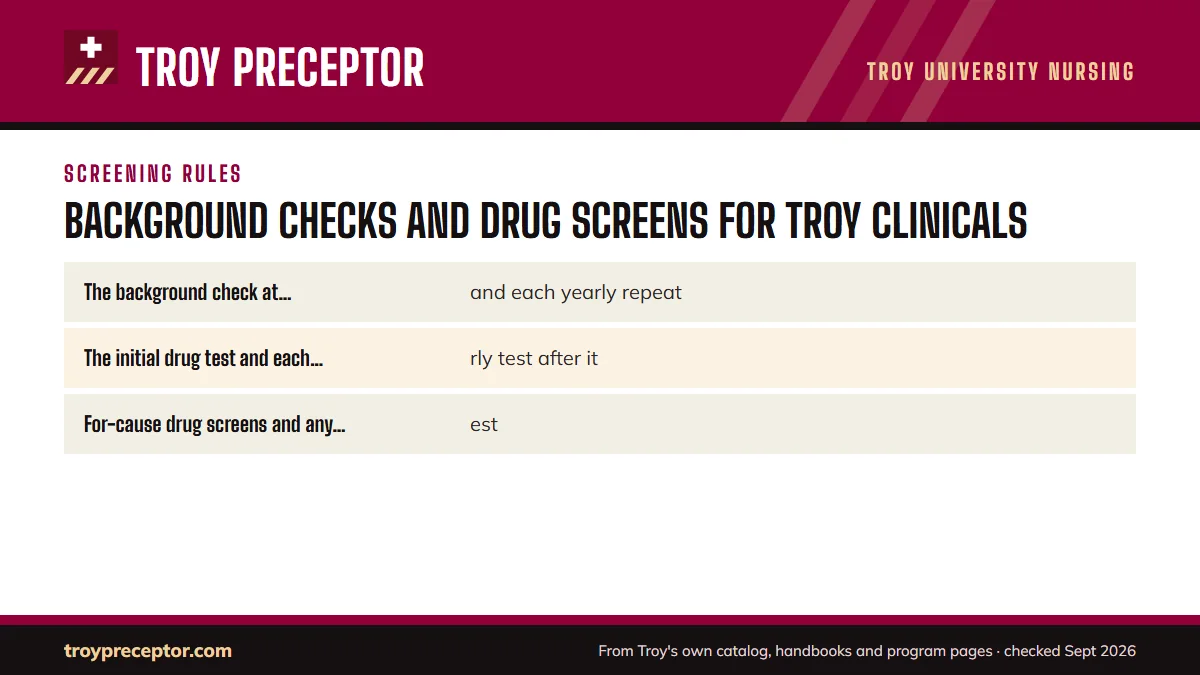
- The background check at admission and each yearly repeat
- The initial drug test and each yearly test after it
- For-cause drug screens and any retest
Keep the date of your most recent negative screen where you can find it quickly, since a site may ask how recent it is. The wider list of clinical expenses, from lab fees to travel, is on the placement costs page.
Conflict: which vendor runs your screen
Troy's own documents disagree on this point. The 2026-27 manuals send your drug collection to Quest and your results and background check through ViewPoint Screening. The MSN program web page instead names LabCorp for the drug test and says Certified Background verifies both the test and the background check.
If the instructions you receive at admission point to a company your manual does not name, raise it before paying either one. A check or screen from a vendor your program does not accept would mean ordering and paying for a second one.
Before you schedule a collection or order a check, find out from your faculty advisor, or the School of Nursing office, which vendor applies to your program and admission term, and save the written reply. The ViewPoint Screening guide explains how the rest of your compliance record is organized and how long each item has to stay valid.
Why Troy students bring us in early
A background check or drug screen that runs late can hold up faculty clearance even after a preceptor has agreed, and Troy counts no hours before faculty clearance. Troy students choose us because we build the preceptor search around those dates. We recruit while your screening is in progress, prepare the preceptor's side of the Preceptor Information Form and Preceptor Biosketch, and keep a second option ready if a site's own requirements add a step.
We also find out at the start whether a practice already has an agreement with Troy, since Troy says the process runs longer where a formal contract has to be created. Approval stays with Troy faculty, and we make sure the packet they review is complete and matches Troy's rules. How it works walks through our steps, or send your details through the form below.
Questions Troy students ask
Does a past conviction stop me from doing clinicals at Troy?
Troy's manuals do not publish a list of disqualifying offenses. They require the disclosure form with each background check and notice to faculty of any new arrest or conviction within 48 hours. Clinical agencies may set their own standards, so talk it through in confidence with your faculty advisor before the check runs and well before you approach a preceptor.
How often do Troy graduate nursing students repeat the drug test?
Once a year while you are in clinical courses, with the first test at the start of your clinical courses under the DNP manual's wording. Additional tests can be required for cause or by a clinical agency, and those are at your expense. Due dates are published for each semester, so confirm yours before scheduling the collection.
Who sees my Troy background check results?
Troy's manuals route results through ViewPoint Screening to the School of Nursing. Your signed Permission to Release Records form is what allows Troy to share clinical records with the agencies where you train. Read that form before signing it, and ask your faculty advisor what a particular agency will receive.
What should I do if I am arrested during a Troy preceptorship?
Notify faculty within 48 hours, as Troy's MSN manual requires for any arrest or conviction. Send the notice in writing to your faculty advisor or course faculty, keep a copy, and ask whether your current clinical site needs to be informed. Missing the 48-hour window adds a second problem to the first one.
Can I use a drug screen from my employer for Troy?
Troy's manuals describe a screen collected by Quest and verified through ViewPoint Screening by the published due date, and they name no employer option for the drug test. OSHA and HIPAA training work differently, since Troy accepts employer-signed verification for those. Ask your faculty advisor before relying on any outside drug test result.
Related pages
Last checked 2026-09-27
We check these pages against Troy's own 2026-27 MSN, DNP, AMSN and RN to BSN orientation manuals, program pages, degree maps and state authorization pages. Your faculty advisor, your course faculty and the School of Nursing have the final word.
Troy asks you to recruit your preceptor. We make that the easy part.
Tell us your Troy program, where you live and which semester your next clinical course starts. We find preceptors who meet Troy's rules for the course, check the setting against Troy's limits, and prepare everything the Preceptor Information Form and biosketch ask for, well ahead of the form deadline.
- Preceptors matched to the course: a graduate-prepared NP or physician for
NSG 6619, pediatrics and women's health forNSG 6666, adults and older adults forNSG 6668 - Preceptor Information Form details, a biosketch and a copy of the preceptor's license, ready for your faculty advisor
- In your own area, in Alabama or a state where Troy can offer clinicals, never in your own work setting
Start your placement plan
Program, city and semester is all we need to begin.