The physical, CPR and insurance items for Troy clinicals
Before each Troy University clinical course you need a current physical on Troy's own form, a CPR card earned with a hands-on skills check, and proof of health insurance for that semester. Professional liability insurance is the unsettled item: the DNP manual says Troy provides it, while neither the MSN manual nor the MSN web page lists it.
Cleared on paper, still no preceptor?
Tell us your program and course, and we will start a preceptor search that fits Troy's rules.
The annual physical on Troy's form
Troy asks for a physical examination every year, recorded on the Troy University Physical Exam Form, titled Verification of Annual Physical Examination, rather than on your provider's own paperwork. The completed form is uploaded to ViewPoint Screening with the rest of your clinical record.
Take the current form from your program's manual to the appointment and have the examining provider complete every section before you leave. The MSN program page pairs the yearly physical with the TB test, so one visit can cover both and keep their dates in step; the TB form and the titers are explained on the immunizations and TB page.
Because the exam is yearly and each document must stay valid until the semester ends, look at the exam date before registration. If the one-year mark falls inside the coming semester, repeat the physical before you register rather than scrambling midway through a clinical course.
CPR: three accepted credentials, hands-on only
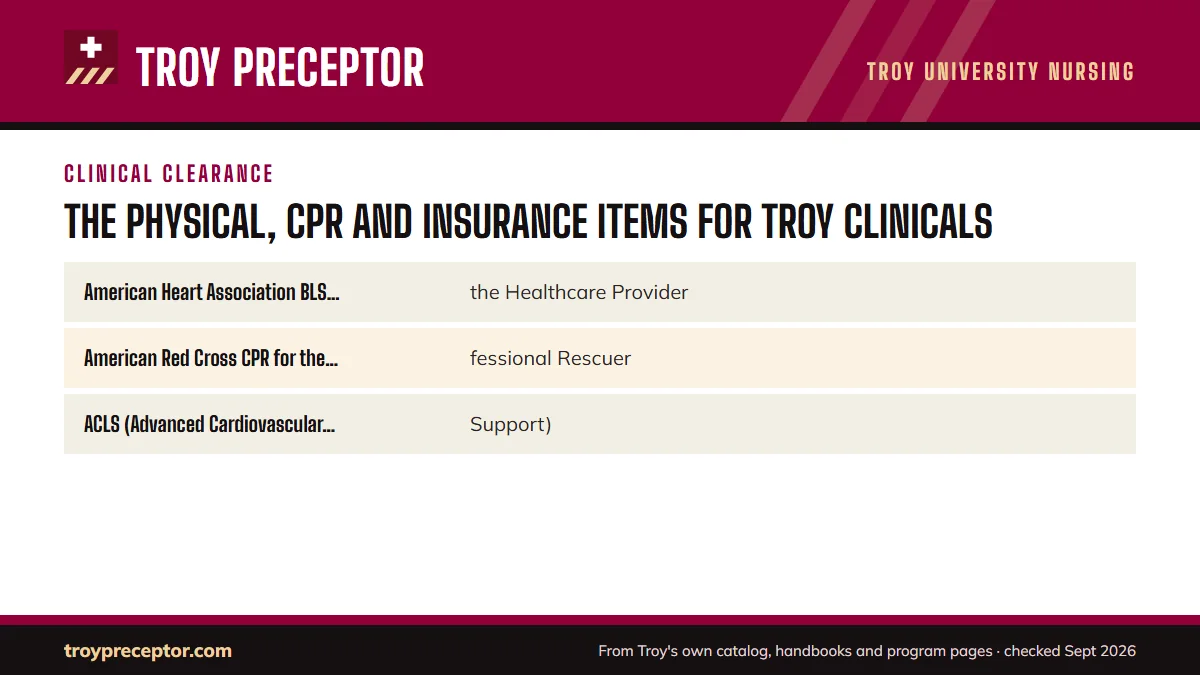
Troy's MSN Student Orientation Manual accepts three CPR credentials:
- American Heart Association BLS for the Healthcare Provider
- American Red Cross CPR for the Professional Rescuer
- ACLS (Advanced Cardiovascular Life Support)
Whichever you hold, the course behind it must include a hands-on skills check. Troy does not accept online-only cards, even from a recognized organization, so a course completed entirely on a screen leaves you short. The program pages summarize the rule as BCLS or ACLS, and BSN students must have CPR in place before any practicum course.
The card's printed expiration date is the one that matters. It has to reach past the last day of your semester, the same validity rule that governs every other upload.
An online-only CPR card does not meet Troy's rule; the card must come from a course with an in-person skills check.
Health insurance every clinical semester
Troy requires proof of health insurance before you begin clinical courses, and the proof goes in again every semester in which you take a clinical course. Troy wants it resubmitted each time, even when nothing about your policy has changed, so build it into your routine before each registration.
The MSN manual notes that coverage through TROY is available for students who need it. The program pages count personal health insurance among the items that have to remain current for the full semester, so if your coverage ends or changes during a clinical course, tell your faculty advisor and upload the new proof as soon as you have it.
Health insurance and professional liability insurance are different things. Health insurance covers your own medical care; liability coverage relates to claims that arise from your clinical work. Troy's documents are clear about the first and divided about the second.
Conflict: professional liability insurance
Troy's documents do not agree on malpractice coverage for students. The 2026-27 DNP Student Orientation Manual lists professional liability insurance among its clinical requirements and says Troy University provides it. Neither the MSN program web page nor the 2026-27 MSN manual lists it at all.
Catalog sources add a third version. The 2021-22 graduate catalog listed liability insurance as required and available through the School of Nursing, and the 2025-26 Graduate Catalog still names professional liability insurance, available through the School of Nursing, among the items students in clinical courses must keep current.
Put three questions to your faculty advisor: whether you are covered in your program, who provides the coverage, and whether you need to show proof in ViewPoint Screening. Keep the reply in writing. If a preceptor's practice asks about student coverage, you will then have a clear answer from Troy to pass along.
How these items set your clearance date
None of these items is difficult on its own, but together they set the earliest day you can start hours. Troy faculty clear a student only after the preceptor and setting are approved, the agreements are signed and the clinical documents are current, and hours before faculty clearance do not count. A physical that expires in week three or an insurance card from last semester can hold that date back.
Work backward from the first day you hope to be with your preceptor. The physical, the CPR card and the insurance proof each need to be current on that day and still in date when the semester ends. Put the three dates on one page with your other ViewPoint items, and renew anything that falls short before you register, while there is still room in the calendar.
Why Troy students hand us the preceptor search
Troy students choose us because we work toward that clearance date from the first conversation. While your physical, CPR card and insurance proof are being finished, we recruit near your home a preceptor whose credentials match your course and whose practice is not your own workplace. The details Troy's preceptor paperwork asks for, biosketch and license copy included, are collected and ready well before your form deadline.
Any practice without an existing Troy contract is flagged at the outset, since Troy warns that the process runs longer when a contract has to be drawn up. If a preceptor withdraws later in the semester, we stay on call and find a replacement. Troy faculty make every approval; our part is a packet they can approve without chasing anything. Start with how it works or the form below.
Questions Troy students ask
Can an employer health screening replace Troy's physical form?
Troy's manual asks for its own Troy University Physical Exam Form every year, so an employer screening on different paperwork is not the named document. Bring Troy's form to your provider and have it completed there. If you believe an employer exam should count, ask your faculty advisor before uploading anything other than Troy's form.
Is a BLS card from a blended online course accepted at Troy?
The deciding factor is the skills check. Troy rejects online-only cards and accepts AHA BLS for the Healthcare Provider, Red Cross CPR for the Professional Rescuer or ACLS when the course included a hands-on skills check. A blended course that ends with an in-person skills session meets that description; confirm with your faculty advisor if you are unsure.
Does Troy provide malpractice insurance for MSN students?
Troy's sources conflict. According to the DNP manual, Troy provides professional liability insurance. Neither the MSN manual nor the MSN web page mentions it, and the 2025-26 Graduate Catalog describes it as available through the School of Nursing. Put the question to your faculty advisor directly and keep the written answer with your clinical records.
Can I get health insurance through Troy?
Troy's MSN manual says coverage through TROY is available. Check the current plan details with Troy before you enroll in it, and whichever policy you choose, upload proof before each semester that includes a clinical course. Troy asks for fresh proof every clinical semester, not just once at admission.
How long is a CPR card good for at Troy?
Troy sets no separate period of its own. The card carries its own expiration date, and Troy needs that date to reach past the final day of your semester. If your card will lapse during a clinical course, renew it through an accepted course with a hands-on skills check before you register.
Related pages
Last checked 2026-09-27
We check these pages against Troy's own 2026-27 MSN, DNP, AMSN and RN to BSN orientation manuals, program pages, degree maps and state authorization pages. Your faculty advisor, your course faculty and the School of Nursing have the final word.
Troy asks you to recruit your preceptor. We make that the easy part.
Tell us your Troy program, where you live and which semester your next clinical course starts. We find preceptors who meet Troy's rules for the course, check the setting against Troy's limits, and prepare everything the Preceptor Information Form and biosketch ask for, well ahead of the form deadline.
- Preceptors matched to the course: a graduate-prepared NP or physician for
NSG 6619, pediatrics and women's health forNSG 6666, adults and older adults forNSG 6668 - Preceptor Information Form details, a biosketch and a copy of the preceptor's license, ready for your faculty advisor
- In your own area, in Alabama or a state where Troy can offer clinicals, never in your own work setting
Start your placement plan
Program, city and semester is all we need to begin.