OSHA, HIPAA and the signed forms Troy asks for
Every year, Troy University graduate nursing students complete OSHA Bloodborne Pathogen training and a HIPAA review, either through modules in the MSN Student Shell in Canvas or with an employer-signed verification. Three signed items sit beside them: Permission to Release Records, the Electronic Device Use Policy form and the Core Performance Standards acknowledgment. DNP students add a certification and an hours verification.
Paperwork handled, preceptor next?
Tell us your program and course, and we will begin a preceptor search built on Troy's rules.
OSHA and HIPAA: two trainings, renewed yearly
Troy's MSN Student Orientation Manual requires OSHA Bloodborne Pathogen training and a HIPAA review once a year. The first deals with exposure to blood and body fluids in clinical settings; the second deals with the privacy of the patient information you will see and handle during a preceptorship. Both are clinical requirements, so the proof belongs in ViewPoint Screening with the rest of your record.
The modules sit in the MSN Student Shell in Canvas, the place Troy's manual points graduate students to for this training. Complete them there, save the completion record, and upload it before the due date for your semester. Because the training is yearly, look at the completion date against the semester's last day, the same way you would for a CPR card or a physical.
The 2025-26 Graduate Catalog also expects students in clinical courses to follow CDC and OSHA guidelines. The training is the documented part; working to those guidelines at the clinical site is the expectation behind it.
Using your employer's verification instead
Troy's online MSN, certificate and DNP students are licensed RNs, and many already complete bloodborne pathogen and privacy training at work. Troy's manual accepts an employer-signed verification of that training, which saves you from repeating the same content in Canvas.
Make sure the verification covers both trainings, carries a signature from your employer, and is dated so it stays current through the end of the semester you are registering for. If your employer's training cycle runs on a different calendar from Troy's semesters, the Canvas modules are often the faster way to close a gap, since you can complete them on your own schedule rather than waiting for the next session at work.
Keep a copy of whichever proof you use. A clinical agency may ask to see training records directly, and having them ready saves an exchange of emails in the days before you start.
Permission to Release Records
The Permission to Release Records form gives Troy your written consent to share clinical records with the agencies where you train. A preceptorship places you inside another organization's practice, and this signature is what allows the School of Nursing to send that organization documents about you.
Read the form before you sign it rather than treating it as a formality. Note which records it covers, and ask your faculty advisor if you want to know what a particular agency will receive. The background check and disclosure form are among the more sensitive items in your file, and the background check and drug screen guide explains how those are handled.
Sign it once you understand it, upload it with your other compliance items, and keep your own copy with the date you signed.
Electronic Device Use Policy and Core Performance Standards
The Electronic Device Use Policy form records that you have read Troy's policy on electronic devices and agree to follow it. Read the policy itself in your program's manual before signing. On your first day with a preceptor, ask about the practice's own device rules as well, since a clinic can set stricter expectations than you are used to at work.
The Core Performance Standards acknowledgment confirms that you have read the performance standards Troy expects of nursing students in clinical settings. Your signature says you know what those standards ask of you, so read the full text before signing; if your copy of the manual does not reproduce it, ask your faculty advisor where to find it.
Both forms are short, and both are easy to leave until the last minute. Sign and upload them with the rest of your yearly items so they do not become the one missing piece that holds up clearance.
Extra items by program
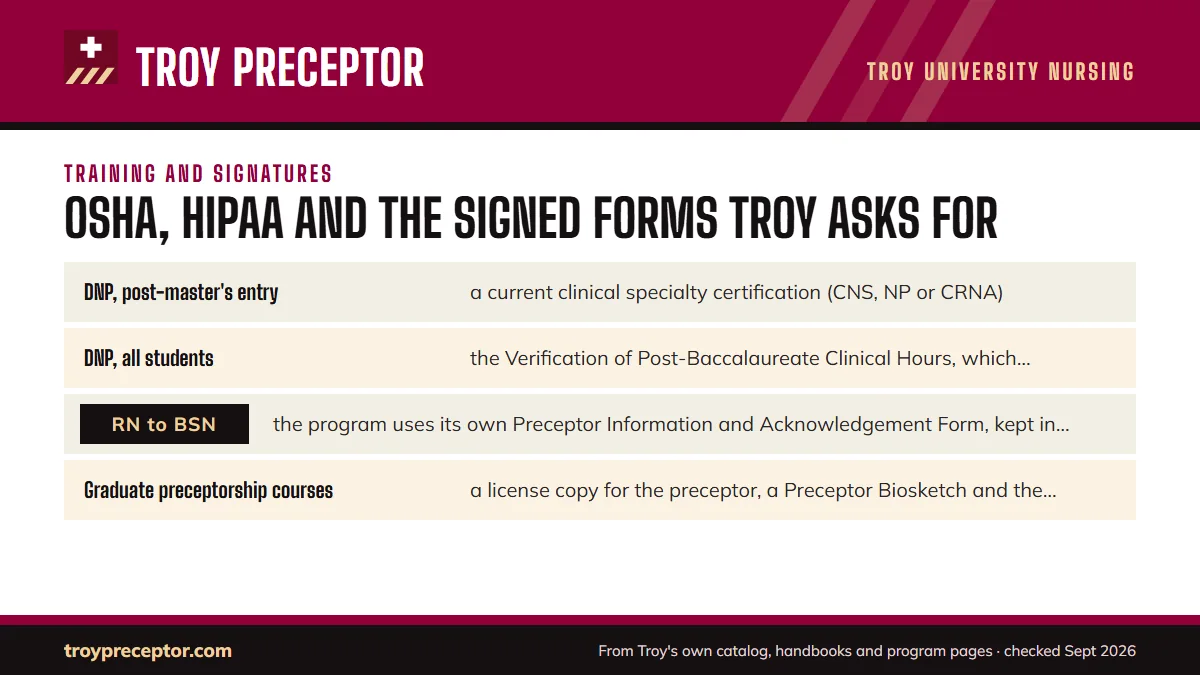
- DNP, post-master's entry: a current clinical specialty certification (CNS, NP or CRNA)
- DNP, all students: the Verification of Post-Baccalaureate Clinical Hours, which goes to the DNP Program Coordinator and feeds the 1,000-hour rule
- RN to BSN: the program uses its own Preceptor Information and Acknowledgement Form, kept in Canvas and approved by lead faculty, and its clinical requirements also go to ViewPoint Screening
- Graduate preceptorship courses: a license copy for the preceptor, a Preceptor Biosketch and the Preceptor Information Form itself, all sent to your faculty advisor and explained field by field on the Preceptor Information Form page
One rule reaches everything you sign or submit about clinical time. Under Troy's MSN Standards of Conduct, reporting clinical hours falsely can cost you the course, and the penalty can reach suspension or expulsion, so keep your hours records as carefully as your compliance forms.
Why Troy students let us run the preceptor side
Training modules and signatures are tasks you finish in an evening. Finding a preceptor who fits Troy's rules is not, and it is the part Troy leaves to the student. Troy students choose us because we take that search on in full while you complete the forms.
Each preceptor's graduate preparation and experience is checked against your course. You stay clear of your own work area and within Troy's limits on reusing preceptors and sites, and we ask the practice whether it runs onboarding or privacy training of its own. Details for the preceptor's form, biosketch and license copy are gathered well before the deadline, and a practice lacking a Troy contract is flagged at once. Troy faculty decide on approval; we hand them a packet with no gaps.
Questions Troy students ask
Where do I find the MSN Student Shell in Canvas?
The MSN Student Shell is a Canvas course for Troy MSN students, and it holds the OSHA and HIPAA training modules. Look for it in your Canvas course list. If it is missing, ask your faculty advisor to have you added, and do it well before your compliance due date so the training does not become the late item.
Can I reuse last year's HIPAA certificate from work?
Only if it stays current through the end of the semester. Troy wants OSHA and HIPAA training every year and accepts an employer-signed verification, so a certificate that expires partway through a clinical course would need to be renewed first, either through your employer or through the modules in the MSN Student Shell in Canvas.
What if I need an accommodation to meet Troy's Core Performance Standards?
Raise it before the semester starts. TROY Online lists Student Disability Services among its resources for online learners, and your faculty advisor needs to know early enough to plan clinical arrangements. Read the standards first so you can point to the specific one the accommodation concerns.
Why does Troy need permission to release my records?
Clinical agencies take part in your education during a preceptorship, and Troy lists a Permission to Release Records form so the School of Nursing can share clinical records with them. Without that signature, Troy lacks your written consent to send an agency the documents it asks for, which can slow approval of your placement.
Do BSN and ASN students sign the same Troy forms?
The items on this page come from Troy's graduate manuals. The BSN Prelicensure manual also routes clinical requirements into ViewPoint Screening and posts the due dates through Canvas and Troy email, but its form list may differ. ASN students in Montgomery should ask course faculty for the current list and follow their own program's instructions.
Related pages
Last checked 2026-09-27
We check these pages against Troy's own 2026-27 MSN, DNP, AMSN and RN to BSN orientation manuals, program pages, degree maps and state authorization pages. Your faculty advisor, your course faculty and the School of Nursing have the final word.
Troy asks you to recruit your preceptor. We make that the easy part.
Tell us your Troy program, where you live and which semester your next clinical course starts. We find preceptors who meet Troy's rules for the course, check the setting against Troy's limits, and prepare everything the Preceptor Information Form and biosketch ask for, well ahead of the form deadline.
- Preceptors matched to the course: a graduate-prepared NP or physician for
NSG 6619, pediatrics and women's health forNSG 6666, adults and older adults forNSG 6668 - Preceptor Information Form details, a biosketch and a copy of the preceptor's license, ready for your faculty advisor
- In your own area, in Alabama or a state where Troy can offer clinicals, never in your own work setting
Start your placement plan
Program, city and semester is all we need to begin.