Grades and progression for Troy University graduate nursing students
Troy University's 2025-26 Graduate Catalog sets the grade rules that decide whether an MSN or DNP student keeps moving: no more than six semester hours below a B, a B or better in named courses, and repeats in which both attempts count. For a clinical student, a repeat also means another semester, another preceptor and another round of approval.
Repeating a clinical course?
Tell us the course and semester, and we start the preceptor search for your next attempt.
The minimum grades Troy sets
Every rule on this page comes from Troy's 2025-26 Graduate Catalog. Ask your faculty advisor whether the 2026-27 catalog changed anything for your cohort.
| Rule | Who it applies to |
|---|---|
| A grade below C does not satisfy a later course that requires the first one | MSN students |
B or better in NSG 6691 | MSN students and BSN-to-DNP students |
B or better in NSG 8812 Foundations of Evidence-based Practice | DNP students |
Completing NSG 6697 satisfies the comprehensive examination | MSN students |
| No more than six semester hours of grades below B | Every graduate student; repeated in the DNP section |
A C, in other words, still moves you forward in most courses. It counts against the six-hour limit below, though, and in a course that requires a B it has to be replaced by repeating the course. Before a semester ends badly, compare your options on incompletes, withdrawal and time limits.
The six-hour rule
Troy caps grades below B at six semester hours for any graduate student. Once your hours at C or lower pass six, academic suspension from the University follows automatically, for one calendar year. The rule is university-wide, and the catalog repeats it in the DNP section.
Credits, not courses, are what count, and nursing courses vary in size. Two 3-credit courses at C reach the limit exactly. A single C in NSG 6680, the 5-credit FNP Internship, uses five of the six hours on its own, leaving room for one more credit below B in the whole program. Practicums such as NSG 6666 and NSG 6668 carry 3 credits each.
Keep your own running count from your first semester. Your faculty advisor can confirm where you stand, but the hours add up quietly, and the suspension is automatic once the line is crossed.
Repeating a course does not erase the first grade: both attempts count in your GPA.
Repeating a course, and what it means for clinicals
Courses graded D, F or W may be repeated. A C or lower in a research course, or in any course that requires a B, must be repeated until you earn a B or better. Both attempts stay in your GPA.
For a clinical student, a repeat is also a scheduling problem. With each FNP-specific course offered only once a year and in sequence, a repeated FNP practicum generally waits a full year for its next run, and the courses after it wait too. Plan on a new preceptor search, a new Preceptor Information Form and fresh approval for the repeated course, with the usual form deadline.
The reuse rule applies across attempts as well. Because Troy caps each preceptor and site at two uses per program, ask your faculty advisor whether going back to the same preceptor for a repeat uses up the second slot, before you ask the preceptor. When a repeat pushes your finish date, delayed graduation covers how to replan.
Conditional admission, suspension and readmission
Conditionally admitted MSN students must reach a 3.0 GPA after nine semester hours or be dropped for one calendar year, after which they may petition to return. Temporary admission is not available for the MSN or DNP. The MSN manual also places conditionally admitted FNP students on a part-time path that can be completed in eight semesters.
The catalog's graduate rules speak of suspension and being dropped from the program rather than a probation status. For progression questions in nursing specifically, your faculty advisor is the first contact, and Troy's manuals also name a Graduate Nursing Admissions and Progressions Committee.
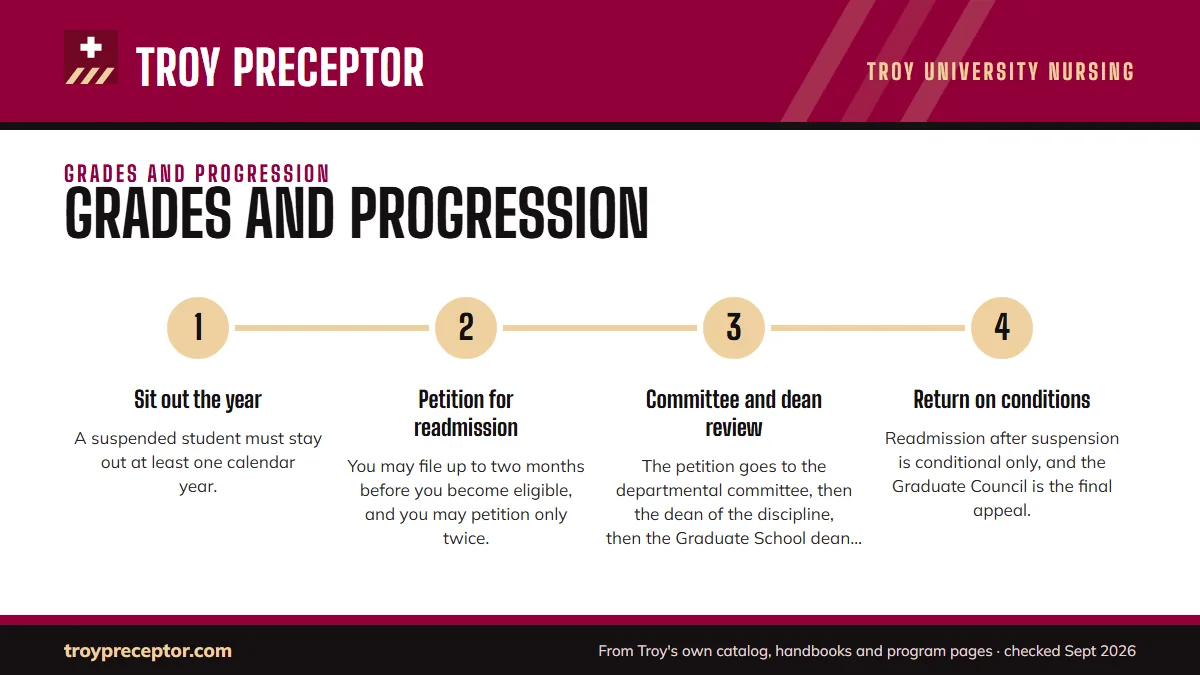
- Sit out the yearA suspended student must stay out at least one calendar year.
- Petition for readmissionYou may file up to two months before you become eligible, and you may petition only twice.
- Committee and dean reviewThe petition goes to the departmental committee, then the dean of the discipline, then the Graduate School dean and the Graduate Council chair.
- Return on conditionsReadmission after suspension is conditional only, and the Graduate Council is the final appeal.
Clinical conduct that reaches your grade
Some clinical rules in Troy's MSN manual act directly on your grade. Faculty can check on you without notice, by phone, by video or at the site itself, and if you are absent on a scheduled clinical date during a visit, your clinical evaluation is graded zero. Any hours logged ahead of faculty clearance are simply not credited to the course.
The heaviest rule concerns honesty. Giving false information about clinical hours means course failure, and it can reach suspension or expulsion under the Standards of Conduct. Academic-honesty appeals follow The Oracle, Troy's student handbook, rather than the grade-appeal path below.
How each practicum is graded day to day, including what counts as passing clinical performance, is set out in the course syllabus and by course faculty. Read it in the first week and raise anything unclear before your first shift. Troy's rules for filing and changing your schedule are on clinical schedule and site visits.
Appealing a grade
Troy's grade appeal starts informally and runs on firm windows, so keep to each one.
- Talk to the instructorRaise it informally within the first four weeks of the next term or semester.
- Write to the department chairSubmit a written request by the end of week five. The chair meets with you within two weeks.
- Chair's decisionIf the chair upholds the grade, the matter is closed.
- Faculty panelOtherwise, within two weeks, a panel of three faculty named by the dean decides, and that decision is final.
Comprehensive examinations follow their own rule: a failed comprehensive exam must be passed within one year, and a student who fails cannot change programs. For MSN students, completing NSG 6697 satisfies the comprehensive examination.
Why students rebuilding a semester call us
A repeated clinical course comes with a tight window: a new preceptor, a complete form set and approval before the deadline, often while you are still recovering from the semester that went wrong. That is the moment Troy students bring us in.
We source a preceptor who fits Troy's requirements for that exact course, test the choice against the reuse and work-setting limits, and assemble the details for the information form, the biosketch and the license copy well before the deadline. We look closely at the preceptor's weekly availability, because a repeat leaves no room for a second shortfall. If a preceptor steps away mid-course, we find a replacement.
Approval stays with Troy faculty, and our aim is a packet they can sign off on at first review. Tell us about your repeat through the contact page or read how it works.
Questions Troy students ask
Does a C count in Troy's graduate nursing programs?
A C still passes most courses and satisfies most prerequisites, since only a grade below C fails to count toward a later course. It does count toward Troy's limit of six semester hours below B, and in a research course or any course that requires a B, such as NSG 6691 or NSG 8812, a C must be repeated to a B or better.
How many C grades can a Troy graduate student get?
The limit is counted in semester hours, not grades: no more than six hours below B. That is two 3-credit courses, or one 5-credit course like NSG 6680 plus very little else. Exceed six such hours and the 2025-26 Graduate Catalog makes suspension from the University automatic, for a full calendar year.
Does Troy replace a grade when I repeat a course?
No. Under the 2025-26 Graduate Catalog, both attempts count in your GPA. You may repeat a course graded D, F or W, and you must repeat a C or lower in a research course or any course that requires a B. For a clinical course, the repeat also needs a preceptor approved in time for that semester's form deadline.
Does Troy put graduate nursing students on academic probation?
Troy's 2025-26 Graduate Catalog uses suspension and being dropped from the program rather than a probation status. Conditionally admitted MSN students must reach a 3.0 GPA after nine semester hours or be dropped for a calendar year, then may petition to return. Ask your faculty advisor how the nursing program applies these rules to you.
How long do I have to appeal a grade at Troy?
Start within the first four weeks of the next term or semester, with an informal appeal to the instructor. If that does not settle it, a written request must reach the department chair by the end of week five. The chair meets within two weeks, and if the chair does not uphold the grade, a panel of three faculty named by the dean makes the final decision.
Related pages
Last checked 2026-09-27
We check these pages against Troy's own 2026-27 MSN, DNP, AMSN and RN to BSN orientation manuals, program pages, degree maps and state authorization pages. Your faculty advisor, your course faculty and the School of Nursing have the final word.
Troy asks you to recruit your preceptor. We make that the easy part.
Tell us your Troy program, where you live and which semester your next clinical course starts. We find preceptors who meet Troy's rules for the course, check the setting against Troy's limits, and prepare everything the Preceptor Information Form and biosketch ask for, well ahead of the form deadline.
- Preceptors matched to the course: a graduate-prepared NP or physician for
NSG 6619, pediatrics and women's health forNSG 6666, adults and older adults forNSG 6668 - Preceptor Information Form details, a biosketch and a copy of the preceptor's license, ready for your faculty advisor
- In your own area, in Alabama or a state where Troy can offer clinicals, never in your own work setting
Start your placement plan
Program, city and semester is all we need to begin.