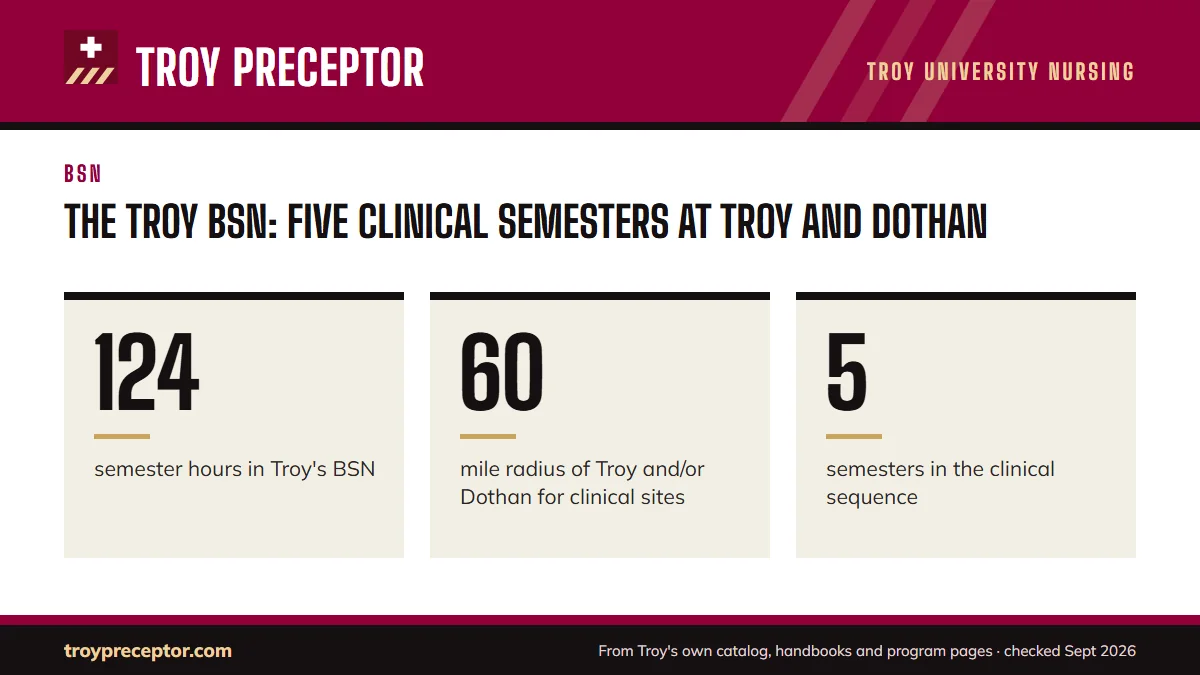
The Troy BSN: five clinical semesters at Troy and Dothan
Troy University's pre-licensure BSN runs in person on the Troy and Dothan campuses, with a five-semester clinical sequence that ends in NSG 4421 Professional Nursing Clinical Preceptorship. Troy's BSN manual places clinical sites within a 60-mile radius of Troy and/or Dothan. Our work with BSN students looks ahead: in Troy's online graduate programs, the orientation manuals ask students to contact their own preceptors, and that search is what we do best.
Plan ahead for graduate clinicals
Tell us your campus, your graduation term and your next goal.
The clinical sequence, semester by semester
The BSN is 124 semester hours. Once you enter the clinical sequence you take practicum courses in each of five semesters, and Troy's 150 percent rule expects you to graduate within seven semesters of entering it.
| Semester | Practicum courses (credits) |
|---|---|
| I | NSG 3310 Health Assessment Practicum (1); NSG 3314 Nursing Concepts Practicum (3) |
| II | NSG 3326 Adult Health Nursing I Practicum (3); NSG 3335 Psychiatric-Mental Health Nursing Practicum (2) |
| III | NSG 3324 Maternal-Infant Health Nursing Practicum (2); NSG 3337 Adult Health Nursing II Practicum (2) |
| IV | NSG 4404 Child Health Nursing Practicum (2); NSG 4414 Complex Nursing Practicum (2) |
| V | NSG 4406 Public Health Nursing Practicum (2); NSG 4421 Professional Nursing Clinical Preceptorship (3) |
Troy lists credits for these courses rather than clinical hours; each course's faculty and syllabus give the hours. Current CPR is required before any practicum course, and clinical requirements go to ViewPoint Screening, with due dates announced in Canvas and by Troy email.
Clinical sites and the apprenticeship, in Troy's words
Troy's BSN manual says: "Sites for clinical experiences will be within a 60-mile radius of Troy University in Troy and/or Dothan." Specialty rotations can reach beyond that; pediatrics includes two days at Children's Hospital in Birmingham. The 2026-27 catalog's degree planner describes the clinical facilities as being in Troy and surrounding communities.
Troy's BSN page also describes a Nurse Student Apprenticeship with Flowers Hospital in Dothan and the Baptist Health system. Selected students take part, and the apprenticeship replaces some clinical rotations. How students are selected, and which rotations it covers, is set by the School of Nursing.
For questions about a particular rotation, including travel for the Birmingham pediatric days, go to your course faculty or the BSN coordinator for your campus. Each facility's own rules, such as its dress code, come through the course.
Two campuses, one sequence
The BSN is offered in person on the Troy and Dothan campuses. On the Troy campus, Jones Hall is the School of Nursing's home, with a 30-bed hospital lab and five advanced simulation rooms. Each campus has its own coordinators: Troy students work with the BSN Coordinator and Troy BSN Assistant Coordinator, while Dothan students work with the Dothan BSN and AMSN Assistant Coordinator.
One Troy document is out of step here. The DNP manual describes the BSN as a Troy-campus program only, while the MSN manual, the BSN page and the accreditation page list both Troy and Dothan. Trust the BSN page and your admission letter for campus questions.
Admission to the clinical sequence runs twice a year, with deadlines of March 15 for fall and September 15 for spring. The catalog planner lists a minimum 2.5 GPA, and Troy freshmen with a 3.2 GPA can earn early acceptance. The campuses and online page shows what happens where across the School of Nursing.
Licensure, approval and accreditation
BSN graduates are eligible to sit for the NCLEX-RN. Troy's 2025 licensure disclosure for the ASN and BSN lists every state, the District of Columbia and American Samoa, and marks each one as meeting the educational requirements for RN licensure. Each state board still sets its own application steps. That disclosure is separate from the 2020 table for Troy's online RN to BSN, MSN and DNP, which answers a different question: whether clinical experiences can be offered in each state.
The BSN is approved by the Alabama Board of Nursing and accredited by ACEN, and Troy University holds institutional accreditation from SACSCOC. What each of those covers, and where the ACEN scope lists Troy and Dothan for the BSN, is on our accreditation page. Keep your clinical documents and course records organized as you go, since a graduate program or employer may ask for them later.
After the BSN: where preceptors come in
If you come back to Troy for graduate study, clinicals work differently. Troy's MSN Student Orientation Manual makes contacting preceptors the student's job and reserves approval of every preceptor for faculty, and the DNP manual asks the same of post-BSN DNP students, with faculty able to suggest names.
- Online MSN FNP: four preceptorships and 780 clinical hours, with an unencumbered RN license in the clinical state. See the MSN FNP guide.
- Online MSN HINL: three informatics and leadership practicums, 480 hours.
- Post-BSN DNP: the FNP or Nurse Leader track on the way to 1,000 clinical hours; the DNP overview explains the routes.
The FNP courses accept NPs who have practiced at least a year, as well as physicians, nurse midwives and PAs, and they exclude hours in your own work area. Noting the clinics and practitioners you meet during BSN rotations gives you a head start on that search later.
How we help Troy BSN students
We are built for the parts of Troy's programs where students recruit their own preceptors, and for BSN students that begins with graduate study. When you apply to Troy's online MSN or DNP, we map your first preceptorship to its semester, look for preceptors near where you plan to live and work, and have the Preceptor Information Form details, a biosketch and a license copy ready ahead of the form deadline.
For graduates heading into the MSN HINL or the DNP Nurse Leader track, we look for informatics and leadership preceptors instead. Either way, we check each setting against where you will be working as a new nurse, because Troy's graduate manuals rule out hours in your own work area.
If you are finishing the BSN now and aiming for the FNP, talk to us early. The first FNP preceptorship, NSG 6619, runs in fall, and a full semester of lead time makes for a stronger shortlist. Share your plans through the form below; how it works lays out our process.
Questions Troy students ask
Does Troy's BSN include a preceptorship?
Yes. The final clinical semester includes NSG 4421 Professional Nursing Clinical Preceptorship, a 3-credit course taken alongside NSG 4406 Public Health Nursing Practicum. The BSN manual and your course faculty explain how the preceptorship is set up; the BSN coordinator for your campus can answer questions about its structure and timing.
What is Troy's Nurse Student Apprenticeship?
It is an option Troy's BSN page describes for selected BSN students, run with Flowers Hospital in Dothan and the Baptist Health system. Taking part replaces some of your clinical rotations. The School of Nursing sets the selection process and decides which rotations the apprenticeship covers, so ask early if it interests you.
Can I go straight from Troy's BSN to the DNP?
Troy's DNP has a post-BSN entry with two online tracks, FNP and Nurse Leader, and every route ends at 1,000 clinical hours. Every DNP admission is unconditional, and spaces are limited. For the 6000-level clinical courses, the DNP manual asks you to contact prospective preceptors, with faculty able to suggest names.
Can a Troy BSN graduate get licensed in another state?
Troy's 2025 ASN and BSN disclosure marks the BSN as meeting the educational requirements for RN licensure in all 50 states, the District of Columbia and American Samoa. That covers education only. The board in the state where you plan to work sets its own application, background check and fee steps, so check its site before you apply.
What if I fall behind in Troy's BSN clinical sequence?
Troy expects BSN students to graduate within seven semesters of entering the clinical sequence, 150 percent of its five semesters. A repeated practicum uses part of that margin. Talk to the BSN coordinator for your campus as soon as a course is at risk, so you understand how a repeat fits the semesters you have left.
Related pages
Last checked 2026-09-27
We check these pages against Troy's own 2026-27 MSN, DNP, AMSN and RN to BSN orientation manuals, program pages, degree maps and state authorization pages. Your faculty advisor, your course faculty and the School of Nursing have the final word.
Troy asks you to recruit your preceptor. We make that the easy part.
Tell us your Troy program, where you live and which semester your next clinical course starts. We find preceptors who meet Troy's rules for the course, check the setting against Troy's limits, and prepare everything the Preceptor Information Form and biosketch ask for, well ahead of the form deadline.
- Preceptors matched to the course: a graduate-prepared NP or physician for
NSG 6619, pediatrics and women's health forNSG 6666, adults and older adults forNSG 6668 - Preceptor Information Form details, a biosketch and a copy of the preceptor's license, ready for your faculty advisor
- In your own area, in Alabama or a state where Troy can offer clinicals, never in your own work setting
Start your placement plan
Program, city and semester is all we need to begin.