Online Troy University FNP and MSN students in Connecticut
For Connecticut, Troy University's 2020 clinical table gives a plain Yes, with no note attached, covering all of Troy's online programs. What has changed since then is licensing: multistate RN licenses have counted in Connecticut since October 1, 2025, which gives you a second way to meet Troy's license rule there.
Get your placement plan
Tell us your Troy program and where you live. A placement advisor replies with the preceptor and site options that fit your Troy course.
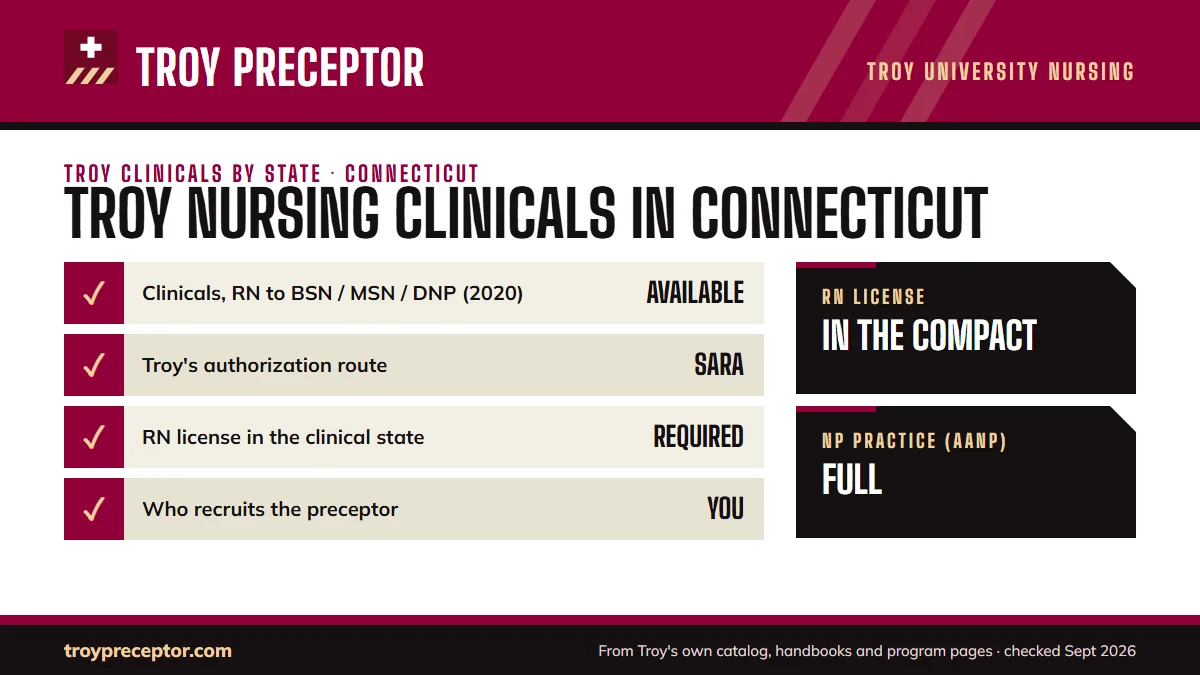
Connecticut at a glance in Troy's records
| Troy record | Entry for Connecticut |
|---|---|
| Online Nursing Programs disclosure, each row dated 12/15/2020 | Yes, no note |
| State authorization page | Listed among Troy's 40 SARA-authorized states |
| Current RN License rule, MSN Student Orientation Manual 2026-27 | An unencumbered RN license good in Connecticut from the first day of the semester to the last |
A clean Yes from 2020 still deserves a fresh look before you plan around it. Troy's Clinical Placements Specialist can confirm the clinical side and its Coordinator of State Authorizations the state side; the state authorization page shows how SARA fits in.
How Connecticut treats programs from other states
Connecticut regulates nurses through a Board of Examiners for Nursing that sits within its public health department. For schools elsewhere that train new nurses, section 20-90-59 treats three facts as enough. The school's own state board has approved it. Its curriculum lines up with what Connecticut demands of RN programs. And the licensure bar in the school's state sits level with Connecticut's or above it. No extra application appears in the text.
Those sections, along with Connecticut's contract and ratio rules for such programs, are written for pre-licensure education. Troy's online MSN, DNP and RN to BSN serve nurses who already hold a license, and the regulations do not speak to them. Any Connecticut step for Troy's programs would run through the Clinical Placements Specialist rather than land on you as a form.
Practice rules, preceptors and places
AANP ranks Connecticut full practice, but NPs earn that status over time: three years of practice alongside a collaborating physician come first, with 2,000 hours as the floor. An NP still inside that window can precept a Troy student if they meet Troy's standard, which asks for graduate preparation, an NP license in their state of practice and twelve months or more of NP work. See who can precept a Troy FNP student.
By 2025 Census Bureau estimates, about 1.17 million people live in the Hartford metro (Hartford-West Hartford-East Hartford), Bridgeport-Stamford-Danbury comes second, while the New Haven and Waterbury-Shelton metros are each well under 600,000. Hospital systems range from Hartford HealthCare to UConn Health, Trinity Health Of New England and Yale New Haven Health. In the west of the state, Danbury Hospital and other hospitals Nuvance Health once ran now belong to Northwell Health, a New York system. Each decides for itself about students.
Licensing now that the compact has arrived
The public health department's compact guidance is short: RN students may now work in Connecticut on a license Connecticut itself issued, or on the multistate license held through their compact home state. Before relying on the multistate route, have your faculty advisor confirm Troy accepts it as proof for Connecticut hours under its license rule. Connecticut has not joined the APRN Compact.
The state line matters more than the drive. On Troy's 2020 table, New York is No and Massachusetts and Rhode Island were Not yet determined, so a preceptor a short trip across the border may not be usable. Keep a Connecticut site as your plan unless Troy tells you otherwise.
Why Connecticut students come to us
A Connecticut search turns on three checks: a license that covers the site, a preceptor who clears Troy's experience bar and a practice on the Connecticut side of the line. We run all three, recruit around your home and work schedule, and assemble what your faculty advisor needs to see: the Preceptor Information Form, a biosketch and the preceptor's license. Troy's faculty make every approval decision; we deliver a file with nothing left to chase. Your first step is the form below.
Questions Troy students ask
Can I do Troy University clinicals in Connecticut?
Troy's 2020 table answers yes for Connecticut, with no strings, for every online Troy program. The row carries a December 15, 2020 date and does not address licensure, so verify it with the Clinical Placements Specialist, then keep an unencumbered license valid in Connecticut throughout the semester.
Is my multistate license good for Connecticut clinicals now?
In most cases, yes. Connecticut's compact participation began October 1, 2025, and state guidance now lets RN students practice there on a multistate license from the compact state they call home. Show Troy that license before the preceptor request goes in; out-of-state requests wait for proof of licensure in the clinical state.
Could I use a New York preceptor while living in Connecticut?
Not on the basis of Troy's 2020 table. It marks New York No. Troy's note says New York's education department has to register or approve any nursing program based out of state or taught online before that program's students can rotate through New York clinicals. Plan on a Connecticut site unless the Clinical Placements Specialist confirms something different.
Do Connecticut NPs need a physician to precept a student?
Only early on. A Connecticut NP works in collaboration with a physician through a first stretch of three years and 2,000 hours, then practices independently. Either stage can suit Troy, provided faculty approve and the NP brings graduate preparation, an NP license and one year or more of NP experience.
Related pages
Last checked 2026-09-27
We check these pages against Troy's own 2026-27 MSN, DNP, AMSN and RN to BSN orientation manuals, program pages, degree maps and state authorization pages. Your faculty advisor, your course faculty and the School of Nursing have the final word.
Troy asks you to recruit your preceptor. We make that the easy part.
Tell us your Troy program, where you live and which semester your next clinical course starts. We find preceptors who meet Troy's rules for the course, check the setting against Troy's limits, and prepare everything the Preceptor Information Form and biosketch ask for, well ahead of the form deadline.
- Preceptors matched to the course: a graduate-prepared NP or physician for
NSG 6619, pediatrics and women's health forNSG 6666, adults and older adults forNSG 6668 - Preceptor Information Form details, a biosketch and a copy of the preceptor's license, ready for your faculty advisor
- In your own area, in Alabama or a state where Troy can offer clinicals, never in your own work setting
Start your placement plan
Program, city and semester is all we need to begin.