How to choose a preceptor placement service for Troy clinicals
The right placement service for a Troy University student is one built around Troy's own process: the preceptor rules for each course, the form packet, the deadlines and the approval steps that follow. Use the questions below to judge any service, including ours.
Get your placement plan
Tell us your Troy program and where you live. A placement advisor replies with the preceptor and site options that fit your Troy course.
The standard comes from Troy's manuals
Any service you hire works inside a process Troy has already defined. Troy's 2026-27 manuals ask students to contact and recruit their preceptors, leave approval of each preceptor and setting to faculty, and give the School of Nursing the job of starting agreements with the clinical agency. A good service takes the recruiting and the preparation off your hands and leaves the decisions where Troy puts them.
That gives you a simple test. A service worth paying knows Troy's rules by course number, not only by program name, because the rules shift from NSG 6619 to NSG 6666, from FNP to HINL, and from the MSN manual to the DNP manual. A generic list of nurse practitioners who precept somewhere is the easy part. Matching one to your course, your location and your record is the real work.
Seven questions to ask before you sign up
Put these to any service, ours included. The answers show quickly whether it knows Troy or only knows preceptors in general.
| Ask | Why it matters for a Troy student |
|---|---|
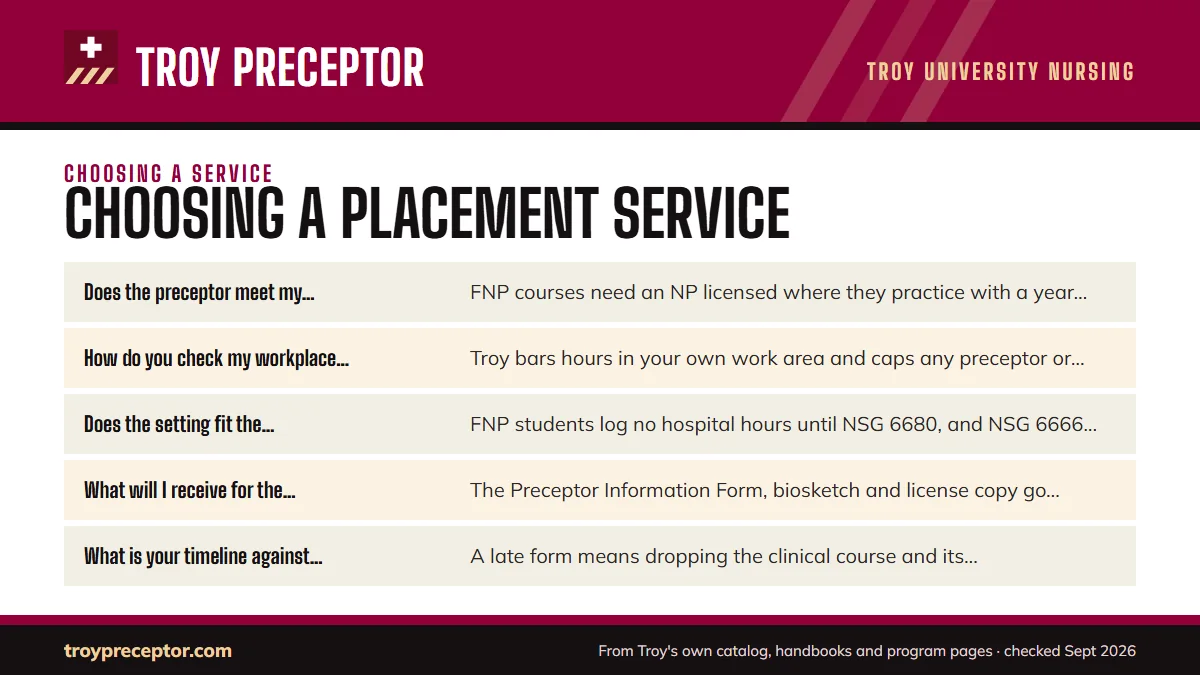
| Does the preceptor meet my course's list? | FNP courses need an NP licensed where they practice with a year of NP experience, or a physician, midwife or PA; HINL, Nursing Education and Accelerated MSN courses each have their own lists |
| How do you check my workplace and my history? | Troy bars hours in your own work area and caps any preceptor or site at two uses in the program |
| Does the setting fit the course? | FNP students log no hospital hours until NSG 6680, and NSG 6666 needs two preceptors |
| What will I receive for the packet? | The Preceptor Information Form, biosketch and license copy go in together, and incomplete forms are not processed |
| What is your timeline against my deadline? | A late form means dropping the clinical course and its co-requisite |
| Will the site need a new contract? | Troy says sites without an existing formal contract take longer |
| What happens if the preceptor leaves mid-semester? | A replacement needs its own approval and clearance before hours count |
Claims to question
Some promises sound reassuring and still do not fit how Troy works. Ask a service to explain any of these before you commit:
- An approval promise. Troy faculty approve every preceptor and setting, so no outside service can promise that outcome.
- A claimed partnership with Troy. Troy publishes no list of affiliated agencies or placement services.
- Hours that start before faculty clear you, or fall during a semester break. Troy counts neither.
- A preceptor in another state before you hold that state's RN license.
- A quote with no scope attached. Ask what it covers: one course or several, one preceptor or the two
NSG 6666needs, and what happens if a preceptor leaves.
Our cost page explains what shapes a quote for Troy students, and placement help versus finding your own weighs the choice itself.
What a finished match should include
A placement is not finished when a clinician says yes. It is finished when you can send your faculty advisor a complete, typed Preceptor Information Form with a Preceptor Biosketch and a license copy, for a preceptor and setting that already fit the course. Ask to see what that handoff looks like before you commit.
A complete handoff covers:
- The preceptor's credential, matched to the right box on Troy's biosketch and to the course's list
- A current license in the state where you will do the hours
- The setting type, checked against the course and against your own workplace
- Confirmation that this is your first or second use of the preceptor and site
- Proposed dates inside the course, ready for the clinical schedule form once faculty clear you
The Preceptor Information Form guide covers each field in detail.
Why Troy students choose us
Our whole method follows Troy's clinical process one course at a time. Each preceptor we propose practices near you, satisfies the list for your exact NSG course, sits outside your employer's settings, has not reached Troy's two-use cap on your record, and works in a setting the course allows, from primary care offices for NSG 6666 to leadership and informatics settings for the HINL practicums.
Paperwork details are gathered before your deadline rather than on it, and a site that may require a fresh formal contract is raised with you at the outset. A preceptor who withdraws mid-semester sets our replacement search going that same day. Approval is Troy faculty's call, and the packet that reaches them is whole and already consistent with Troy's rules. See how it works for the full sequence.
What to have ready when you ask for a quote
You will get a faster, more accurate answer from any service if you bring the details a Troy match depends on: your program and track, the NSG course number, the city and state where you will do the hours, the semester the course starts, the hours still needed, where you work, and every preceptor and site you have used so far.
Add each state where you are licensed as an RN and, if known, the date your form is due. Those same details are what your faculty advisor will look at, so collecting them is never wasted effort. With them in hand, a placement advisor can tell you quickly whether your area and timing are workable and what the search involves. Use the form below to start.
Questions Troy students ask
Does Troy approve preceptors found through a placement service?
Troy faculty review every preceptor and setting against the same course rules, using the Preceptor Information Form, the biosketch and the license copy you submit. A service's job is to make sure the preceptor meets those rules and that your packet is complete; the approval itself always sits with Troy faculty.
Can a placement service promise my preceptor will be approved?
No. Approval belongs to Troy faculty, who sign off on each preceptor and setting before any agreement moves. What a strong service can do is cut the risk of a rejection by checking the course list, your workplace, the twice-per-program limit and the setting type before your packet goes in.
How early should I contact a placement service?
Troy gives no number of weeks, but it says a site with no formal contract in place moves slower, and its form deadlines do not move: the final no-penalty drop date for NSG 6619 and for DNP students, and a month into the other MSN clinical courses. Beginning a full semester early leaves the most preceptors to choose from.
Is a placement service worth it if I already have some leads?
It can be. A service can check your own leads against Troy's rules, fill gaps such as the second preceptor for NSG 6666, and keep a replacement in view. Weigh the cost against the risk of a late form, which the MSN manual answers by taking away both the clinical course and its co-requisite.
Do placement services help RN to BSN and Accelerated MSN students?
They can. Troy's RN to BSN manual asks students to identify and contact qualified preceptors, and the AMSN manual does the same for NSG 5549 and NSG 6698. Each has its own forms and preceptor rules; RN to BSN students, for example, use an acknowledgement form in Canvas that lead faculty approve.
Related pages
Last checked 2026-09-27
We check these pages against Troy's own 2026-27 MSN, DNP, AMSN and RN to BSN orientation manuals, program pages, degree maps and state authorization pages. Your faculty advisor, your course faculty and the School of Nursing have the final word.
Troy asks you to recruit your preceptor. We make that the easy part.
Tell us your Troy program, where you live and which semester your next clinical course starts. We find preceptors who meet Troy's rules for the course, check the setting against Troy's limits, and prepare everything the Preceptor Information Form and biosketch ask for, well ahead of the form deadline.
- Preceptors matched to the course: a graduate-prepared NP or physician for
NSG 6619, pediatrics and women's health forNSG 6666, adults and older adults forNSG 6668 - Preceptor Information Form details, a biosketch and a copy of the preceptor's license, ready for your faculty advisor
- In your own area, in Alabama or a state where Troy can offer clinicals, never in your own work setting
Start your placement plan
Program, city and semester is all we need to begin.