Hawaii: Troy University's online nursing clinicals listed as not available
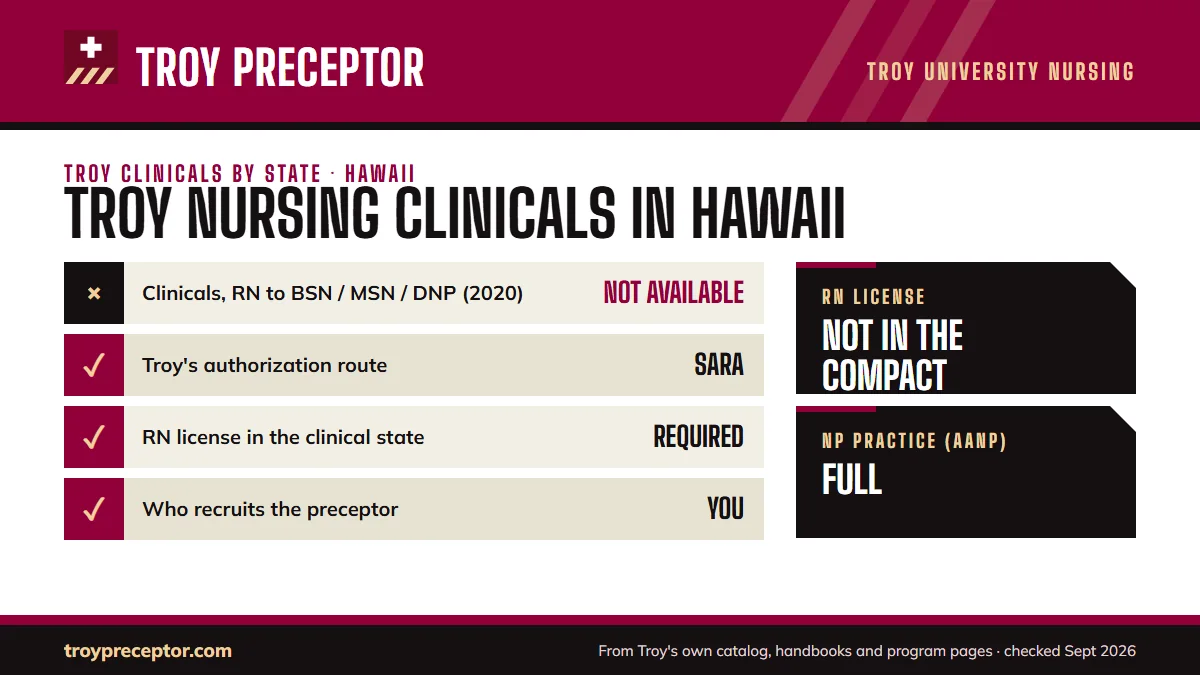
If you live in Hawaii, start here: the 2020 table Troy University publishes for its online nursing programs marks clinical experiences in Hawaii as not available. Troy's note gives the reason: Hawaii's nursing board does not approve post-licensure programs that come from out of state or are taught online or at a distance. Nothing on that row has changed since 12/15/2020, which is why Troy's own confirmation comes before any application or move.
Get your placement plan
Tell us your Troy program and where you live. A placement advisor replies with the preceptor and site options that fit your Troy course.
What Troy published, and where it pulls two ways
The tension is easy to see. Troy's SARA listing covers distance education for Hawaii residents, while the 2020 table says clinicals there were not available, and neither page explains how the two fit. Only Troy's state authorization coordinator, working with its Clinical Placements Specialist, can say which applies to your program now. The other four states marked the same way are on clinicals by state.
| What Troy published | Hawaii |
|---|---|
| Online Nursing Programs disclosure | No: the Hawaii board does not approve out-of-state, online or distance post-licensure programs (12/15/2020) |
| State authorization page | SARA authorized |
| MSN program page | The online MSN may not be available in every state |
| Graduate manuals | Clinicals need an RN license valid in the clinical state all semester |
Checking first: Hawaii residents weighing Troy
Ask before you apply, not after. Troy's 2025-26 graduate catalog says FNP students complete clinical requirements in their locale, so a Hawaii resident on the MSN FNP depends entirely on Troy's answer for Hawaii. One status in that table serves all three online programs, RN to BSN included.
Some residents wonder about training on the mainland instead. That would take licensure in each state where a site sits, for every whole semester, Troy's approval of each state and site, and repeated long-distance travel. Nothing in Troy's documents sets up such an arrangement, so raise it with Troy before counting on it.
Anyone relocating to Hawaii in the middle of a program should alert their faculty advisor at the first sign of the move. Troy publishes no relocation policy, and a Hawaii move changes both the state answer and the license you need (Troy's license rule).
How Hawaii treats programs from elsewhere
Hawaii licenses nurses through a board inside its commerce and consumer affairs department. The Board's written guidance for post-licensure programs taught from elsewhere, with RN to BSN among its examples, is blunt: a program with no Hawaii campus receives no approval from the Board, has no form to file, and need not notify anyone there. A teacher or preceptor from such a program needs a Hawaii license only when physically working with a student in the state.
The student exemption in Hawaii law covers students of Board-accredited programs, and a Board committee decided in 2016 that a mainland BSN program could not send a student who was not yet licensed to Hawaii clinical sites. Graduate and APRN programs are not addressed by name in any of it, and Troy's 2020 note rests on the Board's position on distance programs.
Licensing and practice in the islands
Because Hawaii sits outside the Nurse Licensure Compact, mainland multistate licenses stop at the shoreline; clinical work there needs a license Hawaii itself issues. The APRN Compact is not law in Hawaii either. AANP lists the state as full practice.
Hawaii's preceptor tax credit is written for island-based programs. The APRN student's program must be accredited in or physically located in Hawaii and draw most of its students from Hawaii, which leaves out preceptors working with a mainland school's students.
Most residents live in Urban Honolulu, with Kahului-Wailuku and Hilo-Kailua the next largest areas. HHSC, Kaiser Permanente's Hawaii region, Hawaii Pacific Health and The Queen's Health Systems are the major systems; none of them is a site for Troy students by arrangement.
Help for Hawaii residents checking first
Our work starts with the right questions. We help Hawaii residents set out their program, track and island for Troy's offices so the reply is specific, and if you are relocating to a state where Troy confirms clinicals, we begin the preceptor search there with every Troy form in order. Describe your plans in the form below.
Questions Troy students ask
Can I take Troy's online FNP while living in Hawaii?
Troy's 2020 disclosure lists clinical experiences in Hawaii as not available for its online programs, and the FNP depends on clinicals near home. No newer Troy list exists. Put the question to Troy's placement and state authorization offices before you apply, and do not treat the SARA listing as the answer.
Why is Hawaii on Troy's SARA list if clinicals are listed as not available?
The two lists answer different questions. SARA concerns whether Troy may offer distance education to people in a member state; the 2020 table concerns clinical experiences. Troy has not reconciled them in writing, so ask Troy which one governs your program. The state authorization page explains SARA.
Will my mainland multistate license work for Hawaii clinicals?
No. Hawaii has stayed out of the compact, so a license that is multistate elsewhere carries no practice privilege on the islands. Clinical work in Hawaii would call for a Hawaii-issued RN license, on top of Troy's own approval of the state, the preceptor and the site.
Is Troy's HINL track treated differently in Hawaii?
The 2020 table gives one status for every online program, so HINL is listed the same way. HINL has no on-campus requirements, but its practicums still happen in a real organization under an approved preceptor, so the Hawaii question applies in full.
Related pages
Last checked 2026-09-27
We check these pages against Troy's own 2026-27 MSN, DNP, AMSN and RN to BSN orientation manuals, program pages, degree maps and state authorization pages. Your faculty advisor, your course faculty and the School of Nursing have the final word.
Troy asks you to recruit your preceptor. We make that the easy part.
Tell us your Troy program, where you live and which semester your next clinical course starts. We find preceptors who meet Troy's rules for the course, check the setting against Troy's limits, and prepare everything the Preceptor Information Form and biosketch ask for, well ahead of the form deadline.
- Preceptors matched to the course: a graduate-prepared NP or physician for
NSG 6619, pediatrics and women's health forNSG 6666, adults and older adults forNSG 6668 - Preceptor Information Form details, a biosketch and a copy of the preceptor's license, ready for your faculty advisor
- In your own area, in Alabama or a state where Troy can offer clinicals, never in your own work setting
Start your placement plan
Program, city and semester is all we need to begin.